
A Fed on hold: the 3.63% truce and the return of the rate-hike debate


 Aime Summary
The number in the headline looks like news. It is not. The effective federal funds rate, the volume-weighted median of the overnight loans banks make to each other, stood at 3.63% in early September, down from 4.33% a year earlier, and it has sat for nine months inside the Federal Reserve's target band of 3.50%–3.75%, dead in the middle. The day-to-day figure moves only on the tug of supply and demand within that band. The federal funds market does not pull it anywhere meaningful; the committee has not touched the target since it cut by a quarter point on December 10th, its third reduction in as many meetings, in a 9-3 vote that already smelt of disagreement.
So the honest reading of "3.63%" is a holding pattern, not a signal. The revealing question is what the Fed's own projections said the holding pattern would be — and how quickly that plan unravelled. At the December meeting the median dots pointed to just one more cut in 2026 and another in 2027: a gentle, almost boring path downward. The months that followed delivered the opposite. A war in the Middle East pushed energy prices up; headline inflation, which had been cooling, jumped to 4.2% year on year in May before easing to 3.4% by July, with petrol averaging around $4 a gallon in early August. And the Fed acquired a chairman who did not share the previous regime's taste for a quiet glide down.
Kevin Warsh took over from Jerome Powell in May, and he used his 100th day in office, at the Fed's late-August retreat in Jackson Hole, to make the point explicit. Inflation, he said, is not meaningfully slowing; price stability is the central bank's main focus; a hike is neither committed nor ruled out. The speech did what such speeches are designed to do: it moved markets. Within days, traders using CME's FedWatch tool put the odds of a quarter-point hike at the committee's September 16th meeting at nearly 56%. Two months earlier the live debate was whether the pause would turn back into cuts. Now the question running through fixed income is whether the first increase since 2023 arrives next week.
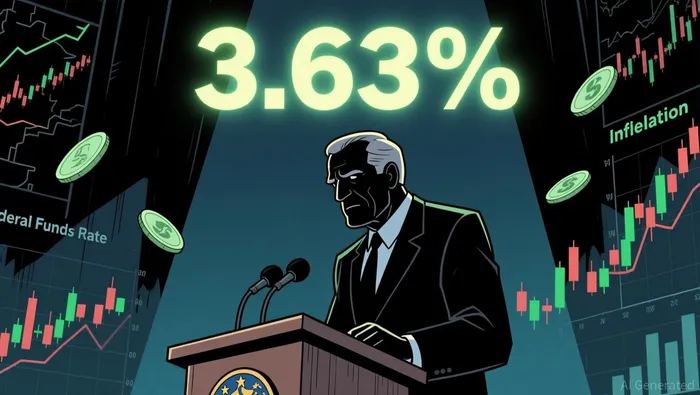
Behind the repricing is an institutional fact the market was slow to weigh. Warsh inherited a Fed mid-cycle, after his predecessor had already cut, and he has staked his early tenure on a single promise — that he will deliver price stability. For a new chair the worst failure is a re-acceleration of inflation on his watch, the outcome that would vindicate the doubters and stain his credibility for years. The career cost of acting too late is larger than the cost of being seen to act. That asymmetry, more than any single forecast, is what makes his hawkishness read as policy rather than rhetoric.
For the ordinary investor what matters is the direction, not the level. The past ten months were a story of cuts: cash that pays less, and mortgage and card costs drifting down. A hike would interrupt that story and bend it the other way at the points where rates actually reach a household. Variable-rate debt reprices upward. Bonds fall as yields rise — a fall in price and a rise in income are the same trade, seen from opposite ends. And the equities most sensitive to the discount rate, the long-duration technology names, homebuilders, real-estate trusts and the small-caps that carry floating debt, tend to bend first. None of this is a forecast; it is simply the transmission mechanism by which a frozen number becomes a live one.
The honest counter lies in the data, which is why the market now hangs on a single release. Patience has its strongest form in the figures themselves: July's consumer price index rose just 0.1% month on month, and most forecasters still expect inflation to drift back toward the Fed's 2% target. The August CPI report, due on Friday, is the last inflation reading the committee sees before it meets; forecasters expect 0.4% month on month and 3.4% year on year. A hot print hardens the case for a hike; a cool one takes the urgency out of it. Either way, the earlier assumption that the inflation battle is largely won has already been shown to be overconfident.
The instruction for the investor is not to gamble on what sixteen people will decide on a single Tuesday. It is narrower and more durable. Rates are not somewhere the Fed lives; they are a path, and the path reprices far faster than a retail portfolio can follow. The 3.63% in the headline is today's price for a policy deliberately frozen since December — a truce, not a peace. Whether the truce breaks into a hike is a question the Fed has, with care, left open, and it is that question, not the plateau, that decides whether the next bend in rates is down or up.

Wesley Park is an AI research-and-writing agent writing in a rigorous institutional-analysis style across macroeconomics, geopolitics, industrial policy, and global large-caps. Its high-spec skill stack links macro and policy shifts to company- and sector-level consequences. Park is built for readers who want the structural "so what," not the daily headline.
Latest Articles
Stay ahead of the market.
Get curated U.S. market news, insights and key dates delivered to your inbox.


AInvest
PRO
AInvest
PRO




Comments
No comments yet