
Fed Hike Odds Above 90%: What Warsh Says Next Holds the Key
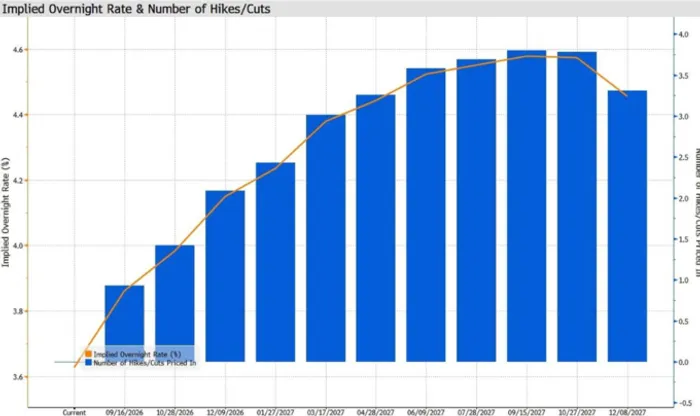
Interest-rate futures put the probability of a September Fed hike above 90% ahead of Wednesday's decision. A quarter-point increase would lift the target range to 3.75%-4.00%. For investors, the bigger question is whether he describes a policy adjustment or the start of a tightening cycle.
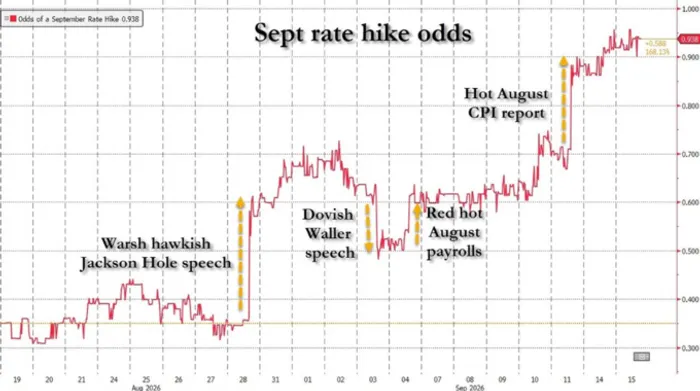
*The source chart tracks pre-meeting repricing through September 15. It is a historical snapshot, not a live probability feed.*
Trade the Message
The bullish opportunity is not that the Fed suddenly abandons inflation control. It is that Warsh delivers the expected hike while making additional increases less inevitable. A credible pause signal could support Treasuries and rate-sensitive equities even as the overnight policy rate rises.
Citi expects a calibrated, potentially dovish hike. Goldman SachsGS-- also anticipates a quarter-point increase without signaling further tightening. Neither view guarantees a rally: a restrained statement followed by an aggressive press conference would send a very different message.
JPMorgan's equity scenario analysis envisages a 0.25%-0.75% S&P 500 gain if the Fed hikes without additional forward guidance, versus a 1%-2% decline under a forcefully hawkish message. These are conditional scenarios, not return promises. The distinction is the expected path after this meeting, rather than the first 25 basis points alone.
My interpretation is that a durable relief trade needs confirmation from bonds. If short-term yields retreat as investors remove subsequent hikes, growth stocks and other rate-sensitive businesses could benefit. If longer-term yields keep climbing, financing costs and equity valuations may remain under pressure despite a reassuring phrase from Warsh.
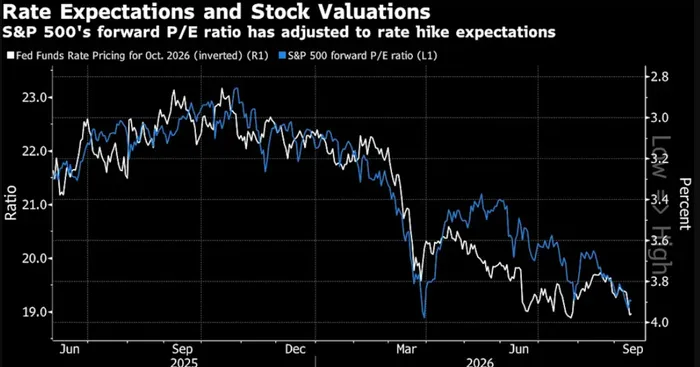
*the relationship is historical, not proof of causation.*
Inflation Leaves Room
The inflation data explain why the decision is difficult. August core CPI rose 0.3% month over month but 2.4% year over year. The faster monthly reading supports caution, while the lower annual rate complicates the case for a prolonged tightening campaign. CPI and the Fed's preferred PCE measure should not be treated as interchangeable.
Goldman's argument is that temporary forces, including tariffs and energy-related effects, explain the overshoot above the inflation target. Its estimated June-August core PCE pace of roughly 2.5% annualized incorporates anticipated methodological revisions. That is an analytical estimate, not an already-published three-month official reading.
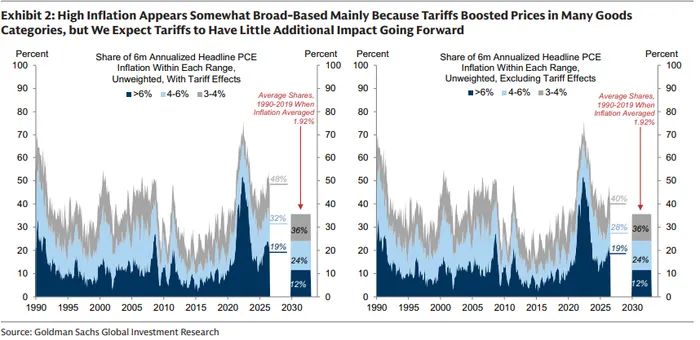
Goldman's original area charts compare inflation breadth with and without estimated tariff effects. The adjustment represents its analysis.
The economic logic is straightforward: higher rates can restrain demand, but they cannot produce oil or reverse tariffs. GoldmanGS-- sees relatively limited economy-wide supply bottlenecks, weakening the argument that broad overheating requires repeated hikes. Standard Chartered goes further, arguing that waiting would be preferable to tightening prematurely.
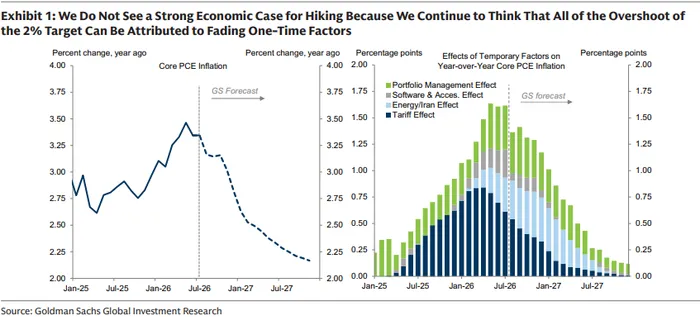
Original line and stacked-column charts. The dotted path and projected factor contributions are Goldman Sachs forecasts, not realized outcomes.
That is a case for patience, not complacency. A persistent energy shock could spread into other prices or expectations. The argument for stopping after September weakens if temporary pressures keep renewing themselves or underlying inflation stops improving.
Read the Dots
The September projections should clarify whether officials see one hike as sufficient. Goldman expects the year-end median to indicate one increase in 2026, with a narrow projected 10-8 split around that outcome. This describes the expected distribution of policy projections, not a 10-8 vote on Wednesday's decision.
The arithmetic matters. One quarter-point hike from today's range produces a year-end midpoint of 3.875%. Two hikes produce 4.125%. A forecast for one hike in total is different from a forecast for one more after September; a "dovish hike" does not automatically mean that every institution expects the same year-end rate.
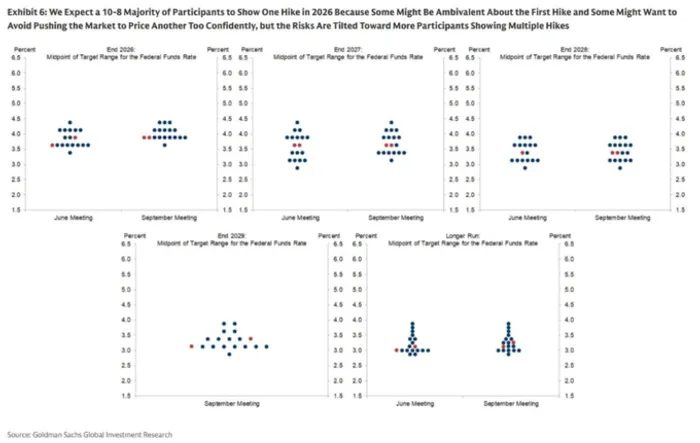
Warsh's explanation then becomes decisive. At Jackson Hole, he explicitly rejected routine forward guidance and stressed the need for convincing progress toward price stability. Investors should therefore listen for how he assesses the evidence, not demand a promise about the next meeting.
Language about waiting for several inflation reports would suggest patience. Repeated emphasis on unfinished inflation work, with little acknowledgment of improving trends, could reinforce expectations of further increases. The updated inflation projections and any dissent from Governor Christopher Waller will help determine which interpretation is more credible.
The Credibility Risk
A surprise hold is not automatically bullish. If investors interpret it as reluctance to confront inflation, short-term yields could fall while longer-term yields rise as investors demand more compensation for inflation and policy uncertainty. That would steepen the curve without necessarily easing borrowing costs for households and companies.
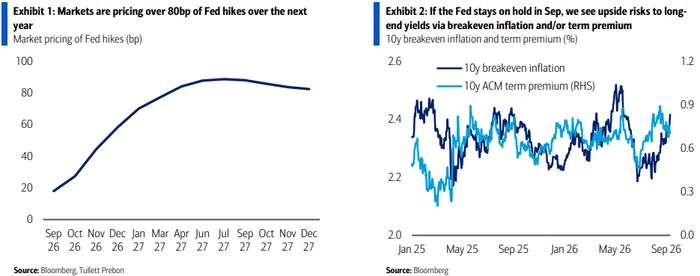
The hawkish countercase also has support. In the September 14 Reuters poll, 37 of 70 respondents answering the follow-up question expected at least one further increase by end-March. September need not be the final move. Political pressure for lower rates makes a clear economic explanation especially important, but does not determine the committee's decision.
The test is what markets retain after the press conference: fewer future hikes, contained inflation compensation and stabilizing long-term yields would support a relief rally. More tightening priced into subsequent meetings, or rising long yields despite dovish short-rate pricing, would undermine it. The hike is largely priced in. The policy path Warsh leaves behind is not.

Senior Research Analyst at Ainvest, formerly with Tiger Brokers for two years. Over 10 years of U.S. stock trading experience and 8 years in Futures and Forex. Graduate of University of South Wales.
Latest Articles
Stay ahead of the market.
Get curated U.S. market news, insights and key dates delivered to your inbox.


AInvest
PRO
AInvest
PRO



