
Fed's Hesitation on Rate Cuts Fuels Market Volatility Amid Trade Tensions
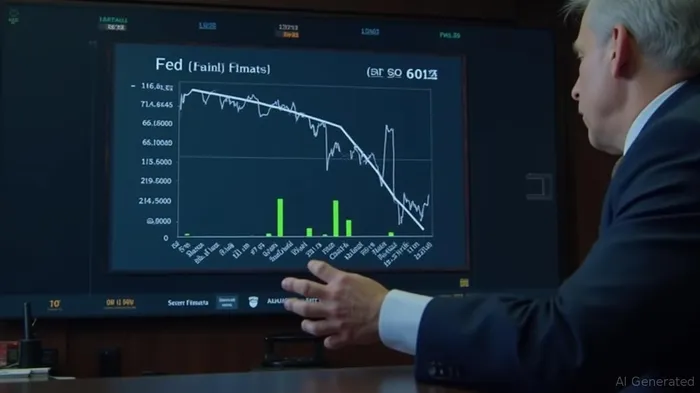
The Federal Reserve's decision to hold interest rates steady at its June 2025 meeting underscores a growing dilemma: how to balance lingering inflation pressures with geopolitical and trade-related risks. With the central bank's “wait-and-see” approach now extending into its fourth consecutive meeting since December 2024, investors are left grappling with heightened uncertainty. This caution, detailed in the June FOMC minutes, has sparked volatility in equity markets, as traders weigh the timing of potential rate cuts against the backdrop of escalating trade tensions and Middle East instability.
The Fed's Tightrope Walk
The Fed's June decision to maintain its benchmark rate at 4.25%-4.5% reflects its dual mandate challenges. While the “dot plot” still hints at two rate cuts by year-end, longer-term projections were downgraded, signaling a prolonged period of elevated rates. Key concerns include:
- Inflation Persistence: Core PCE inflation rose to 3.1%, above the Fed's 2% target, with tariffs and supply chain pressures complicating price stability.
- Trade Policy Risks: President Trump's tariffs, though not yet inflationary, are seen as a “wild card” that could delay rate reductions if they disrupt global supply chains.
- Geopolitical Volatility: The Israel-Iran conflict has introduced energy price risks, adding another layer of uncertainty to the Fed's calculus.
The minutes emphasize that the Fed will await clearer signals on labor market softening and inflation trends before easing. This hesitation has already triggered market whiplash: equities oscillated sharply, and Treasury yields steepened as investors priced in a slower path to cuts.
Trade Tensions: The Unseen Inflation Catalyst
While tariffs have yet to ignite broad-based price spikes, the Fed's concern lies in their latent potential. show modest increases, but the risk of supply chain bottlenecks remains. For sectors like industrials and consumer discretionary—both sensitive to cost pressures—this creates a double-edged sword.
Equity markets have already begun pricing in this risk. Tech stocks, which typically thrive in low-rate environments, have underperformed in recent months, while utilities and consumer staples—defensive sectors—have held up better. This rotation hints at investor skepticism toward the Fed's ability to engineer a “soft landing.”
Geopolitical Risks: The Energy Wild Card
The Israel-Iran conflict adds another variable. A disruption in Middle East oil supplies could send energy prices surging, further complicating inflation and forcing the Fed's hand. reveal a clear correlation between geopolitical events and market uncertainty.
For equity investors, energy stocks now present a dual opportunity/risk. While companies like ExxonMobil and ChevronCVX-- might benefit from higher prices, broader market sentiment could sour if inflation spirals.
Navigating the Volatility: Investment Strategies
- Sector Rotation: Favor defensive sectors (utilities, healthcare) until inflation trends stabilize.
- Quality Over Momentum: Focus on companies with strong balance sheets and pricing power, such as consumer staples giants Procter & Gamble or Coca-ColaKO--.
- Short-Term Treasuries: Consider short-duration bonds to hedge against rate volatility.
- Geopolitical Plays: Use ETFs like XLE (energy) or IEF (intermediate Treasuries) to capitalize on specific risks.
Conclusion: Patience is a Virtue
The Fed's reluctance to cut rates is not a sign of weakness but a reflection of its constrained options. Investors should prepare for prolonged volatility, with the next data releases—particularly on inflation and employment—likely to drive market direction. Until the Fed's “wait-and-see” stance evolves, a diversified, defensive portfolio will be critical to weathering the storm.
In this environment, the path forward hinges on the Fed's ability to navigate between inflation control and geopolitical headwinds. For now, patience—and a healthy dose of caution—should guide equity allocations.

Delivering real-time insights and analysis on emerging financial trends and market movements.
Latest Articles
Stay ahead of the market.
Get curated U.S. market news, insights and key dates delivered to your inbox.
AInvest
PRO
AInvest
PRO



Comments
No comments yet