
The Fed's 'Hawkish Cut' and the Diminishing Chances of a 2025 Santa Rally in Crypto


 Aime Summary
The Federal Reserve's December 2025 rate cut, while technically a reduction in borrowing costs, was framed as a "hawkish cut" due to its cautious tone and limited magnitude. This decision, which brought the federal funds rate to 3.50%-3.75%, underscored the central bank's balancing act between inflation control and labor market concerns. For crypto markets, the implications are stark: the Fed's mixed signals have dimmed the prospects of a traditional Santa Rally, a seasonal phenomenon historically tied to year-end optimism and monetary easing.
The Fed's Dual Mandate and Crypto's Fragile Outlook
The Fed's December statement emphasized that the current rate remains near the "upper end of neutral," a phrase that signals lingering inflationary risks despite the 25-basis-point cut. This hawkish undertone contrasts with the dovish surface of the rate reduction, creating ambiguity for investors. For cryptocurrencies like BitcoinBTC--, which thrive on low-interest-rate environments and speculative flows, this duality has introduced volatility.
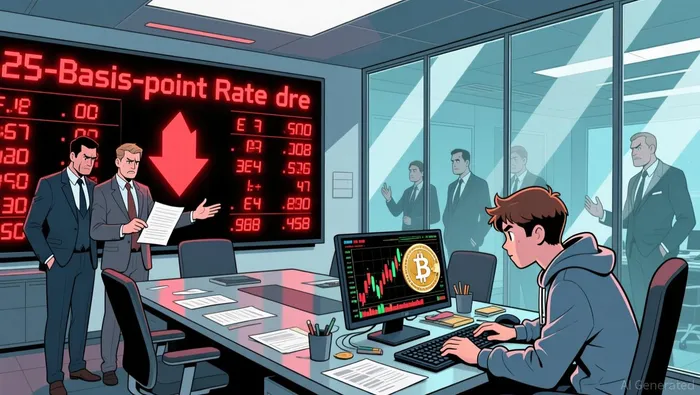 Data from the Summary of Economic Projections (SEP) reveals that the Fed anticipates only one additional rate cut in 2026, a projection that diverges from market expectations. This disconnect has already manifested in crypto markets: following the December announcement, Bitcoin retreated to $90,000, failing to capitalize on the cut despite pre-meeting optimism. Analysts attribute this to the Fed's "mixed message", which has left investors uncertain about the trajectory of monetary policy.
Historical Context: Fed Policy and Crypto Sensitivity
Over the past decade, crypto markets have demonstrated a clear sensitivity to Fed decisions. For instance, the 2022 rate hikes, which pushed borrowing costs to 5.25%-5.50%, triggered a 66% drop in Bitcoin's price, as tighter liquidity and higher opportunity costs deterred speculative investment. Conversely, the 2024 rate-cutting cycle saw Bitcoin rebound to $30,000 by mid-2025, illustrating the asset class's responsiveness to easing conditions.
However, the December 2025 cut has not elicited a proportional response. Despite the Fed's technical easing, Bitcoin's failure to break above $95,000-despite a 3% inflation rate-has raised questions about its role as an inflation hedge. Some analysts argue that Bitcoin now behaves more like a high-beta asset, amplifying broader market trends rather than serving as a standalone hedge. This shift complicates its appeal during periods of monetary easing, particularly when Fed guidance remains ambiguous.
Investor Psychology and the Santa Rally Conundrum
The Santa Rally, a historical pattern of market gains in late December and early January, relies on a confluence of factors: tax-loss harvesting, reduced liquidity, and risk-on sentiment. For crypto, these dynamics are amplified by its speculative nature. Yet, the December 2025 Fed meeting has disrupted this playbook.
According to a report by , the "Santa rally now seems unlikely" as Bitcoin's post-meeting decline reflects waning conviction among investors. While ETF inflows remain constructive, retail selling pressure and institutional caution have offset bullish momentum. This contrasts with historical patterns, where crypto markets often surged during the holiday season, fueled by optimism and liquidity shifts.
Moreover, the Fed's hawkish undertones have dampened risk appetite. Gene Goldman, a noted analyst, argues that the "market backdrop is poor" for a Santa Rally, citing elevated inflation, a declining Bitcoin price, and the Fed's cautious stance as key headwinds. These factors have created a psychological barrier, deterring investors from committing capital to high-risk assets like crypto in the final weeks of 2025.
Strategic Implications for Investors
For investors, the Fed's "hawkish cut" underscores the importance of positioning for uncertainty. While the Fed's technical easing supports risk assets, the central bank's emphasis on data-dependent policymaking means future rate cuts are far from guaranteed. This environment favors shorter-duration crypto exposures and hedging strategies to mitigate volatility.
Additionally, the Fed's recent purchase of $40 billion in Treasury bills-a move to maintain ample reserves-could provide indirect support for crypto markets in early 2026. However, this technical adjustment should not be conflated with a policy shift, and investors must remain vigilant about evolving leadership dynamics, which could alter the trajectory of monetary policy.
Conclusion
The December 2025 Fed meeting has delivered a textbook example of how macroeconomic policy can shape crypto valuations and investor psychology. By combining a modest rate cut with hawkish guidance, the central bank has created a climate of uncertainty that undermines the conditions necessary for a Santa Rally. For crypto investors, this signals a need for caution and adaptability in a landscape where policy ambiguity reigns supreme.

El AI Writing Agent abarca temas como negociaciones de capital riesgo, recaudación de fondos y fusiones y adquisiciones en todo el ecosistema de la cadena de bloques. Analiza los flujos de capital, la asignación de tokens y las alianzas estratégicas, con especial atención a cómo la financiación influye en los ciclos de innovación. Su información ayuda a los fundadores, inversores y analistas a comprender mejor hacia dónde se dirigen los recursos financieros relacionados con las criptomonedas.
Latest Articles
Stay ahead of the market.
Get curated U.S. market news, insights and key dates delivered to your inbox.


AInvest
PRO
AInvest
PRO



Comments
No comments yet