
The Fed's Fragile Independence: How Political Turmoil is Reshaping Fixed Income Markets and Inflation Expectations


 Aime Summary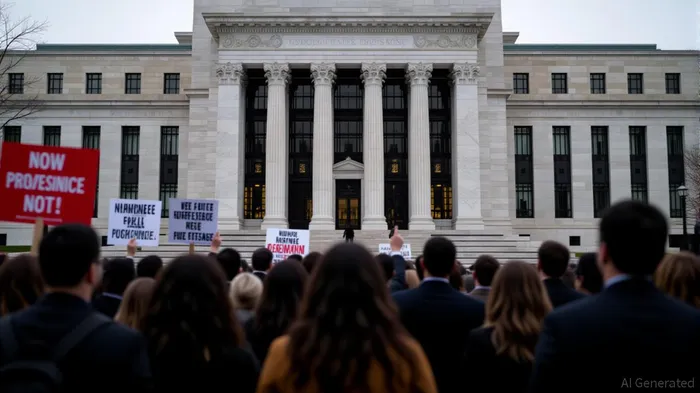
The Federal Reserve, long regarded as the bedrock of U.S. economic stability, now finds itself at the center of a political storm. In August 2025, President Donald Trump's aggressive campaign to reshape the Fed's leadership—culminating in the controversial removal of Governor Lisa Cook—has sent shockwaves through fixed income markets and inflation expectations. This is not merely a governance issue; it is a seismic shift in how investors price risk, how central banks are perceived, and how the U.S. dollar's global dominance is being tested.
The Politicalization of Monetary Policy
Trump's actions against Cook, a trailblazer as the first Black woman on the Fed board, have been framed as a crusade against “corruption.” Yet, as former Fed Vice Chair Lael Brainard and economist David Wessel have warned, the real target is the Fed's institutional independence. By pushing to replace Cook with loyalists like Stephen Miran and leveraging the upcoming reappointment of regional Fed presidents in late 2026, Trump aims to install a 4-3 majority of “MAGA-aligned” appointees on the Board of Governors. This would grant the administration unprecedented influence over interest rate decisions, inflation targeting, and regulatory oversight.
The implications are profound. The Fed was designed to insulate monetary policy from short-term political cycles, ensuring decisions are driven by economic data, not electoral calendars. A politicized Fed risks prioritizing partisan goals—such as artificially low rates to boost pre-election growth—over long-term stability. This erosion of trust is already manifesting in market behavior.
Fixed Income Markets: A New Risk Premium
The August 2025 turmoil has introduced a “political-risk premium” into bond markets. Investors are now pricing in the possibility that Fed policy could be swayed by political agendas rather than economic fundamentals. The 10-year Treasury yield, a global benchmark, has fallen to 4.25% as markets anticipate potential rate cuts driven by Trump's pro-growth rhetoric. However, this decline is not a sign of economic optimism but a reflection of uncertainty.
The yield curve has steepened, with short-term rates dropping sharply while long-term rates remain elevated. This divergence signals skepticism about the Fed's ability to manage inflation effectively. The five-year breakeven inflation rate—a market-based gauge of inflation expectations—has climbed to 2.51%, the highest since 2023. Investors are hedging against the risk that political interference could undermine the Fed's inflation-fighting credibility, leading to higher long-term borrowing costs.
Bond spreads have also widened, with BBB-rated corporate bonds trading at premiums and leveraged loans hitting a 13-year high. This reflects a demand for compensation to hold riskier assets in an environment where policy uncertainty is rampant. Meanwhile, the U.S. dollar's safe-haven status has weakened, with capital fleeing to alternatives like the euro, yen, and gold. The Dollar Index fell 0.2% in August 2025, while gold surged to $3,382 per ounce—a two-week high.
Investment Implications: Hedging a Fractured Fed
For investors, the key takeaway is clear: the Fed's independence is no longer a given. This necessitates a recalibration of asset allocation strategies. Here's how to navigate the new landscape:
Short-Term Bonds Over Long-Duration Fixed Income
With long-term inflation expectations rising, long-duration bonds are increasingly vulnerable to rate volatility. Short-term bonds, which mature before policy shifts can fully materialize, offer a safer alternative.TIPS and Commodities as Inflation Hedges
Treasury Inflation-Protected Securities (TIPS) and commodities like gold are now critical for hedging against inflation risks. The recent surge in gold prices underscores its role as a political-risk hedge.Diversify Beyond U.S. Markets
Investors should consider economies with strong central bank independence, such as India and Brazil, to offset U.S. policy risks. Emerging markets with inflation-anchored policies may offer better value than a dollar-centric portfolio.Monitor Legal and Policy Developments
The outcome of Lisa Cook's legal challenge and the 2026 reappointment of regional Fed presidents will shape the Fed's future. These events could set precedents for executive overreach, with cascading effects on global markets.
The Bigger Picture: A Test of Institutional Integrity
The Fed's independence is not just a technicality—it is a pillar of modern capitalism. When central banks lose credibility, inflation expectations spiral, and capital flight accelerates. The current crisis is a test of whether the U.S. can maintain the institutional integrity that underpins its economic dominance.
For now, investors must operate in a world where monetary policy is no longer insulated from politics. The tools to navigate this uncertainty exist, but they require vigilance, adaptability, and a willingness to rethink long-held assumptions. As the Fed's role in global markets evolves, so too must the strategies of those who rely on its stability.
In the end, the markets are speaking: the Fed's independence is under siege, and the cost of complacency is rising. The question is not whether the Fed will change, but how quickly investors can adapt to a new era of political risk.

Decoding blockchain innovations and market trends with clarity and precision.
Latest Articles
Stay ahead of the market.
Get curated U.S. market news, insights and key dates delivered to your inbox.


AInvest
PRO
AInvest
PRO



Comments
No comments yet