
Fed Flies Blind: Rate Cut Battle Heats Up Amid Data Gaps


 Aime Summary
Federal Reserve officials remain deeply divided over whether to cut interest rates in December, with Governor Christopher Waller advocating for further easing to support a weakening labor market, while others caution against premature action amid inflation concerns and data gaps caused by a recent government shutdown according to reports. Waller, a prominent candidate for the next Fed chair, emphasized in a London speech that the labor market is "near stall speed" and that restrictive monetary policy disproportionately harms lower- and middle-income households as stated. His stance aligns with a minority of policymakers who argue that a December rate cut would provide "additional insurance against an acceleration in the weakening of the labor market," as he stated.
However, Fed Vice Chair Philip Jefferson and several regional bank presidents, including Boston's Susan Collins, have urged caution. Jefferson, speaking at a Kansas City Fed event, called for proceeding "slowly" as the central bank approaches a neutral policy stance, noting that inflation risks "have declined somewhat recently" but remain above target according to Reuters. Collins, meanwhile, set a "high bar" for additional easing, warning that absent clear signs of labor market deterioration, further cuts could reignite inflation according to Reuters. The divide reflects broader tensions within the Federal Open Market Committee (FOMC), where minutes from the October meeting revealed "strongly differing views" on December's policy path according to Morningstar.
Complicating the decision is the lack of timely economic data. The 43-day government shutdown delayed critical reports, including the September jobs data, which is now scheduled for release on Thursday according to Morningstar. Waller acknowledged that while private and public data still point to a weak labor market, the absence of official metrics has left policymakers "flying blind" in some respects according to CNBC. 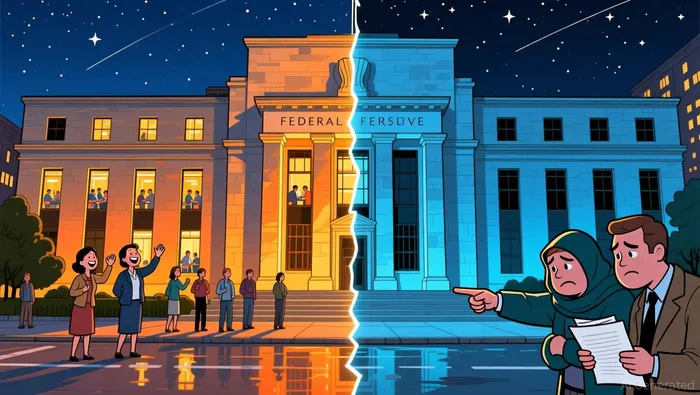 The Fed's December meeting, set for Dec. 9-10, will occur with only partial visibility into recent economic trends, raising concerns about the reliability of its decision-making.
Market expectations have also fluctuated. Traders initially priced in a 93.7% chance of a December cut in October, but that probability has dropped to 47.4% as of Nov. 18 according to Yahoo Finance. The CME FedWatch tool now shows a roughly 50% chance of a cut, with investors reacting to mixed signals from Fed officials and soft employment data, such as a two-month high in jobless claims according to Fidelity. Gold prices, which typically rise in a lower-rate environment, have mirrored this uncertainty, fluctuating as traders weigh the likelihood of easing according to CNBC.
The debate underscores the Fed's dual mandate dilemma: balancing inflation control with labor market stability. While Waller and others argue that inflation is "unlikely to accelerate" and that rate cuts are necessary to prevent further job market erosion as reported, hawks like Collins and Kansas City Fed President Jeffrey Schmid contend that structural factors, such as technological shifts and immigration policy, are more significant drivers of labor market weakness than monetary policy according to Investopedia. With the September jobs report and FOMC meeting minutes due in the coming days, the Fed's next move remains a pivotal test of its ability to navigate these competing priorities.

Stay ahead of the market.
Get curated U.S. market news, insights and key dates delivered to your inbox.






Comments
No comments yet