
Fed Ends QT, Crypto Weighs Rate Relief Against Regulatory Storms


 Aime Summary
The Federal Reserve has concluded its quantitative tightening (QT) program, marking a pivotal shift in monetary policy that could reshape financial markets, including the cryptocurrency sector. The central bank's policy committee announced on October 29 that it would halt the reduction of its balance sheet, which had been shrinking since June 2022 to counter the liquidity surge from pandemic-era stimulus. "The Committee decided to conclude the reduction of its aggregate securities holdings on December 1," the Fed stated, signaling a commitment to achieving its 2% inflation target while supporting maximum employment according to the Fed's October 29 announcement.
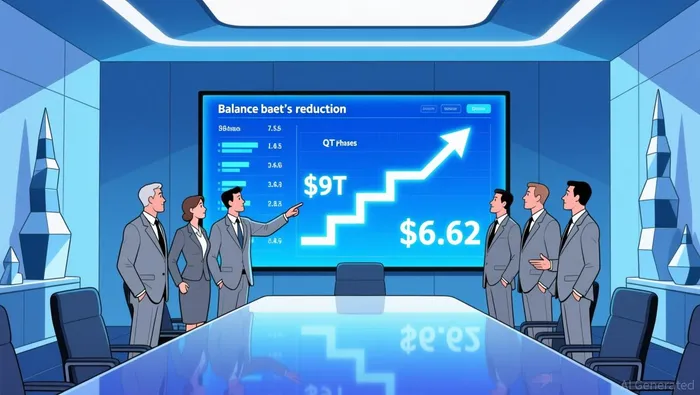
The decision to end QT follows mounting pressure in money markets, where short-term borrowing rates had begun rising amid tighter financial conditions. Fed Governor Chris Miran emphasized the need for regulatory adjustments to ensure bank balance sheets remain flexible as the central bank reduces its footprint. "We first have to get the regulations right," Miran said, adding that the October 29 decision to stop the balance sheet runoff was prudent given evolving market signals. The Fed's balance sheet, which peaked at $9 trillion in 2022, now stands at around $6.6 trillion after allowing over $2 trillion in bonds to mature without reinvestment.
For the cryptocurrency sector, the Fed's pivot could have mixed implications. While reduced QT may ease upward pressure on interest rates, which have historically weighed on risk assets like crypto, the broader economic context remains uncertain. BitcoinBTC-- ETFs, for instance, saw a record $523 million in outflows in November as markets priced in diminishing odds of rate cuts in 2025. BlackRock led this exodus, reflecting investor caution ahead of a potential Fed tightening cycle.
However, the crypto industry is also adapting to a shifting regulatory and financial landscape. Clapp Finance, a European fintech, recently launched multi-collateral crypto credit lines, allowing users to access liquidity without selling their holdings. The product, which supports up to 19 cryptocurrencies as collateral, addresses growing demand for flexible financing tools in a market where volatility and liquidity constraints persist according to Clapp Finance's announcement. CEO Ilya Stadnik highlighted the innovation as a response to the rigid structures of traditional CeFi lending, which has seen a 150% growth since 2023.
Meanwhile, institutional players are navigating regulatory clarity and market consolidation. Bullish, an institutional crypto exchange, reported a record $18.5 million net income in Q3 2025, driven by its U.S. spot market and options trading. Despite the strong earnings, its stock continued a downward trend, down nearly 40% since August, reflecting broader crypto market jitters according to Cointelegraph. Similarly, Kraken's confidential IPO filing underscores the sector's push for traditional capital markets access, even as political uncertainties loom ahead of the 2026 midterms according to Reuters.
The Fed's policy shift also intersects with broader macroeconomic trends. Amundi's chief investment officer predicted the European Central Bank could adopt a more dovish stance than currently priced in by markets, a view that contrasts with ECB President Christine Lagarde's recent statements. In the U.S., the Fed's potential rate cuts-now seen at a 46% probability for December-remain a key variable for risk assets. A smaller Fed balance sheet, as advocated by Miran, could further test market resilience, particularly in crypto, where liquidity and regulatory risks remain elevated.
As the Fed pivots, the crypto sector's response will hinge on balancing regulatory tailwinds with macroeconomic headwinds. Innovations like Clapp's credit lines and ETF dynamics highlight the sector's adaptability, but sustained growth will require navigating a complex interplay of monetary policy, market sentiment, and institutional adoption.

Stay ahead of the market.
Get curated U.S. market news, insights and key dates delivered to your inbox.






Comments
No comments yet