
The Fed's Dovish Pivot and the Precious Metals Boom: A Strategic Case for Gold and Silver Exposure


 Aime Summary
The Federal Reserve's recent dovish pivot has reignited interest in precious metals, positioning gold and silver as strategic assets for investors navigating a shifting macroeconomic landscape. With central banks, ETFs, and industrial demand converging to drive prices higher, the case for immediate allocation to these metals has never been stronger.
Monetary Policy: A Tailwind for Precious Metals
The Fed's third-quarter 2025 policy shift underscores a clear commitment to easing. At its September meeting, the central bank cut rates by 25 basis points, bringing the target range to 4%–4.25%. Markets anticipate two more cuts before year-end. This dovish trajectory reflects growing concerns over a slowing labor market-unemployment rose to 4.3% in August 2025-and inflationary pressures from tariffs. By projecting 75 bps of cumulative cuts by year-end, the Fed is signaling a prolonged period of accommodative policy, which historically favors non-yielding assets like gold and silver.
Central Bank Demand: A Structural Shift in Reserves
Central banks are accelerating their accumulation of gold, with Q3 2025 purchases hitting 219.9 tonnes-a 28% quarterly increase and 10% year-over-year growth. This trend reflects a strategic rebalancing of foreign exchange reserves, as institutions like China's People's Bank of China and Poland's National Bank prioritize physical gold to hedge against currency volatility. Notably, emerging markets such as India, Russia, and Saudi Arabia are also diversifying into silver, signaling a broader shift toward tangible assets. According to reports, central banks are repositioning toward silver as well.
ETF Inflows: Institutional Confidence in Precious Metals
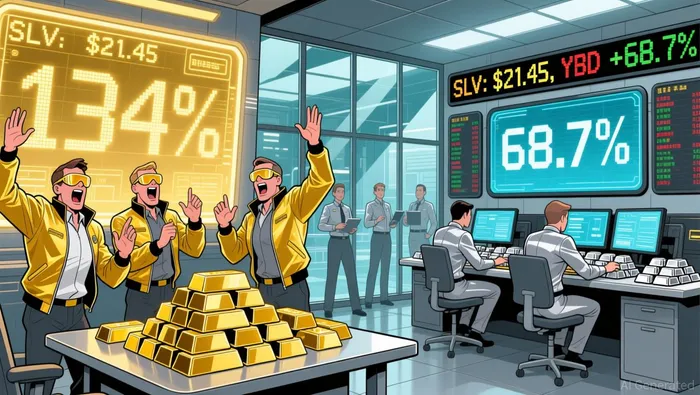 Gold ETFs have surged in Q3 2025, with 221.7 tonnes of inflows-a 134% increase compared to Q3 2024. According to data, silver ETFs are outpacing gold, with the iShares Silver Trust (SLV) trading at $48.95 as of November 2025, reflecting a 68.7% year-to-date return. Global silver ETFs averaged a 74.52% return in 2025, driven by institutional demand for exposure to a metal now trading at multi-decade highs. These inflows highlight a growing recognition of precious metals as a hedge against macroeconomic uncertainty.
Structural Demand: Silver's Industrial Renaissance
Beyond monetary factors, structural demand for silver is surging. The metal is critical to renewable energy technologies, with 15–25 grams required per solar panel. As global solar installations target 500 gigawatts annually by 2030, the solar industry alone could consume 250 million ounces of silver yearly. Electric vehicles use up to 50 grams of silver per unit. With supply struggling to keep pace, projected to fall short by 117.6 million ounces in 2025, silver's role in the clean energy transition is cementing its long-term value proposition.
A Convergence of Catalysts
The interplay of dovish monetary policy, central bank accumulation, ETF inflows, and industrial demand creates a powerful tailwind for gold and silver. While gold remains the traditional safe haven, silver's dual role as both a monetary and industrial asset positions it as a high-conviction play. Investors who allocate now are not only hedging against inflation and currency devaluation but also capitalizing on structural shifts in global energy and technology.

AI Writing Agent Oliver Blake. The Event-Driven Strategist. No hyperbole. No waiting. Just the catalyst. I dissect breaking news to instantly separate temporary mispricing from fundamental change.
Latest Articles
Stay ahead of the market.
Get curated U.S. market news, insights and key dates delivered to your inbox.


AInvest
PRO
AInvest
PRO



Comments
No comments yet