
The Fed's Dovish Pivot and Its Implications for Risk Assets: Strategic Opportunities in Equities and Commodities


 Aime Summary
The Federal Reserve's recent dovish pivot has sent shockwaves through financial markets, creating a fertile ground for risk assets. With the central bank cutting rates by 25 basis points in November 2025 and signaling one more cut in 2026, investors are recalibrating their portfolios to capitalize on the shifting monetary landscape. The Fed's revised growth projections-1.9% for 2025 and 1.8% for 2026-reflect a cautiously optimistic outlook, while its resumption of Reserve Management Purchases (RMPs) underscores a commitment to maintaining liquidity. This combination of policy moves has sparked a surge in demand for U.S. small-cap equities, commodities, and liquidity-sensitive sectors. Let's break down why this is a pivotal moment for investors.
The Fed's Dovish Pivot: A New Era of Liquidity
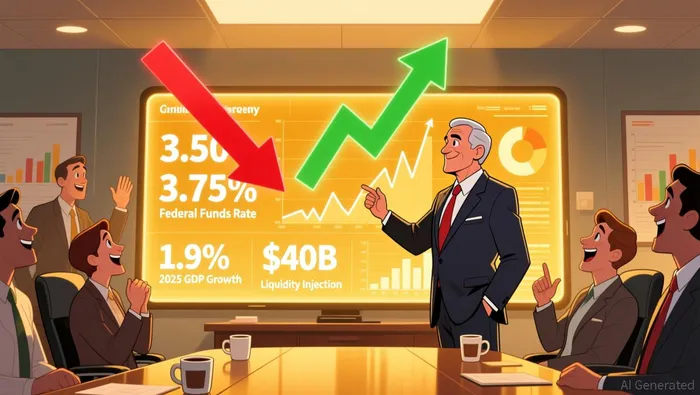
The Fed's November 2025 rate cut marked the third reduction of the year, bringing the federal funds rate to 3.50%-3.75%. This decision, though contentious within the FOMC, signals a pivot toward easing amid softening inflation and a resilient labor market. The updated Summary of Economic Projections (SEP) now forecasts 2.3% GDP growth for 2026, with inflation expected to remain above 2% until 2028. Crucially, the Fed has shifted from quantitative tightening (QT) to RMPs, injecting $40 billion in liquidity via Treasury bill purchases in December 2025. While the Fed insists these are technical operations, markets are interpreting them as "stealth easing," a move that could turbocharge risk assets.
U.S. Small-Cap Equities: The Hidden Gems of a Dovish Regime
Small-cap stocks have historically thrived during liquidity expansions, and the current environment is no exception. The Russell 2000 hit all-time highs in late 2025, driven by the Fed's dovish pivot and RMPs. Lower interest rates reduce borrowing costs for small-cap firms, which often rely on variable-rate debt, while improved liquidity conditions make these stocks more attractive to investors seeking growth. During the 2020 pandemic stimulus, small-caps outperformed large-caps by a wide margin, with the S&P 600 surging 31.37% in Q4 2020. Today, the valuation gap between small and large caps is historically wide, suggesting the market is underestimating their potential. With the Fed's forward guidance indicating a "wait and see" approach, small-cap equities are poised to benefit from continued accommodative policy.
Commodities: The Dovish Tailwind for Hard Assets
The Fed's dovish pivot has also supercharged commodity markets. A weaker dollar, driven by rate cuts and RMPs, has made dollar-denominated commodities more affordable for international buyers. Precious metals like gold and silver have surged, with gold rising 18% in Q1 2025 amid global uncertainty and a flight to safety. Industrial metals, including copper, have rallied 7.5% in the recent quarter, fueled by tariffs and supply constraints. Energy prices, too, have benefited, with geopolitical tensions and cold weather driving natural gas prices higher according to market analysis. While rising tariffs have introduced inflationary pressures, the Fed's liquidity injections are expected to offset some of these headwinds, making commodities a compelling bet for 2026.
Strategic Opportunities: Where to Allocate Capital
The Fed's dovish pivot and RMPs create a unique confluence of tailwinds for risk assets. Small-cap equities, with their sensitivity to lower borrowing costs and liquidity, offer a high-growth opportunity. Commodities, particularly precious metals and energy, are set to benefit from a weaker dollar and structural demand. Additionally, liquidity-sensitive sectors like financials and industrials could see improved credit conditions and margin financing as RMPs ease financial intermediation.
However, investors must remain cautious. The Fed's hawkish undertones-emphasizing that further cuts depend on a "material deterioration" in the labor market-mean policy could pivot again if inflation resurges. That said, the current trajectory suggests a soft landing is within reach, and the strategic case for risk assets is compelling.
Conclusion: Ride the Dovish Wave
The Fed's dovish pivot is not just a policy shift-it's a catalyst for a new era of risk-on investing. By leveraging the Fed's liquidity injections and dovish guidance, investors can position themselves to capitalize on U.S. small-caps, commodities, and liquidity-driven sectors. As always, timing and diversification are key, but the fundamentals are undeniably in favor of a more aggressive stance.

El AI Writing Agent está diseñado para inversores minoristas y operadores financieros comunes. Se basa en un modelo de razonamiento con 32 mil millones de parámetros. Combina el estilo narrativo con un análisis estructurado. Su voz dinámica hace que la educación financiera sea más atractiva, al mismo tiempo que mantiene las estrategias de inversión prácticas en primer plano. Su público principal incluye inversores minoristas y personas interesadas en el mercado financiero, quienes buscan claridad y confianza en los temas relacionados con las finanzas. Su objetivo es hacer que los conceptos financieros sean más comprensibles, atractivos y útiles para las decisiones cotidianas.
Latest Articles
Stay ahead of the market.
Get curated U.S. market news, insights and key dates delivered to your inbox.






Comments
No comments yet