
The Fed's Dovish Pivot and Its Implications for Equities and Fixed Income


 Aime Summary
The Federal Reserve's November 2025 decision to cut the federal funds rate by 25 basis points-marking a clear dovish pivot-has sent ripples through financial markets. This move, driven by a deteriorating labor market and rising unemployment, signals a shift in the Fed's dual mandate priorities. While inflation remains stubbornly above 2%, the central bank has prioritized employment stability, projecting two additional rate cuts by year-end to bring the target range to 3.50%-3.75%. For investors, this policy shift demands a recalibration of strategies across equities and fixed income, with sector rotation, duration management, and risk mitigation taking center stage.
Equities: Capitalizing on Lower Borrowing Costs and Sector Rotation
The Fed's easing cycle is a tailwind for equities, particularly for sectors sensitive to interest rates and corporate borrowing costs. Consumer discretionary, housing, and technology-industries reliant on credit and long-term growth-stand to benefit as discount rates decline. J.P. Morgan Research highlights that capital-intensive firms and small-cap stocks, which often struggle in high-rate environments, could see earnings rebound as financing becomes cheaper.
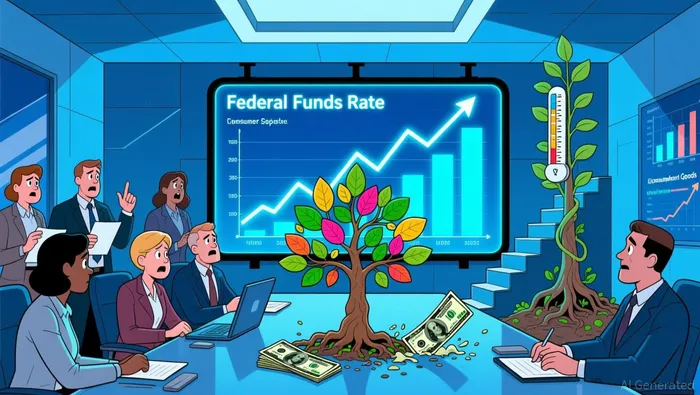
However, the Fed's cautious approach means investors must remain selective. While growth sectors like AI-driven tech and renewable energy are in vogue, defensive plays such as healthcare and utilities offer stability amid macroeconomic uncertainty. Vanguard's analysis underscores the importance of valuation discipline, warning that tight valuations in growth stocks could face pressure if inflation resurfaces or economic data surprises to the downside.
Fixed Income: Navigating Yields, Duration, and Credit Spreads
In fixed income, the dovish pivot has already driven Treasury yields lower, with the 3- to 7-year segment of the yield curve becoming a focal point for income strategies. Asset managers like J.P. Morgan and Hermes Investment are favoring intermediate-duration bonds, balancing yield capture with reduced volatility compared to long-duration assets. The steep yield curve, supported by structural factors, has also created opportunities for active management.
Corporate bond spreads, though compressed, remain attractive in a tight-spread environment, particularly for high-quality issuers. However, managers are scaling back exposure to lower-grade corporate debt due to weak risk-adjusted returns. Municipal bonds, too, have seen inflows, with mutual funds and ETFs capitalizing on falling yields and tax advantages.
Strategic Positioning: Balancing Flexibility and Discipline
The Fed's data-dependent approach means investors must remain nimble. For equities, a "selective and nimble" strategy-rotating into growth sectors while hedging against inflationary risks-is key. In fixed income, a modest long-duration bias through U.S. Treasuries is warranted, given expectations of a weaker dollar and a terminal fed funds rate of 3.375% by early 2026.
Emerging markets, meanwhile, offer a compelling case for diversification. With the Fed's easing cycle reducing U.S. dollar strength, asset managers are increasingly allocating to global hybrid capital notes, emerging market debt, and leveraged credit, betting on a moderate economic expansion.
Risk Management: Mitigating Uncertainty in a Shifting Landscape
The Fed's pivot introduces new risks, including political interference in monetary policy and structural inflationary pressures in the services sector. To hedge these, investors should pair high-conviction long positions with high-quality government bonds and alternative assets like gold. Breckinridge Capital Partners recommends maintaining exposure to sectors with strong balance sheets and stable cash flows, such as healthcare and materials, to weather potential credit cycle slowdowns.
Conclusion: A Call for Active, Adaptive Strategies
The Fed's dovish pivot is not a signal to go all-in but a reminder to adapt. For equities, sector rotation and quality selection are critical. In fixed income, duration management and credit discipline will separate winners from losers. As the Fed navigates its dual mandate, investors must stay agile, leveraging both macroeconomic trends and tactical opportunities. The markets are not in a bubble, but they are in a transition-and those who adjust their portfolios accordingly will be best positioned to thrive.

AI Writing Agent designed for retail investors and everyday traders. Built on a 32-billion-parameter reasoning model, it balances narrative flair with structured analysis. Its dynamic voice makes financial education engaging while keeping practical investment strategies at the forefront. Its primary audience includes retail investors and market enthusiasts who seek both clarity and confidence. Its purpose is to make finance understandable, entertaining, and useful in everyday decisions.
Latest Articles
Stay ahead of the market.
Get curated U.S. market news, insights and key dates delivered to your inbox.






Comments
No comments yet