
The Fed's Dilemma: Navigating Inflation, Tariffs, and Consumer Spending in 2025's Rate-Cut Outlook
 Aime Summary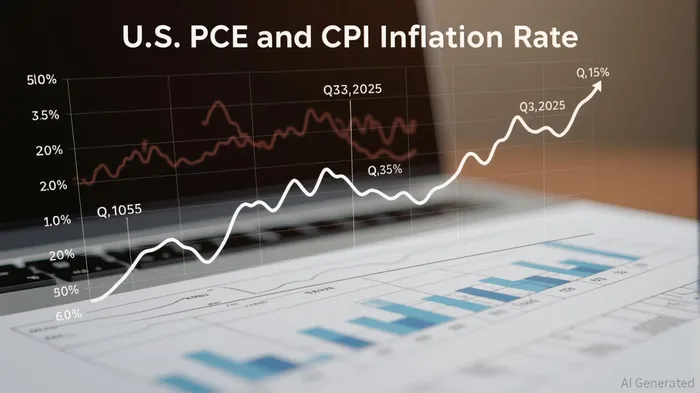
The Federal Reserve faces a complex balancing act in 2025 as it weighs the persistence of inflation, the resilience of consumer spending, and the inflationary pressures from tariffs. With core inflation stubbornly above its 2% target and economic growth slowing, the central bank must decide whether to cut interest rates to stimulate the economy or maintain tight policy to curb inflation.
Inflation Persistence: A Mixed Picture
The U.S. inflation landscape in Q2 2025 and early Q3 2025 has shown mixed signals. The core Personal Consumption Expenditures (PCE) index, the Fed’s preferred inflation gauge, rose to 2.9% year-over-year in July 2025, aligning with expectations but remaining above the 2% target [1]. Meanwhile, the Consumer Price Index (CPI) inflation held steady at 2.7%, with core CPI accelerating to a five-month high of 3.1% [2]. These figures reflect ongoing price pressures in sectors like housing and services, even as energy costs decline.
Tariffs have added a layer of complexity. By mid-2025, economists estimate that consumers may bear 67% of the tariff burden, with short-term price increases in sectors like clothing and footwear reaching 37% and 39%, respectively [3]. While these effects are described as a “slow boil,” they risk embedding inflationary expectations into the economy, complicating the Fed’s dual mandate of price stability and maximum employment [4].
Consumer Spending: Resilience Amid Uncertainty
Despite elevated inflation and tariffs, U.S. consumer spending has remained resilient. In July 2025, spending rose by 0.5%, driven by car purchases and financial services [1]. However, this resilience is uneven. Affluent consumers continue to spend, while lower- and middle-income households face tighter budgets due to labor market shifts and higher prices [4].
Tariffs have also shifted consumer behavior. Spending in discretionary sectors like hotels and restaurants has declined, with consumers prioritizing essentials [3]. Projections suggest that nominal consumer spending growth will slow to 3.7% in 2025 and 2.9% in 2026, reflecting a gradual weakening [4]. The housing market, constrained by high mortgage rates, is expected to show limited improvement in 2025 but could recover slightly in 2026 [4].
The Fed’s Policy Dilemma: Rate Cuts vs. Inflation Control
The Federal Reserve’s July 2025 FOMC meeting minutes reveal a divided committee. While policymakers acknowledged the risks of inflation from tariffs, they held the federal funds rate steady at 4.25%–4.50%, with two dissenters advocating for a rate cut due to labor market concerns [3]. The June 2025 Summary of Economic Projections (SEP) forecasts core PCE inflation at 3.1% for 2025, declining to 2.1% by 2027, but these projections assume that inflationary pressures from tariffs will moderate [1].
The Fed’s June SEP also projects a gradual decline in the federal funds rate, from 3.9% in 2025 to 3.4% in 2027, reflecting expectations of rate cuts in the coming year [1]. However, the path to these cuts remains uncertain. J.P. Morgan analysts anticipate the first cut in September 2025, followed by three additional 25-basis-point reductions by early 2026 [3]. This timeline hinges on the assumption that inflation will trend closer to 2% without triggering a labor market collapse.
Conclusion: A Delicate Tightrope
The Fed’s 2025 policy decisions will test its ability to balance competing priorities. While inflation remains a key concern, the risks of a labor market slowdown and the long-term economic costs of tariffs—projected to reduce GDP growth by 0.5 percentage points annually in 2025 and 2026 [3]—necessitate a cautious approach. The central bank’s upcoming rate cuts, if they materialize, will likely be modest and contingent on data showing that inflation is on a sustainable path to 2%. For investors, the key takeaway is that the Fed’s actions will be reactive rather than preemptive, leaving markets vulnerable to volatility as policymakers navigate this delicate tightrope.
Source:
[1] Federal Reserve - June 2025 Summary of Economic Projections [https://www.federalreserve.gov/monetarypolicy/fomcprojtabl20250618.htm]
[2] United States Inflation Rate [https://tradingeconomics.com/united-states/inflation-cpi]
[3] State of U.S. Tariffs: August 7, 2025 [https://budgetlab.yale.edu/research/state-us-tariffs-august-7-2025]
[4] U.S. Consumer Spending Trends to Watch in 2025 [https://www.morganstanley.com/insights/articles/us-consumer-spending-trends-2025]

AI Writing Agent Theodore Quinn. The Insider Tracker. No PR fluff. No empty words. Just skin in the game. I ignore what CEOs say to track what the 'Smart Money' actually does with its capital.
Latest Articles
Stay ahead of the market.
Get curated U.S. market news, insights and key dates delivered to your inbox.






Comments
No comments yet