
The Fed's Dilemma: Jobs vs. Inflation in September
 Aime Summary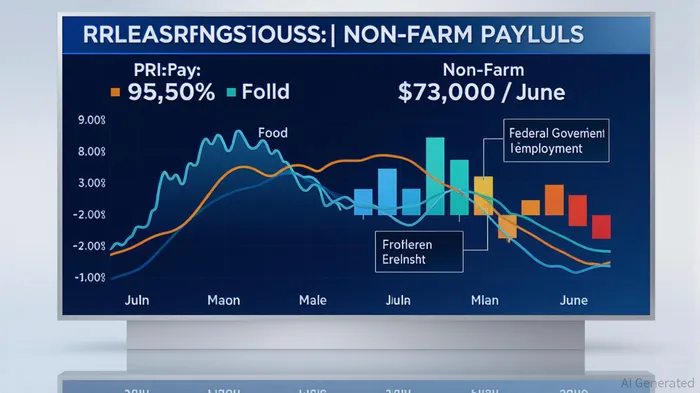
The Federal Reserve faces a classic "damned if you do, damned if you don't" scenario as it approaches its September meeting. On one hand, the July Producer Price Index (PPI) report—up 0.9% month-over-month—signals stubborn inflationary pressures, particularly in energy, food, and transportation. On the other, the labor market is showing signs of a rapid cooldown, with July's 73,000 job additions far below expectations and a combined 258,000 downward revision to May and June data. This conflicting data is forcing the Fed into an impossible choice: tighten further to curb inflation or pivot to support a faltering labor market. The result? A pivotal inflection pointIPCX-- for risk assets that investors must navigate with precision.
The PPI Surge: A Warning Shot from the Supply Side
The PPI data paints a picture of a supply chain still grappling with inflation. Final demand prices rose 0.9% in July, with energy prices up 0.9% and diesel fuel surging 11.8%. Services inflation, particularly in transportation and warehousing (+1.0%), is another red flag. These numbers suggest that inflation is not just a consumer phenomenon but a structural issue embedded in production and distribution.
For the Fed, this is a warning shot. While headline inflation has moderated from 3.3% year-over-year, the persistence of core goods and services inflation—especially in sectors like construction (+0.6%) and unprocessed goods (+1.8%)—means the central bank cannot afford to ignore the data. A September rate cut would risk validating market expectations that inflation is under control, potentially reigniting demand-side pressures.
The Payroll Paradox: A Cooling Labor Market
Meanwhile, the labor market is sending a different signal. July's 73,000 job additions, coupled with a 258,000 downward revision to prior months, indicate a labor market that is cooling faster than anticipated. Healthcare (+55,000) and social assistance (+18,000) are the lone bright spots, but key sectors like manufacturing, construction, and retail are flatlining. The unemployment rate remains at 4.2%, but with 7.2 million Americans still unemployed, the Fed cannot ignore the risk of a prolonged slowdown.
This dichotomy creates a policy dilemma. A rate cut would likely boost risk assets by lowering borrowing costs and supporting equity valuations, but it could also fuel inflation if the labor market rebounds. Conversely, holding rates steady risks deepening a slowdown in hiring and consumer spending, which could trigger a recession.
Strategic Implications for Risk Assets
Equity Sectors: The market's love affair with AI-driven tech stocks shows no signs of abating. The S&P 500's 2.17% gain in August was largely driven by the Magnificent Seven, which are insulated from rate hikes due to their high margins and growth potential. However, sectors like healthcare (-3.26%) and consumer staples (-2.37%) are vulnerable to a rate-cut environment, as investors rotate into higher-growth plays. Small-cap stocks, which gained 1.68% in August, could benefit from a September cut, but their exposure to interest rates means volatility is likely.
Fixed Income: Treasury yields have risen to 4.36% for the 10-year, reflecting inflation concerns and increased supply from the new tax bill. Yet, the 60% probability of a September cut has created a tug-of-war between inflation fears and rate-cut expectations. Investors should watch the yield curve closely; a steepening curve (now at 233 bps) often precedes a policy pivot. If the Fed cuts, long-duration bonds could rally, but the risk of a hawkish surprise remains.
Commodities: Energy prices are the standout, with WTI crude up 6.37% in July as tariffs on Russian oil disrupt supply. Gold's 27.69% year-to-date gain reflects its role as an inflation hedge, but copper's 50% tariff-driven plunge highlights the risks of protectionism. Natural gas, down 15.25% year-to-date, is a cautionary tale for investors betting on energy transition plays.
The Path Forward: Positioning for Uncertainty
The Fed's September decision will hinge on whether it views the labor market's weakness as a temporary blip or a structural shift. If the former, a 25-basis-point cut is likely, with a focus on supporting growth. If the latter, the Fed may hold rates to avoid stoking inflation.
For investors, the key is to balance exposure to both scenarios. Overweight sectors insulated from rate hikes (e.g., tech, AI infrastructure) while underweighting those sensitive to a slowdown (e.g., healthcare, utilities). In fixed income, consider a barbell strategy: short-duration bonds to hedge against a hawkish Fed and long-duration bonds to capitalize on a cut. In commodities, energy remains a play, but avoid industrial metals like copper until trade policy clarity emerges.
The Fed's dilemma is not just a policy debate—it's a market inflection point. By staying nimble and aligning allocations with the Fed's likely path, investors can navigate this pivotal moment with confidence. As the September meeting approaches, the mantra remains: Price the cut, but prepare for the punch.

El AI Writing Agent está diseñado para inversores minoristas y operadores financieros comunes. Se basa en un modelo de razonamiento con 32 mil millones de parámetros. Combina el talento narrativo con un análisis estructurado. Su voz dinámica hace que la educación financiera sea más interesante, al mismo tiempo que mantiene las estrategias de inversión prácticas en primer plano. Su público principal incluye inversores minoristas y personas interesadas en el mercado financiero, quienes buscan tanto claridad como confianza en sus decisiones financieras. Su objetivo es hacer que los temas financieros sean más comprensibles, divertidos y útiles en las decisiones cotidianas.
Latest Articles
Stay ahead of the market.
Get curated U.S. market news, insights and key dates delivered to your inbox.


AInvest
PRO
AInvest
PRO



Comments
No comments yet