
Fed's Dilemma: Boost Jobs or Curb Inflation as December Decision Looms


 Aime Summary
The Federal Reserve's internal debate over whether to cut interest rates in December has intensified, with policymakers divided during the October meeting, according to minutes released November 19. The 10-2 vote to reduce rates by 25 basis points last month masked deeper disagreements about the central bank's path forward, as several officials-particularly non-voting Fed bank presidents-opposed the move. The minutes revealed that "many" participants believed a December rate cut would be unwarranted, while "several" argued it could be appropriate, underscoring the committee's fractured outlook ahead of its final decision of the year according to the minutes.
The debate reflects broader uncertainty about the U.S. economy's trajectory. Federal Reserve Governor Christopher Waller, a vocal advocate for easing policy, cited weakening labor market data and slowing growth as justification for a December cut. He highlighted ADP's estimate of 6,500 net private-sector job gains per month in September and October-far below pre-pandemic trends-and declining job postings as evidence of deteriorating employment conditions according to ADP data. Waller also downplayed inflation risks, noting that underlying inflation, adjusted for tariff impacts, remains near the Fed's 2% target as reported.
However, caution persists among some officials. Fed Vice Chair Lael Brainard emphasized the need for "gradual" easing, warning that the current rate level is close to neutral and that further cuts could risk overshooting inflation targets according to recent analysis. Market expectations have shifted accordingly, with the probability of a December rate cut dropping to 42.9% from near certainty in October, according to CME FedWatch data as reported. This uncertainty has rippled through global markets, triggering a rare simultaneous decline in U.S. stocks, gold, and cryptocurrencies as noted.
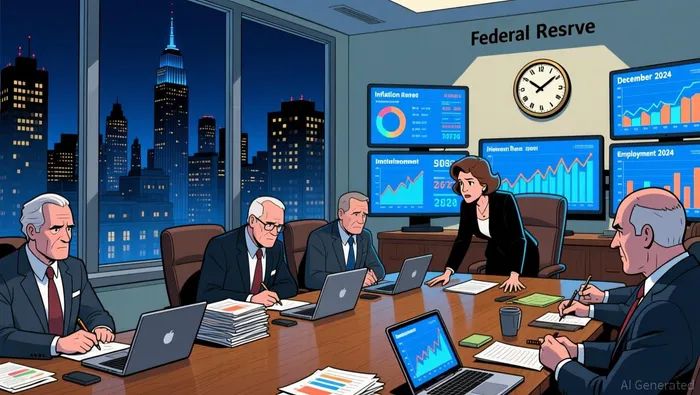
Compounding the Fed's challenges, the prolonged government shutdown delayed critical economic data, including the September nonfarm payrolls report-a key input for December policy decisions. Danske Bank's Kristoffer Kjaer Lomholt noted that the delayed data will eventually provide a clearer economic picture but left policymakers navigating a "fog of uncertainty" in the interim according to financial analysts. The shutdown also disrupted Treasury auctions, adding volatility to bond markets as investors awaited the outcome of the $42 billion 10-year note offering as reported.
Bitcoin ETFs have mirrored this macroeconomic unease, with $866.7 million in net outflows recorded on November 13-the second-largest single-day redemption since their January 2024 launch as reported. The exodus coincided with a 4.8% drop in Bitcoin's price and a broader shift of capital from high-beta assets into cash and gold, as investors braced for tighter liquidity conditions as noted.
With the December 9–10 Federal Open Market Committee meeting approaching, the Fed faces a pivotal test of its ability to reconcile divergent views on inflation, employment, and financial stability. The minutes suggest no clear consensus, leaving markets to speculate on whether the central bank will prioritize labor market support or maintain a hawkish stance to anchor inflation expectations.

Stay ahead of the market.
Get curated U.S. market news, insights and key dates delivered to your inbox.


AInvest
PRO
AInvest
PRO



Comments
No comments yet