
The Fed's Dilemma: Balancing Inflation and Growth—Implications for Bond Investors
The Federal Reserve's decision to hold the federal funds rate steady at 4.25-4.5% in its June 2025 meeting underscores the central bank's delicate balancing act between curbing inflation and sustaining economic growth. With unemployment near historic lows and inflation edging closer to the 2% target, the Fed faces mounting calls to ease monetary policy. Yet, lingering uncertainties—particularly the impact of trade tariffs on prices and demand—have kept policymakers cautious. For fixed-income investors, this fraught equilibrium presents both challenges and opportunities. The dilemma now is how to navigate a prolonged high-rate environment while safeguarding portfolios against volatility.
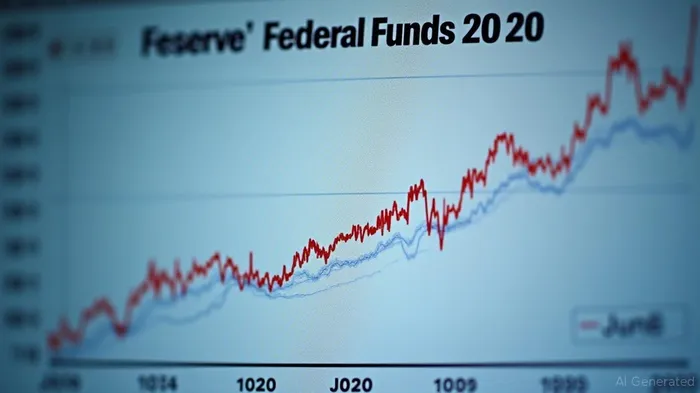
The Fed's Stance: A Data-Driven Pause
The June decision reflected the Fed's reliance on hard economic data. The labor market remains robust, with 139,000 jobs added in May and unemployment at 4.2%, near a 50-year low. Inflation, while still elevated at 2.4% year-over-year, has cooled from its 2022 peak, with core CPI (excluding food and energy) at 2.8%. Yet, the Fed remains wary of trade policies that could reignite inflation or weaken growth. The Summary of Economic Projections (SEP) released alongside the decision indicated no near-term rate cuts, aligning with market pricing of a 99.9% chance of a hold.
Fixed-Income Sectors in a Prolonged High-Rate Environment
Treasuries: Navigating Duration Risk
The Treasury market faces a conundrum. With yields on the 10-year note near 3.8%—a level unseen since the early 1980s—investors must weigh the allure of high incomePCF-- against the risk of rising rates. Historically, prolonged high-rate environments (e.g., the early 1980s) saw bond prices collapse until rates peaked. Today's uncertainty—whether the Fed will cut rates by year-end or hold firm—demands duration management. Short-term Treasuries (e.g., 2-5 year maturities) offer insulation against volatility while retaining liquidity. Avoiding long-dated bonds (e.g., 30-year Treasuries yielding ~4.2%) is prudent unless one is certain of a rate-cut trajectory.
Corporate Bonds: Credit Quality Over Yield
Corporate bonds, particularly high-yield (HY) issues, have seen spreads narrow to pre-pandemic levels. Yet, with trade tensions and potential economic slowdowns, credit quality is paramount. Investment-grade corporates (e.g., the iShares iBoxx $ Investment Grade Corp Bond ETF (LQD)) offer safer yields (~5.1%) than HY peers (e.g., the iShares iBoxx $ High Yield Corp Bond ETF (HYG) at ~6.3%). The risk-reward trade-off favors favoring investment-grade issuers with strong balance sheets. High-yield bonds, while tempting, face heightened default risks if tariffs trigger a recession.
TIPS: A Hedge Against Inflation Volatility
Inflation-protected securities (TIPS) remain underappreciated. While headline inflation is muted, shelter costs—a major CPI component—could rise further, creating tail risks. TIPS yields (~2.3%) are lower than nominal Treasuries, but their principal adjustments for inflation provide asymmetric upside. Allocating 10-15% of a bond portfolio to TIPS (e.g., the iShares TIPS Bond ETF (TIP)) offers a hedge without excessive duration exposure.
Historical Precedents: A Cautionary Tale
Past episodes of prolonged high rates offer lessons. In the early 1980s, the Fed's aggressive rate hikes (peaking at 20%) crushed bond prices until Paul Volcker's policies tamed inflation. Similarly, in the early 2000s, the Fed's gradual tightening led to a "bond bear market" that lasted until 2011. Today's environment lacks the extreme volatility of the 1980s but shares risks of prolonged uncertainty. Investors must avoid complacency, as even small rate hikes can disproportionately hurt long-duration assets.
Strategic Allocation Shifts
- Shorten Duration: Prioritize 2-5 year Treasuries over long-dated bonds.
- Quality Over Yield: Favor investment-grade corporates (LQD) over high-yield (HYG).
- Inflation Hedge: Allocate to TIPS (TIP) to mitigate shelter-cost risks.
- Liquidity: Maintain cash reserves (10-15%) to capitalize on volatility-driven opportunities.
Conclusion: The Fed's Tightrope and Investor Prudence
The Fed's June decision highlights its commitment to data-driven policy, but the path ahead remains fraught. Investors must recognize that the era of easy fixed-income returns is over. Success hinges on strategic duration management, disciplined credit selection, and preparedness for volatility. In this high-rate, low-predictability environment, portfolios should be diversified, nimble, and focused on preserving capital until clarity emerges. The Fed's dilemma is now investors' challenge—and their response must be both measured and mindful.

Stay ahead of the market.
Get curated U.S. market news, insights and key dates delivered to your inbox.






Comments
No comments yet