
Fed's December Meeting: What Investors Need to Know About the Rate Cut and Market Implications


 Aime Summary
With the Federal Reserve's final meeting of 2025 just around the corner, investors are on edge. The meeting, set for December 9–10, is expected to deliver a long-awaited 25 basis point rate cut. That alone is enough to send ripples across global markets. But behind the anticipated easing lies a more complex story — one shaped by a divided FOMC, concerns over stagflation, and the looming economic impact of new tariffs. Understanding what's at stake for both policy and portfolios is now more critical than ever.
What We Know About the Fed's December Decision
The Federal Open Market Committee (FOMC) is expected to cut the federal funds rate by 25 basis points during its December 9–10 meeting, bringing the rate to a new range of 3.50%–3.75%. Futures traders have priced in an 89% chance of this cut, a number that has steadily climbed in recent weeks as more data pointed to a weaker labor market and slowing economic growth. The decision will be announced at 2:00 p.m. ET on December 10, followed by a press conference at 2:30 p.m. ET featuring Fed Chair Jerome Powell.
This is the first rate cut of 2025 and likely the first of several. Morgan Stanley recently revised its outlook, now forecasting additional 25 basis point cuts in January and April 2026, pushing the terminal rate down to 3.00%–3.25%. The move signals a shift in the Fed's strategy from tightening to cautious easing — a response to a cooling labor market and persistent inflation concerns.
A Divided Fed and the Shadow of Stagflation
The Fed's decision is not made in a vacuum. Inside the room, there's visible division. Governor Stephen Miran, a recent Trump appointee, has consistently voted against the majority and pushed for larger cuts. His stance has raised questions about the Fed's independence and whether political pressures could influence monetary policy.
Meanwhile, the economic backdrop is clouded by a mix of signals. On one hand, initial unemployment claims hit a three-year low recently, suggesting the labor market isn't as weak as some fear. On the other, the ADP report revealed a surprising 32,000 job loss in November, mostly from small businesses, adding to concerns of a hiring slowdown. Trump's aggressive tariff policies are also stirring worries about inflation. 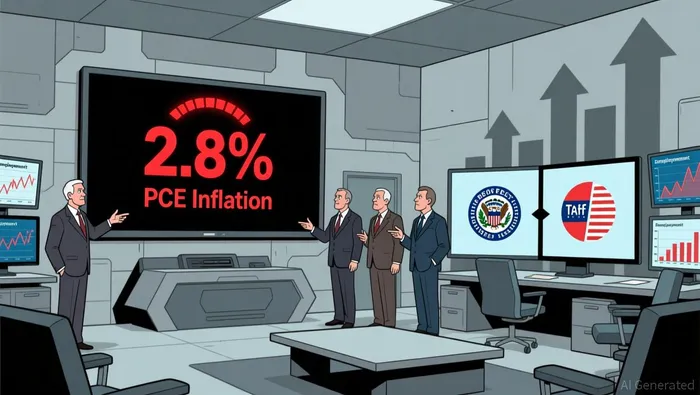 The September core PCE report showed an annual inflation rate of 2.8% — still above the Fed's 2% target and expected to remain so into 2027.
Market Implications and Investor Sentiment
The Fed's move to cut rates is broadly seen as a tailwind for stocks, especially for small-cap and growth-oriented companies. Lower rates reduce borrowing costs and make equities more attractive compared to fixed income. In fact, the Russell 2000 index — a key barometer for small companies — hit a record high recently amid rate cut expectations.
For now, investors are cautiously optimistic. The Q4 2025 CNBC CFO Council Survey shows business leaders are generally upbeat about the economy for 2026 but cautious about Trump's first year in his second term. They expect rate cuts to come at a measured pace — at most two in the first half of 2026 — and they're not convinced the incoming Fed chair will do more than Powell. Still, they see inflation remaining stubbornly above 2% for years.
Looking Ahead: What Investors Should Watch
The December meeting is just the beginning. The Fed's 2026 outlook will be shaped by how the labor market evolves, how inflation responds to rate cuts, and whether the broader economy can avoid a soft patch. RSM US economists project 2.2% GDP growth in 2026 and a terminal rate of 3.00%–3.25% by year-end 2026, with a 30% chance of a recession in the next 12 months.
For now, the focus is on the coming weeks. The official jobs report for November is still delayed and will be a key barometer for the Fed's next moves. Meanwhile, the central banks of the UK, Europe, and Japan will all be watching the Fed closely, as its decisions set the tone for global monetary policy.
At the end of the day, investors should take a measured approach. A 25 basis point cut is a step in the right direction, but the broader economic picture remains mixed. Markets have priced in the cut and are reacting accordingly, but there's still room for surprises — and volatility — ahead.

Delivering real-time insights and analysis on emerging financial trends and market movements.
Latest Articles
Stay ahead of the market.
Get curated U.S. market news, insights and key dates delivered to your inbox.


AInvest
PRO
AInvest
PRO



Comments
No comments yet