
Fed Crossroads: How Powell's Thresholds and Shifting Risks Signal a Rate Cut Pivot
The Federal Reserve stands at a critical juncture, balancing fragile inflation trends, geopolitical uncertainty, and a labor market near full employment. Federal Reserve Chair Jerome Powell's June 2025 testimony underscored a “wait-and-see” approach, with the federal funds rate held steady at 4.25%–4.5% since January. Yet beneath the surface, shifting economic indicators and escalating risks may force the Fed to abandon its cautious stance—and investors who anticipate this pivot could reap rewards in bonds, rate-sensitive equities, or USD-hedged assets.
The Fed's Current Stance: Powell's Thresholds
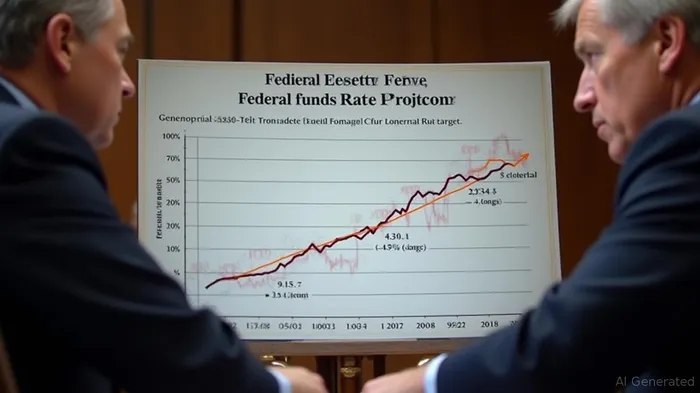
The June 2025 FOMC projections reveal a divided committee. While the median forecast calls for the federal funds rate to ease to 3.4% by 2027, a growing chorus of hawks and doves argues over near-term triggers for cuts. Powell has set clear thresholds:
- Inflation Must Cool: Core PCE inflation (excluding food and energy) must trend below 2.5% to alleviate concerns over persistent price pressures.
- Employment Risks Must Materialize: A sustained rise in unemployment above 4.5% could signal a labor market softening.
- Geopolitical Risks Must Escalate: Trade tariffs and global instability must visibly dampen growth or destabilize financial markets.
Shifting Economic Indicators: The Case for a Pivot
Recent data suggests the Fed's thresholds may soon be met.
Inflation: The Tariff Wild Card
Core PCE inflation has eased to 2.6% year-over-year (YoY) as of May 2025, down from 3.1% in early 2024. However, Powell warns that tariffs on Chinese imports—now averaging 18%—could push prices higher. A shows volatility in goods prices, while services inflation remains sticky. If tariffs trigger a sustained rise above 2.7%, the Fed may delay cuts; a decline below 2.5%, however, could open the door to easing.
Labor Market: Strength Masks Risks
The unemployment rate holds at 4.2%, near its 50-year low. Yet jobless claims have risen 15% since early 2025, and labor force participation remains depressed. A reveals that past Fed pivots often followed unemployment breaching 4.5%. With layoffs in tech and energy sectors accelerating, this threshold may be crossed by year-end.
GDP Growth: Slowing but Stable?
The Fed's June projection for 1.4% 2025 GDP growth reflects a moderation in consumer spending. However, business investment has stalled, and housing remains depressed by high mortgage rates. A shows that rate cuts typically follow growth below 2%.
Geopolitical Risks: The Wild Card in Fed Policy
Powell's “wait-and-see” mantra hinges on geopolitical developments. The Fed's June statement noted “heightened uncertainty” from trade disputes and global inflation. A shows tariffs have already added 0.8% to headline inflation. If the U.S.-China trade war escalates, the Fed may preemptively cut rates to cushion the blow.
Historically, the Fed has acted swiftly in crisis. During the 2019 trade war with China, the Fed cut rates three times to offset growth risks. Today, with bond markets already pricing in a 30% chance of a July cut, the Fed risks losing credibility if it waits too long.
Investment Implications: Positioning for the Pivot
Markets are pricing in a December 2025 rate cut, but investors should act sooner. Here's how to position:
Bonds: Anticipate the Yield Drop
If the Fed cuts rates, 10-year Treasury yields—currently at 3.2%—could fall to 2.5% by end-2025. Consider:
- Long-Term Treasuries: ETFs like TLTTLT-- (7+ year duration) benefit from yield declines.
- Investment-Grade Corporates: IEF (7–10 years) offers higher yields than Treasuries with manageable credit risk.
Rate-Sensitive Equities: Target Consumer and Tech
A Fed pivot would boost sectors tied to low rates, such as consumer discretionary and technology.
- Consumer Discretionary: An shows strong correlation with easing cycles. Look for names like AmazonAMZN-- (AMZN) or TeslaTSLA-- (TSLA).
- Tech: Lower rates reduce discount rates for growth stocks. NVIDIANVDA-- (NVDA) or MicrosoftMSFT-- (MSFT) could outperform.
USD-Hedged Assets: Prepare for Dollar Weakness
A Fed cut would weaken the dollar, favoring USD-hedged equity ETFs (e.g., FXI for China, EWJ for Japan) or commodities like gold (GLD).
Conclusion: The Clock Is Ticking
The Fed's patience is finite. If inflation slips below 2.5%, unemployment rises, or trade risks spike, a rate cut is inevitable—and markets will react swiftly. Investors who front-run this pivot could secure gains in bonds, equities, and hedged assets. As Powell's thresholds near, the question isn't if the Fed will act, but how soon—and markets will reward those who bet on the latter.

Stay ahead of the market.
Get curated U.S. market news, insights and key dates delivered to your inbox.






Comments
No comments yet