
The Fed's Crossroads: Political Pressure and Investment Opportunities in a Volatile Market
 Aime Summary
The Federal Reserve's independence, long a cornerstone of U.S. economic stability, faces its most severe test in decades. Recent political rhetoric, particularly from former President Donald Trump's relentless criticism of Chair Jerome Powell, has injected unprecedented uncertainty into monetary policy. This volatility creates both risks and opportunities for investors, especially in sectors like financials and technology, which are uniquely positioned to capitalize on shifting Fed dynamics.
Political Siege on the Fed: A New Era of Uncertainty
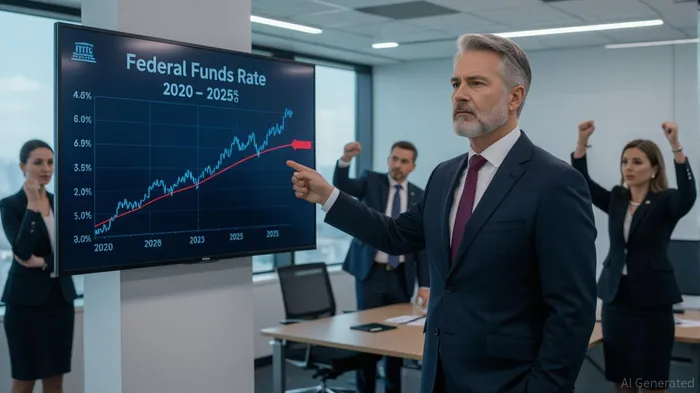
Trump's vocal demands for aggressive rate cuts—aimed at stimulating growth and reducing government borrowing costs—have drawn scrutiny to the Fed's autonomy. His public denunciations of Powell as a “FOOL” and threats to replace him before his term expires in 2026 challenge the legal safeguards enshrined in the Humphrey's Executor Supreme Court ruling, which limits presidential power to remove Fed governors without cause. While the Fed's institutional structure has so far resisted politicization, the mere perception of interference has fueled market volatility.
Legal Safeguards vs. Market Realities
The Fed's legal framework, including its dual mandate of price stability and full employment, remains intact. Powell's public reaffirmation of data-driven policymaking in July 遑 2025 underscored the central bank's commitment to independence. However, markets are pricing in political risks: the yield curve has flattened, with a 35% probability of three rate cuts by year-end, despite the Fed's cautious stance.
For investors, this disconnect between rhetoric and reality creates asymmetric opportunities.
Sector Analysis: Financials and Tech in the Crosshairs
Financials: Navigating Rate Sensitivity and Regulatory Risks
Financial stocks like JPMorgan (JPM) and Citigroup (C) have been caught between conflicting forces. Higher rates traditionally boost net interest margins, but political pressure to cut rates risks compressing these margins. Meanwhile, Trump's executive orders targeting the Fed's regulatory oversight (excluding monetary policy) have raised concerns about broader sector politicization.
Investment Play:
- Overweight defensive financials with strong capital reserves and exposure to fee-based businesses (e.g., asset management).
- Underweight banks heavily reliant on net interest income until clarity emerges on the Fed's policy path.
Technology: Riding AI Gains Amid Rate Volatility
Tech giants like Apple (AAPL) and AMD (AMD) are doubly vulnerable to Fed uncertainty. Rising rates increase borrowing costs, while tariff-driven inflation squeezes profit margins. However, the sector's long-term growth in AI-driven innovation—particularly in data centers and semiconductors—creates a compelling case for selective investment.
Investment Play:
- Focus on AI leaders with strong cash flows and secular growth, such as cloud infrastructure providers and semiconductor firms (e.g., NVIDIA (NVDA)).
- Hedge with put options on rate-sensitive tech stocks to mitigate sudden Fed pivots.
Strategic Portfolio Moves Amid the Fed Crossroads
- Sector Rotation:
- Rotate into rate-sensitive tech if the Fed signals easing, but avoid cyclical industrials exposed to tariff risks.
Overweight utilities and healthcare as defensive havens during policy uncertainty.
Monitor Policy Signals:
- Track the Fed's internal review of its $2.5 billion headquarters renovation controversy—a litmus test for Powell's credibility.
Watch for inflation data post-tariff reforms; persistent above-target readings could delay rate cuts.
Leverage Options:
- Use VIX volatility indices to hedge against sudden market swings.
- Consider long-dated calls on tech firms with AI catalysts to capture upside in a Fed easing scenario.
Conclusion: The Fed's Legacy and Investor Resilience
The Fed's ability to withstand political pressure—and maintain its credibility—will determine the next phase of market stability. While risks like inflation spirals or a dollar sell-off exist, investors can thrive by focusing on:
- Quality assets with pricing power and secular tailwinds (e.g., AI infrastructure).
- Defensive hedges to navigate volatility.
The Fed's crossroads is not just a policy debate—it's a strategic opportunity for investors to position themselves ahead of the next cycle.
Final Note: Monitor Powell's August testimony and July inflation data closely. A 3-4% dollar sell-off or bond yield spike could shift sector dynamics overnight.

Delivering real-time insights and analysis on emerging financial trends and market movements.
Latest Articles
Stay ahead of the market.
Get curated U.S. market news, insights and key dates delivered to your inbox.
AInvest
PRO
AInvest
PRO



Comments
No comments yet