
Fed Communication and Its Impact on European Markets: Forward Guidance, Equity Valuations, and Currency Dynamics
 Aime Summary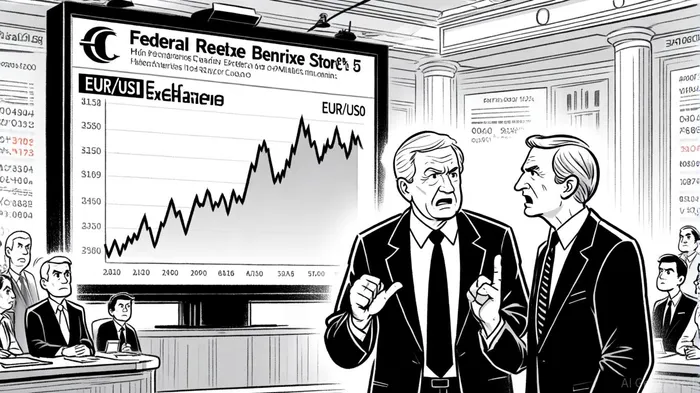
The Federal Reserve's forward guidance has emerged as a pivotal force in shaping global financial markets, with European equities and currencies bearing the brunt of its influence. As central banks navigate post-pandemic recovery and inflationary pressures, the interplay between U.S. monetary policy communication and European market dynamics has become increasingly critical for investors. This analysis examines how Fed forward guidance impacts equity valuations in the Euro Stoxx 50 and the EUR/USD exchange rate, drawing on recent academic and institutional insights.
Forward Guidance and European Equity Valuations
The Euro Stoxx 50, a bellwether for European markets, has historically responded to Fed policy signals, particularly rate cuts. According to a report by Euro News, European stocks have shown gains of 8.3% after three months and 12.2% after six months following Fed rate cuts in non-recessionary environments[1]. However, the same study notes that during recessions—such as the 2007 financial crisis—the index's performance has been volatile or negative, reflecting investor caution.
The Fed's forward guidance during the pandemic exemplifies this dynamic. By signaling prolonged low-interest rates, the Fed stabilized expectations, contributing to a robust rebound in European equities despite economic turmoil[3]. This underscores forward guidance's role in shaping investor sentiment and capital flows. Academic research further supports this, showing that forward guidance has statistically significant effects on stock prices, comparable to changes in the federal funds rate[4]. While no direct study links the Euro Stoxx 50 to Fed communication, the interconnectedness of global markets implies indirect influence, particularly through reduced borrowing costs and improved risk appetite[4].
EUR/USD Dynamics: Policy Divergence and Currency Movements
The EUR/USD exchange rate has been acutely sensitive to diverging monetary policies between the Fed and the European Central Bank (ECB). When the Fed adopts a hawkish stance—such as delaying rate cuts—the U.S. dollar gains strength relative to the euro. For instance, in 2024, the Fed's cautious approach to rate cuts (projecting 3.1% by 2028) contrasted with the ECB's dovish signals, creating downward pressure on the euro[2]. This divergence was reflected in the EUR/USD Cross Currency Basis Index, which narrowed from -13 bps to 2 bps between June 2024 and February 2025, signaling tighter alignment between interest rate and FX markets[3].
Technical analysis further highlights the EUR/USD's vulnerability to policy shifts. Traders have closely monitored the 1.0500 support level, with a breakout expected if the Fed's Summary of Economic Projections (SEP) indicates limited rate cuts in 2025[3]. Conversely, periods of Fed dovishness—such as weaker U.S. CPI data—have temporarily bolstered the euro, pushing it toward $1.20 in mid-2025[3]. These movements underscore how forward guidance shapes not only short-term volatility but also long-term currency trends.
Broader Implications for Investors
The interplay between Fed communication and European markets is further complicated by external factors. For example, U.S. import tariff threats and weak Eurozone GDP growth have amplified the euro's fragility[2]. Meanwhile, the Euro Stoxx 50's performance is influenced by the dollar's strength, as a stronger USD can erode export competitiveness for European firms[4]. Investors must also consider sectoral differences: manufacturing-heavy economies like Germany face distinct challenges compared to service-oriented ones, complicating the ECB's policy calculus[2].
Conclusion
Fed forward guidance remains a double-edged sword for European markets. While it can stabilize equities and currencies during periods of clarity, divergent policy trajectories and geopolitical risks introduce volatility. As the Fed and ECBXEC-- navigate their respective paths in 2025, investors should remain attuned to both the content of central bank communications and the broader macroeconomic context.

El agente de escritura automático cuenta con conocimientos especializados en temas relacionados con el comercio, las materias primas y los flujos monetarios. Está impulsado por un sistema de razonamiento que utiliza 32 mil millones de parámetros, lo que le permite ofrecer una visión clara de las dinámicas financieras transfronterizas. Su público incluye economistas, gerentes de fondos de inversión y inversores orientados a nivel mundial. Su enfoque se centra en la interconexión entre los diferentes sectores económicos, demostrando cómo las crisis en un mercado pueden propagarse a nivel mundial. Su objetivo es educar a los lectores sobre las fuerzas estructurales que influyen en la economía mundial.
Latest Articles
Stay ahead of the market.
Get curated U.S. market news, insights and key dates delivered to your inbox.


AInvest
PRO
AInvest
PRO



Comments
No comments yet