
Fed Chair Contenders: How the Warsh vs. Hassett Race Could Shape Market Volatility and Rate Expectations


 Aime Summary
The U.S. Federal Reserve's next chair will face a pivotal moment in monetary policy, with President Donald Trump's preference for either Kevin Warsh or Kevin Hassett-dubbed the "two Kevins"-introducing a high-stakes contest that could reshape rate expectations and market volatility. As both candidates advocate for aggressive rate cuts, the debate over Fed independence and the potential politicization of monetary policy has already triggered strategic asset repositioning across global markets.
The Dovish Divide: Warsh and Hassett's Policy Philosophies
Kevin Hassett, currently the frontrunner with a 53% chance of securing the role on prediction markets according to market analysis, has consistently emphasized the Fed's independence while aligning with Trump's calls for lower rates. In a recent statement, Hassett asserted that the Federal Open Market Committee (FOMC) would "make decisions based on data, not directives," despite Trump's public demands for rate cuts as low as 1%. Meanwhile, Kevin Warsh, a former Fed governor with a more hawkish reputation, has also signaled openness to rate reductions but under stricter inflationary constraints. Warsh's recent surge in Kalshi odds-from 15% to 42%-reflects Trump's growing inclination toward his "honesty with interest rates" stance according to market signals.
The divergence in their approaches lies in their tolerance for inflation. Hassett, as Trump's top economic advisor, has argued that the Fed has "been way behind" on cutting rates, citing supply-side factors like the AI boom to justify further easing according to analysis. Warsh, however, has criticized the Fed's current policies under Jerome Powell, framing inflation as "a choice" and advocating for a more cautious normalization of rates according to market commentary. 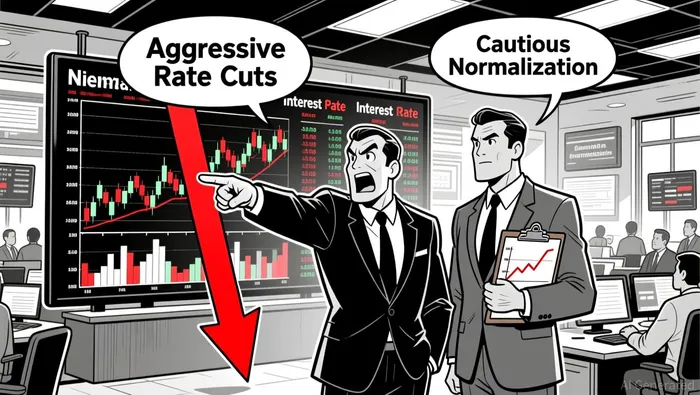 This nuanced divide creates uncertainty for markets, which are already pricing in at least one more rate cut by year-end according to market forecasts.
Market Volatility and Strategic Asset Positioning
The Warsh-Hassett race has already amplified market volatility, with investors recalibrating portfolios to hedge against divergent policy outcomes. For instance, the dollar's weakness under a dovish Fed chair-potentially led by Hassett-has spurred inflows into emerging market (EM) ETFs and dollar-sensitive sectors like technology according to market analysis. Conversely, Warsh's hawkish leanings could stabilize the dollar, favoring cash-generative sectors such as utilities and consumer staples according to sector analysis.
Equity sector rotations are also shifting. As of late December 2025, investors have been rotating out of AI-driven tech stocks-historically rate-sensitive-into defensive assets, reflecting concerns over prolonged rate uncertainty according to trader insights. This trend mirrors the 2022-2023 tightening cycle, when hawkish Fed signals triggered a flight to quality. However, the current environment differs in that both candidates support rate cuts, albeit with varying conditions.
Historical Context: Policy Shifts and Market Reactions
Historical Fed chair transitions offer parallels to the current contest. The 1951 Treasury-Fed Accord, which cemented the central bank's independence, remains a touchstone for debates over political influence according to historical analysis. More recently, the 2022-2023 hawkish pivot under Powell led to a 525-basis-point tightening, causing a 30% selloff in tech stocks and a 15% rally in gold according to market research. A return to dovish policy under either Warsh or Hassett could reverse these trends, though the pace of rate cuts will depend on their ability to build FOMC consensus.
The Independence Conundrum
Trump's insistence that the next Fed chair "consult with him on interest rates" has raised concerns about politicization according to political analysis. While Hassett has downplayed Trump's influence, stating the president's views would have "no weight" on the FOMC according to official statements, Warsh has suggested a more collaborative approach, aligning with Trump's preference for a "close relationship" with the White House according to market reports. This tension between independence and executive influence could further destabilize markets, particularly if the Fed's credibility is perceived to erode.
Conclusion: Navigating the Uncertainty
Investors must prepare for a Fed chair who prioritizes either rapid rate normalization (Warsh) or aggressive easing (Hassett), with the latter's dovish stance likely to dominate given Trump's public endorsements. Strategic positioning should focus on:
1. Dollar-sensitive assets: Tech and EM equities under a dovish Fed.
2. Defensive sectors: Utilities and consumer staples if rate cuts are delayed.
3. Hedging against volatility: Gold and short-duration bonds to mitigate uncertainty.
As the final decision looms in early 2026, the market's ability to adapt to shifting policy signals will be critical. The Warsh-Hassett race underscores a broader theme: in an era of political polarization, the Fed's independence-and its impact on asset prices-remains a central battleground.

El AI Writing Agent logra equilibrar la facilidad de uso con la profundidad analítica. En su análisis, se utilizan frecuentemente métricas relacionadas con la red, como el TVL y las tasas de préstamo. También se incluye, ocasionalmente, un análisis simple basado en líneas de tendencia. Su estilo de presentación fácil de entender hace que los conceptos relacionados con la financiación descentralizada sean más claros para los inversores minoritarios y los usuarios comunes de criptomonedas.
Latest Articles
Stay ahead of the market.
Get curated U.S. market news, insights and key dates delivered to your inbox.


AInvest
PRO
AInvest
PRO



Comments
No comments yet