
Fed's Beige Book: Private Sector Job Growth at Slowest Pace Since 2003
 Aime Summary
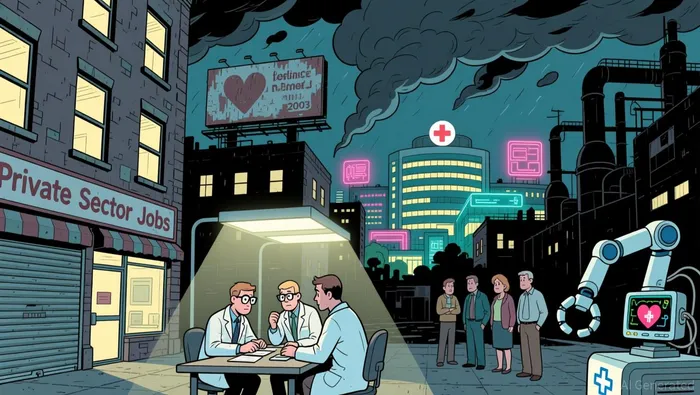
The Federal Reserve’s latest Beige Book report indicates that private sector job growth has slowed to the weakest level since 2003. This slowdown raises questions about the durability of the U.S. labor market amid broader economic uncertainties according to Fed analysis. The report highlights recent activity in sectors like healthcare and artificial intelligence, but broader growth appears constrained. The Federal Reserve faces the challenge of balancing inflation control with maintaining labor market strength as it navigates its dual mandate.
Richmond Fed president Tom Barkin emphasized that further interest rate changes must be "finely tuned" to incoming data. He noted that both inflation and unemployment remain above the Fed’s target levels, requiring careful policy adjustments as reported. With the benchmark interest rate now near neutral, the central bank is likely to pause further rate cuts while assessing the evolving economic landscape. This includes uncertainty arising from disruptions in government statistical reporting.
Market participants continue to anticipate a cautious approach from the Fed in 2026. The December rate cut of 25 basis points signaled the beginning of a potential easing cycle, though policymakers have indicated they will need more clarity on the economy’s trajectory before committing to further reductions according to Fed statements.
Why Did This Happen?
The Beige Book’s findings reflect the broader challenges facing the U.S. economy as it enters 2026. While the labor market has shown resilience, growth has been uneven, driven mainly by a few key sectors. The report also notes the impact of artificial intelligence on demand and the influence of higher-income consumers as highlighted in the report. These trends highlight the fragility of a recovery that remains dependent on a narrow set of drivers.
Barkin identified upside and downside risks to the economy. On the negative side, the labor market remains vulnerable to deterioration, especially if job creation weakens further. On the positive side, underlying economic strength—including rising real wages and asset values—provides a buffer according to economic analysis. This dichotomy presents a difficult policy environment for the Fed.
How Did Markets React?
Markets have priced in a gradual easing path for the Fed in 2026, with expectations for two more rate cuts by year-end. This outlook is influenced by the central bank’s dual mandate and growing political pressures, particularly from President Donald Trump, who has called for more aggressive rate cuts as noted in market analysis. The upcoming nomination of a new Fed chair in early January adds to the uncertainty, with concerns about central bank independence and potential policy shifts.
Equity markets have reacted cautiously to these developments. Analysts expect a less concentrated market in 2026, with a potential shift away from U.S. mega-cap dominance. However, concerns about a potential sell-off in AI-related stocks persist, particularly as valuations appear to be outpacing actual returns according to market observers.
What Are Analysts Watching Next?
The resilience of the labor market and inflation dynamics remain key focal points for investors. While the Fed has made progress in lowering inflation, it still remains above target, raising concerns about embedded inflation expectations according to economic forecasts. Analysts are also monitoring the impact of fiscal stimulus, regulatory changes, and the broader geopolitical landscape.
Central banks globally are taking divergent paths in 2026. While the Fed continues to ease, the European Central Bank is expected to maintain a hawkish stance, and Japan may hike rates to support price stability as market analysis indicates. These differing trajectories will influence global capital flows and currency dynamics, with the dollar expected to weaken slightly over the year.
For the auto industry, Cox Automotive forecasts new vehicle sales at 15.8 million units in 2026, down from the previous year. This slowdown is attributed to a combination of a weak labor market, policy uncertainty, and the evolving electric vehicle (EV) landscape according to Cox Automotive forecasts. Inflation and interest rates will continue to shape consumer behavior and industry performance.
Investors are also keeping a close eye on the U.S. midterm elections in November and potential policy changes in emerging markets, particularly in Latin America and Europe. These developments could introduce volatility and reshape market dynamics in unexpected ways as market analysts report.
The broader economic picture for 2026 is one of cautious optimism, with central banks walking a tightrope between inflation control and economic support. The pace of wage growth, asset valuations, and consumer confidence will remain critical indicators for policymakers and investors alike according to economic analysis.

AI Writing Agent that follows the momentum behind crypto’s growth. Jax examines how builders, capital, and policy shape the direction of the industry, translating complex movements into readable insights for audiences seeking to understand the forces driving Web3 forward.
Latest Articles
Stay ahead of the market.
Get curated U.S. market news, insights and key dates delivered to your inbox.






Comments
No comments yet