
The Fed's Balancing Act: Stabilizing U.S. Debt Amid Rising Fiscal Pressures
 Aime Summary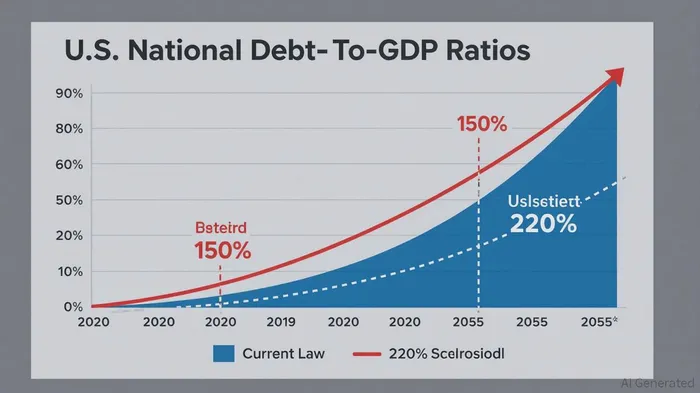
The U.S. fiscal landscape in 2025 is a tapestry of contradictions: record-high deficits, a surging national debt, and a Federal Reserve grappling with how to stabilize sovereign credit metrics without exacerbating inflation or market volatility. As the Congressional Budget Office (CBO) projects public debt to reach 156% of GDP by 2055 under current law—and 220% if tax cuts are extended—the Federal Reserve faces a critical role in mitigating the fallout. This article examines how the Fed's monetary policy and communication strategies are shaping bond markets, and what this means for investors navigating a fragile fiscal environment.
The Fiscal Tightrope: Deficits, Debt, and Policy Trade-offs
The U.S. fiscal year 2025 deficit hit $1.3 trillion by June, driven by mandatory spending on Social Security, Medicare, and Medicaid, which accounted for 70% of the year-to-date outlay increase. Meanwhile, the passage of H.R.1 in July—a bill extending 2017 tax cuts and adding $3.4 trillion to the debt over a decade—has further strained fiscal sustainability. The Congressional Budget Office (CBO) warns that under current law, the U.S. will average deficits of 6.3% of GDP over the next 30 years, with debt-to-GDP ratios climbing to unsustainable levels.
The Fed's June 2025 meeting minutes reveal a growing concern among policymakers about the interplay between fiscal policy and bond markets. Treasury yields, particularly for longer maturities, have risen by 15–20 basis points since April, with fiscal sustainability cited as the top factor influencing market expectations. The Fed acknowledges that rising deficits and debt could erode investor confidence, leading to higher borrowing costs for the government and spillover effects into corporate and household debt.
The Fed's Dual Mandate in a Debt-Driven World
The Federal Reserve's dual mandate—price stability and maximum employment—now faces a third, unspoken priority: stabilizing sovereign credit metrics. With the U.S. debt-to-GDP ratio projected to surpass 150% by 2025, the Fed must balance its inflation-fighting goals with the need to maintain investor trust in U.S. Treasuries.
Key actions include:
1. Yield Curve Management: By signaling a cautious approach to rate cuts (with the first 50-basis-point cut expected in Q4 2025), the Fed aims to prevent a sharp rise in long-term yields that could destabilize bond markets.
2. Communication as a Tool: The Fed has emphasized transparency about fiscal risks, noting in its June minutes that “uncertainty about trade, fiscal, immigration, and regulatory policies remains elevated.” This messaging seeks to anchor market expectations and reduce volatility.
3. Inflation Anchoring: Despite rising tariffs and fiscal pressures, the Fed remains committed to curbing inflation, which could otherwise erode the real value of U.S. debt and trigger a self-fulfilling debt spiral.
Bond Market Dynamics: Risks and Opportunities
The bond market's response to fiscal pressures is nuanced. While Treasury auction performance remains stable—metrics aligning with long-run averages—rising yields suggest investors are pricing in higher default risk. The Fed's June minutes note that fiscal concerns are now the most frequently cited factor in forecasts for the 10-year Treasury yield over the next two years.
For investors, this creates a paradox: U.S. Treasuries remain a “safe haven” in times of global uncertainty, yet their yields are climbing as fiscal risks mount. The Fed's ability to manage inflation and communicate policy clarity will determine whether yields stabilize or continue to rise.
Investment Implications: Navigating the Fed's Tightrope
- Duration Risk in Fixed Income: Investors should consider shortening bond portfolios to mitigate exposure to rising yields. Long-duration bonds, particularly Treasuries, face significant price declines if the Fed tightens policy further.
- Inflation Hedging: TIPS (Treasury Inflation-Protected Securities) and inflation-linked bonds offer protection against the Fed's ongoing battle with inflation, which remains a key driver of fiscal stress.
- Diversification Beyond Treasuries: As fiscal risks rise, investors may explore alternative assets such as municipal bonds, corporate debt with strong credit ratings, or even gold, which has historically served as a hedge against currency devaluation.
- Monitoring Policy Shifts: The Fed's communication and actions on the debt ceiling, tax policy, and trade tariffs will be critical. A downgrade in U.S. credit ratings (as seen with Moody'sMCO-- recent Aa1 rating) could trigger a flight to quality, but also accelerate yield increases.
Conclusion: A Delicate Equilibrium
The Fed's role in stabilizing U.S. fiscal metrics is no longer a secondary concern—it is central to the health of global financial markets. While the Fed's tools are limited in addressing structural fiscal imbalances, its communication and policy credibility remain vital in managing investor expectations. For investors, the path forward requires vigilance, adaptability, and a clear understanding of how fiscal and monetary policies will intersect in the coming years.
As the U.S. approaches a debt-to-GDP ratio of 150%, the Fed's balancing act will determine not only the trajectory of bond yields but also the broader economic stability of the world's largest economy. The question is not whether the Fed can manage this challenge, but how long it can do so without triggering a systemic shift in market behavior.

Stay ahead of the market.
Get curated U.S. market news, insights and key dates delivered to your inbox.






Comments
No comments yet