
Fed's Balance Sheet Crossroads: Liquidity vs. Inflation Control


 Aime Summary
The Federal Reserve faces a pivotal juncture as it navigates the delicate balance between maintaining liquidity and managing inflationary pressures. In a recent address, New York Fed President John Williams outlined the central bank's potential shift toward expanding its balance sheet, a move that could signal a reversal of its years-long quantitative tightening (QT) campaign. 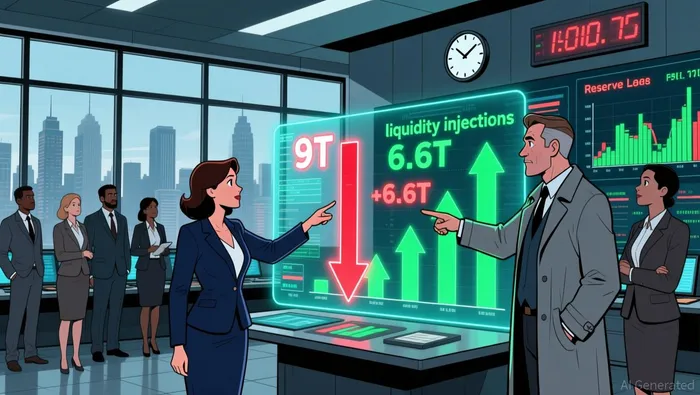 Williams emphasized that the Fed's securities holdings, which have dwindled from a pandemic-era peak of $9 trillion to $6.6 trillion, are now "somewhat above ample" in reserves, prompting discussions about reinjecting liquidity into financial markets Fed’s Williams says central bank may soon need to grow balance sheet. This comes amid recent volatility in short-term lending markets, where overnight interest rates briefly exceeded the Fed's target range, underscoring the need for a recalibrated approach Fed's Williams: Fed may soon need to expand balance sheet for liquidity needs.
The Fed's decision to pause QT in December, announced last week, reflects its assessment that current reserve levels are sufficient to stabilize money markets while avoiding excessive accommodation. Williams noted that the three-year effort to shrink the balance sheet "has worked according to plan," but stressed the importance of monitoring evolving market conditions to determine when reserves might dip to "ample" levels Fed’s Williams says central bank may soon need to grow balance sheet. Analysts suggest this threshold could trigger a return to bond purchases as early as the first quarter of 2026, though the timing remains uncertain. Crucially, such actions would not signal a shift in monetary policy but rather a continuation of the Fed's "ample reserves" strategy to manage liquidity amid growing liabilities like currency issuance Fed's Williams: Fed may soon need to expand balance sheet for liquidity needs.
Meanwhile, Federal Reserve Governor Loretta Mester has tempered expectations for aggressive rate cuts in December, cautioning that the economy is poised for a rebound in early 2026. Mester highlighted factors such as fiscal support, regulatory easing, and the lagged effects of previous rate hikes as key drivers of this outlook. However, she warned that further rate cuts could risk overstimulating the economy, particularly as inflation remains above the Fed's 2% target. Her comments align with broader skepticism among policymakers, who have signaled a preference for a measured approach to easing policy Fed Official Mester Signals Cautious Approach to December Rate Cuts as US Economy Poised for Early Next Year Rebound.
The Fed's balancing act is further complicated by external factors, including geopolitical risks and market uncertainties. For instance, the recent U.S. government shutdown disrupted economic data releases, adding ambiguity to the Fed's decision-making calculus. Analysts at First Abu Dhabi Bank noted that such disruptions could lead the Fed to delay rate cuts in December to preserve policy credibility Analysis: US Government Shutdown Causing Uncertainty, Fed May Pause Rate Cuts in December. Additionally, the growing demand for dollar-pegged stablecoins-a phenomenon highlighted by Fed Governor Stephen Miran-could indirectly influence interest rates by increasing competition for U.S. Treasury assets Stablecoin demand is growing, and it can push down interest rates: Fed’s Miran.
Market reactions to these developments have been mixed. While the Fed's pause in QT has provided some relief to money markets, crypto assets have experienced sharp outflows, with BitcoinBTC-- and EthereumETH-- products losing $932 million and $438 million, respectively, in the latest week. This trend reflects broader risk-off sentiment amid macroeconomic uncertainties, though SolanaSOL-- and XRPXRP-- have bucked the trend with modest inflows Crypto Funds Bleed $1.2 Billion Amid US Weakness, Except Solana and XRP.
As the Fed prepares for its upcoming policy meetings, the focus will remain on its ability to navigate these multifaceted challenges without undermining its dual mandate of price stability and maximum employment. The path forward hinges on real-time assessments of reserve demand, market volatility, and the evolving economic landscape.

Stay ahead of the market.
Get curated U.S. market news, insights and key dates delivered to your inbox.






Comments
No comments yet