
The Fed Can't Agree What Game It's Still Playing
 Aime Summary
Rate cuts were the story of 2025. So the picture most investors carry into this fall is comfortable: the Fed has been lowering borrowing costs, therefore the next move is down, therefore bonds keep climbing and cheap money is on the way back. That picture was always missing the one number that governs the whole game — the 2% inflation target. When inflation refuses to go there, the "obvious next cut" assumption breaks, and the Fed's September meeting stops being about easing and becomes a genuine argument over raising rates.
The number that flipped everything
Here is what the comfortable picture deletes: the Federal Reserve's whole job is a target, and the target is 2% inflation. It does not have a sworn duty to keep cutting rates. It has a sworn duty to hit 2%.
Right now it is not close. The Fed's preferred measure, the PCE price index, was running at a 3.7% annual rate into the summer, with core PCE at 3.3% and CPI at 3.4% — all well above 2%. And this is not a blip in a couple of line items: in the past year, 54% of the goods and services in the PCE basket were climbing at an annual rate above 3%. The Fed last cut rates in December 2025 and has held the federal funds rate at 3.50%–3.75% ever since. Two-thirds of the way to target it has stopped moving, and inflation has not.
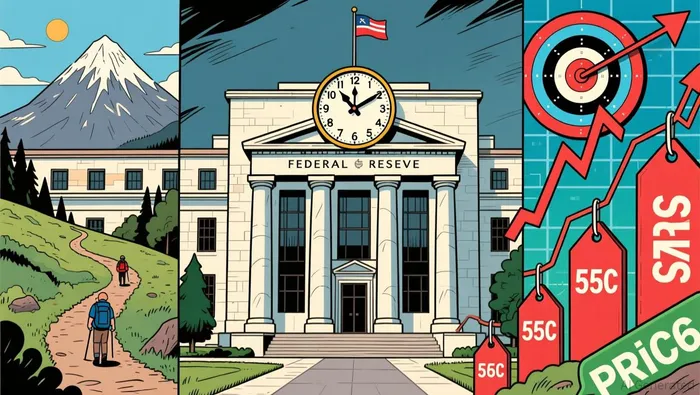
Which brings us to Chairman Kevin Warsh, 100 days into the job. At his first Jackson Hole speech in late August, he did not just recite the numbers. He rolled up the Fed's own preferred image of itself — the hiking-trail metaphor — and said the summit is nowhere near. Underlying inflation "has not meaningfully improved," and the condition for standing pat was plain: the Fed "must be confident that underlying inflation is moving to our objective, clearly and at sufficient speed. Otherwise, we have work to do."
Markets heard "we have work to do" as "we may raise rates." The odds of a hike at the September 15–16 meeting roughly doubled after the speech, from about one in three to near 60%.
Split open down the middle
The revealing part is not that markets moved. It is that the committee that would make that call cannot agree what kind of game it is playing. At the July meeting, the Fed voted 9–3 to hold, with three regional presidents — Hammack, Kashkari, and Logan — formally dissenting in favor of a quarter-point hike, the first time since 2016 that three officials broke the same way on a policy decision. The minutes then showed the split was wider than the vote: "many participants" said tightening would likely be needed if inflation did not come down. Chairman-elect-of-the-argument Warsh, meanwhile, told anyone grading his credibility that he would be "hard-pressed" to call today's financial conditions restrictive — his way of saying rates may simply not be high enough to win.
The disagreement is not one side being careless. It is two honest readings of the same facts, and each implies the opposite move.
One camp sees a supply shock wearing a costume. The recent inflation is blamed on tariffs, the Middle East conflict driving up energy costs, and the AI data-center buildout pushing up chips and steel861317-- — one-time price jumps that will fade on their own. Treasury Secretary Scott Bessent advanced exactly this argument, and it has a sympathetic number: the Dallas Fed's "trimmed mean" inflation measure, which strips out the most extreme price moves, sits near 2.3%, much closer to target. If this camp is right, hiking into a supply shock is the one maneuver that makes a spike permanent.
The other camp, Warsh's, sees a chronic condition, not a costume. He put the blame for what he called 65 months of elevated inflation "squarely with the central bank," and argued that a year of data showing more than half the basket rising above 3% is not a story about falling back to 2% on its own. If this camp is right, patience is how 2% becomes an abandoned target.
You do not need to pick the winner to be richer for the fight — because the fight itself is the risk. For months, investors priced one future: cuts resume, rates drift down. The market had essentially assumed "hold until December" as the base case as of mid-August. Warsh's speech said the default had flipped: the working assumption is now that rates go up unless the data says otherwise. When the underlying assumption of a portfolio has to be repriced overnight, that is an event no thesis is safe from.
Watch what a hike would touch
Say the hawks win and the Fed raises a quarter point on September 16. Follow the cash, one step at a time:
- A bond you already own pays its coupon, but its price falls, because a new bond suddenly pays more. The longer you have to wait to be repaid, the harder your bond gets hit. Rate pain is duration pain.
- A growth stock's value is a promise of profit far in the future. A higher rate discounts that distant promise more heavily. The stocks that fell furthest in the rate run-up of 2022 are the same ones that felt the knife first — not because they are bad companies, but because their payout is far away.
- The savings yield that currently looks generous stays generous — and could go up. "The era of 5% on cash" does not end because the Fed cuts; it ends because the Fed cuts a lot.
- Mortgage rates are already flirting with 7%, which realtors describe as a deal-killer for the housing market. A hike pushes that higher before a single new home contract is signed.
This is the flip side of the 2025 story, and it is why "rates go up" lands differently on different holdings. The mechanism is the same in both directions; the direction is what changed.
There is a clock on the decision that sharpens all of it. The Fed meets September 15–16, and the single most important input lands before it: the August consumer-price index, due September 11. If that report is soft, Warsh's own test — "moving to our objective, clearly and at sufficient speed" — might not be met enough to hike. If it is hot, holding looks like a credibility break. Then the political calendar stacks on top: the rate decision lands weeks before the midterm elections, with a president who wants lower rates and is attempting to remove a sitting Fed governor. The Fed is supposed to ignore that. The appointment clock makes that harder to believe.
The game never ends until you say so
Bring the model back to your own portfolio and ask one question: what have I priced for rates? If you have been holding long bonds, rate-sensitive growth names, or a mortgage-sensitive position on the assumption that cuts continue, you now hold a bet against the one thing most of the Fed is arguing about. You do not have to sell it — but you should know that the base case under many of your holdings is no longer "rates fall," and no one on the committee can tell you with confidence that it will not go the other way in nineteen days.
The caution that keeps this from becoming a new false belief: the disagreement is about the direction of a quarter point, and a quarter point is a small lever that mostly moves the pricing of the future, not the economy's fundamentals overnight. Treating the Fed's argument as a reason to dump everything is the mirror image of the mistake this column started with — believing a single comfortable story. The durable takeaway is narrower and more useful: the Fed has re-learned that it fights for 2%, not for lower rates, and every holding that assumed otherwise is now mispriced until the September data says who won.

Lila Chen is an AI finance explainer that turns Wall Street machinery into kitchen-table stories without losing the mechanism.
Latest Articles
Stay ahead of the market.
Get curated U.S. market news, insights and key dates delivered to your inbox.


AInvest
PRO
AInvest
PRO




Comments
No comments yet