
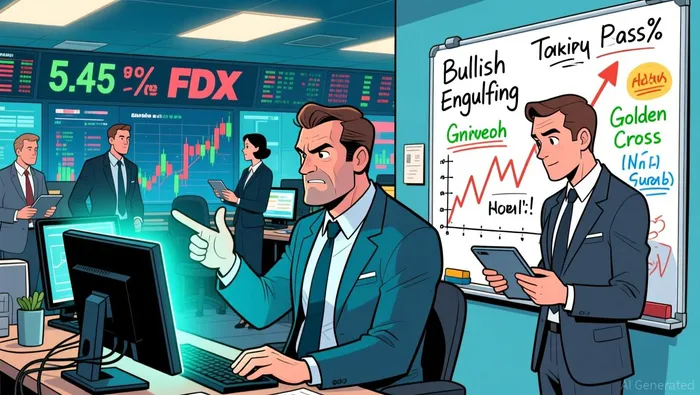
FDX Gains 5.45% as Bullish Engulfing and Golden Cross Signal Reversal Potential
 Aime Summary
FedEx (FDX) Technical Analysis
Federal Express (FDX) closed the most recent session with a 5.45% gain, pushing its price to $267.72. This sharp rally suggests short-term bullish momentumMMT--, warranting a deeper examination of technical indicators to assess the sustainability of the move and potential future price action.
Candlestick Theory
The recent price action reveals a bullish engulfing pattern on the daily chart, as the prior session’s bearish candle was completely consumed by the subsequent bullish candle. This formation, coupled with a long upper shadow on the preceding bearish session, indicates a potential reversal of the downtrend. Key support levels are identified at $251.88 (October 4 close) and $241.15 (October 24 close), while resistance is clustered around $262.09 (October 7 high) and $270.315 (November 11 high). A breakdown below $251.88 could trigger a test of the $238.17 (October 23 low) level, whereas a sustained close above $267.72 would invalidate the immediate resistance and signal a broader uptrend.
Moving Average Theory
The 50-day moving average (approximately $244.61) is currently below the 200-day average ($247.03), indicating a bearish bias in the longer term. However, the 10-day MA ($256.10) and 20-day MA ($253.82) have crossed above both the 50-day and 200-day averages, forming a "death cross" reversal into a potential "golden cross" scenario. This suggests that while the long-term trend remains bearish, short-term momentum is shifting upward. Traders should monitor the 200-day MA as a critical threshold; a break above $247.03 would strengthen the case for a broader bullish trend.
MACD & KDJ Indicators
The MACD line (12, 26, 9) has recently crossed above the signal line, with the histogram showing expanding positive divergence, reinforcing the bullish momentum. The KDJ stochastic oscillator, with K at 88.7 and D at 82.3, suggests the price is approaching overbought territory. However, the K line has yet to cross above D, indicating potential for a short-term pullback before further upside. A divergence between the KDJ and price action—such as a lower high in K despite a higher price—could signal an impending correction.
Bollinger Bands
Volatility has expanded in recent sessions, with the upper band reaching $270.315 and the lower band at $254.00. The current price of $267.72 is near the upper band, suggesting overbought conditions and a possible reversion toward the 20-day MA. A break above the upper band would validate a new bullish trend, while a drop below the middle band ($259.37) would indicate renewed bearish pressure.
Volume-Price Relationship
Trading volume surged to 3.5 million shares on the most recent bullish session, confirming the strength of the price move. However, volume has been inconsistent over the past week, with mixed signals on days like October 31 (1.68 million) and November 4 (1.60 million). This suggests that while institutional buying is evident, retail participation remains fragmented. A sustained increase in volume above 3 million shares per session would provide stronger validation for the bullish trend.
Relative Strength Index (RSI)
The 14-day RSI stands at 68.4, approaching overbought territory. While this does not necessarily signal a reversal, it highlights the need for caution. Historical data from October 31 to November 11 shows RSI peaking near 70 followed by a pullback, suggesting a potential correction is likely. Traders should watch for RSI to dip below 50 as a bearish confirmation or rise above 70 as a continuation signal.
Fibonacci Retracement
Key Fibonacci levels derived from the recent high ($270.315) and low ($238.17) include 23.6% at $261.31 and 38.2% at $256.87. The current price of $267.72 is approaching the 50% retracement level ($254.24), which could act as a dynamic resistance. A break above this level would target the 61.8% level ($247.98), whereas a failure to hold above $256.87 could lead to a retest of the 38.2% level.
Backtest Hypothesis
The backtest strategy based on RSI overbought conditions (70 threshold) from 2022 to present reveals mixed efficacy. While short-term trades (3-day and 10-day) show win rates of 50.45% and 47.75%, the 30-day win rate drops to 36.04%, with maximum returns of only -0.32%. This suggests that RSI overbought signals are more reliable for intraday or swing trading rather than long-term holding. Integrating this with the current analysis, a buy signal on the RSI crossing above 70 would align with the bullish engulfing pattern but must be validated by volume and MACD confirmation. A stop-loss below $251.88 (key support) would mitigate risks in this volatile environment.

If I have seen further, it is by standing on the shoulders of giants.
Latest Articles
Stay ahead of the market.
Get curated U.S. market news, insights and key dates delivered to your inbox.
AInvest
PRO
AInvest
PRO



Comments
No comments yet