
FDV's Paradox: Measuring Potential While Masking Peril


 Aime Summary
FDV (Fully Diluted Valuation) has emerged as a critical metric in 2025 for assessing the long-term potential and risks of crypto projects, particularly as new layer-1 blockchains like Monad and Apertum launch with ambitious tokenomics. FDV represents the theoretical market capitalization of a cryptocurrency if all its tokens-circulating and locked-were in circulation at the current price. This metric helps investors gauge dilution risks and project scalability, but it also highlights structural vulnerabilities in token economics according to analysis.
The recent launch of Monad's mainnet underscores FDV's relevance. On November 24, 2025, Monad's native token MON debuted with a fully diluted valuation (FDV) of $3.9 billion, despite only 10–12% of its 100 billion token supply being unlocked. Early volatility saw the price dip to $0.025 ($2.5 billion FDV) before rebounding to $0.039. The token's performance was supported by a 3.3% airdrop allocation and a $269 million public sale, which created a stable holder base and absorbed selling pressure according to Decrypt. This contrasts with 2025's broader crypto market, where many airdrop tokens collapsed due to uncontrolled dumping by short-term speculators as reported.
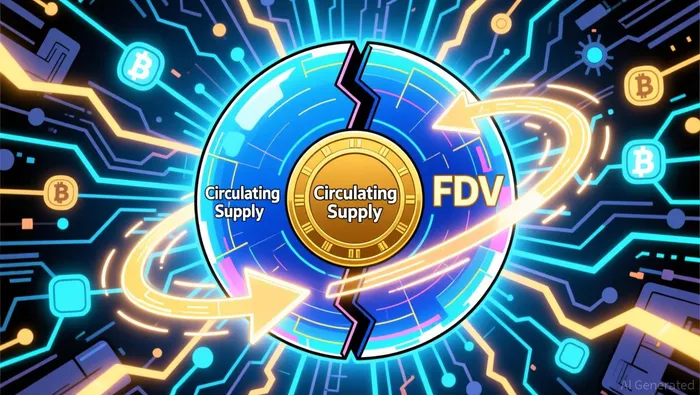 FDV's significance lies in its ability to reveal hidden risks. For example, MON's high FDV relative to its low circulating supply (3.3% airdrop + 7.5% public sale) creates a "low float, high FDV" scenario. Only 12% of tokens are tradable, while 50.6% remain locked until 2029. This structure incentivizes early buyers to hold, but it also means future unlocks could trigger selling pressure according to analysis. Similarly, Apertum (APTM), a layer-1 blockchain on AvalancheAVAX--, has an FDV of $312 million (BTC312.1149) despite a current market cap of $298 million (BTC297.9512). This 1.05x ratio suggests minimal dilution risk, as 98% of APTM's 2.1 billion max supply is already in circulation according to CoinGecko.
However, FDV is not without limitations. It assumes the token price remains constant as new tokens unlock, which rarely happens in practice. For instance, Arthur Hayes, a prominent crypto trader, noted that MON's rally relies on speculative momentum rather than intrinsic fundamentals. "It's a bull market bitches!" he tweeted, acknowledging the token's low float and high FDV as both a strength and a risk according to analysis. Additionally, FDV becomes meaningless for projects with uncapped supply, like EthereumETH--, where inflationary mechanisms complicate valuation as explained.
Investors must also consider the FDV-to-market cap ratio. A ratio below 0.5 (e.g., 1:5) signals significant future dilution, while ratios above 0.8 (e.g., 4:5) indicate stability. Monad's current ratio is around 0.8 (market cap of $3 billion vs. FDV of $3.9 billion), suggesting moderate risk. In contrast, projects with ratios exceeding 10x, such as many 2025 altcoins, face severe price compression as locked tokens unlock according to analysis.
The future of FDV as a metric depends on how projects manage token distribution. Monad's $1.15 billion ecosystem budget (38.5% of total supply) aims to attract developers and users, potentially justifying its high FDV. Meanwhile, Apertum's deflationary model-burning transaction fees to reduce supply-could align FDV with long-term value retention according to CoinGecko.
As the crypto market matures, FDV will remain a key tool for evaluating projects, but it must be paired with on-chain metrics like TVL (Total Value Locked) and transaction volume. For Monad, the next 18 months will test whether its early adoption can translate into sustainable TVL growth and developer activity. For investors, the lesson is clear: FDV is a warning light, not a crystal ball.

Stay ahead of the market.
Get curated U.S. market news, insights and key dates delivered to your inbox.






Comments
No comments yet