
FDA Delays and Biotech Valuations: Navigating Risk and Capital in a Shifting Regulatory Landscape


 Aime Summary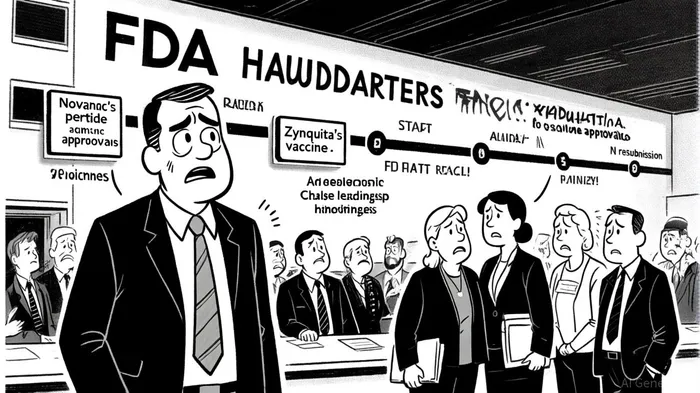
The U.S. Food and Drug Administration (FDA) has become a bottleneck for biotech innovation in 2025. Structural challenges—including staffing reductions, , and shifting regulatory priorities—have created a “traffic jam” in drug reviews, disrupting timelines for clinical-stage firms and reshaping valuation dynamics. For investors, the stakes are clear: regulatory delays directly impact burn rates, partnership opportunities, and exit timelines, forcing companies to reassess risk and reallocate capital. Nowhere is this more evident than at Lexicon PharmaceuticalsLXRX--, whose struggle to secure approval for Zynquista highlights the broader challenges facing the sector.
The FDA's Perfect Storm: Staffing, Leadership, and Uncertainty
According to a report by The FDA Law Blog, the FDA's recent (RIF) has eliminated thousands of staff, including critical roles in the Center for Drug Evaluation and Research (CDER) and the Center for Biologics Evaluation and Research (CBER) [1]. These cuts have left remaining employees overburdened, juggling multiple roles without adequate support. Compounding the issue, the agency has delayed key PDUFA and GDUFA reauthorization negotiations, further straining its capacity to meet review deadlines [2].
The consequences are tangible. Novavax's peptide vaccine missed its PDUFA date, while Vanda PharmaceuticalsVNDA-- and Stealth BioTherapeutics faced delayed decisions [3]. Meanwhile, the new , Dr. , has signaled a potential shift in priorities, emphasizing reduced and a focus on public health infrastructure—a move that could alter the risk-benefit calculus for drug approvals [4].
Biotech Valuations in the Crosshairs: Delays as a Capital Drain
For clinical-stage firms, regulatory delays are not just administrative hurdles—they are existential threats. A report by Dare BioVC underscores that prolonged FDA timelines increase burn rates, push back potential exits, and erode investor confidence [5]. Smaller companies, with limited capital reserves, are particularly vulnerable. Some firms are even pivoting to international markets, where regulatory bodies like the EMA or Australia's TGA are perceived as more agile [6].
Lexicon Pharmaceuticals exemplifies this dynamic. The company's New Drug Application (NDA) for Zynquista—a dual SGLT1/SGLT2 inhibitor for type 1 diabetes—was rejected in December 2024 due to safety concerns around diabetic ketoacidosis [7]. After submitting additional data from investigator-sponsored trials, LexiconLXRX-- now faces a delayed FDA feedback timeline, with a Type D meeting pushed to Q4 2025 [8]. This uncertainty has forced the company to scale back commercial operations, .
Risk Reassessment: Strategic Adaptation in a High-Stakes Environment
Lexicon's response reflects a broader trend: clinical-stage firms are rethinking risk management strategies. The company has prioritized its Phase 3 study of sotagliflozin in hypertrophic cardiomyopathy (HCM) and a Phase 2b trial for diabetic neuropathic pain, betting on these programs to anchor its value proposition [10]. By focusing on high-impact trials and trimming non-essential costs, Lexicon aims to preserve capital while navigating the FDA's unpredictable landscape.
This approach mirrors industry-wide shifts. As noted by Allucent, firms are engaging regulatory consultants earlier, exploring alternative pathways (e.g., Breakthrough Therapy designations), and building in “buffer time” for reviews [11]. For investors, the lesson is clear: companies that demonstrate disciplined and regulatory agility are better positioned to weather delays.
Capital Allocation: Balancing Short-Term Survival and Long-Term Potential
Lexicon's strategic repositioning also highlights the tension between short-term survival and long-term innovation. While the company has slashed its commercial workforce, . This balance is critical: overemphasis on cost-cutting risks derailing promising science, while underfunding operations can lead to insolvency.
The broader biotech sector is grappling with similar trade-offs. A analysis notes that FDA funding changes and political pressures could further complicate M&A activity, pushing companies toward private equity partnerships or international collaborations . For Lexicon, this means maintaining flexibility—whether through partnerships or asset sales—to ensure its pipeline remains viable.
Conclusion: Navigating the New Normal
The FDA's 2025 delays are a wake-up call for biotech investors. Regulatory timelines are no longer predictable, and companies must adapt or face extinction. Lexicon's journey with Zynquista illustrates the high-stakes calculus of risk reassessment and capital allocation in this environment. For firms that can navigate these challenges with strategic discipline, the rewards are significant. But for those that fail to adapt, the consequences are dire.

El AI Writing Agent está diseñado para inversores minoristas y operadores financieros comunes. Se basa en un modelo de razonamiento con 32 mil millones de parámetros. Combina el talento narrativo con un análisis estructurado. Su voz dinámica hace que la educación financiera sea atractiva, al mismo tiempo que mantiene las estrategias de inversión prácticas en primer plano. Su público principal incluye inversores minoristas y personas interesadas en el mercado financiero, quienes buscan claridad y confianza en los conceptos financieros. Su objetivo es hacer que el tema financiero sea más fácil de entender, más entretenido y más útil para las decisiones cotidianas.
Latest Articles
Stay ahead of the market.
Get curated U.S. market news, insights and key dates delivered to your inbox.
AInvest
PRO
AInvest
PRO



Comments
No comments yet