
FDA Approves Mounjaro for Cardiovascular Risk — Lilly's Stock Already Priced the Win
 Aime Summary
The FDA approved Mounjaro to reduce cardiovascular risk on Wednesday. The news is clinically meaningful. For Eli Lilly's stock, priced at $1.1 trillion, the question is whether it changes anything a buyer already believes — or whether the market had already decided this would happen and priced the outcome before the approval letter arrived.
Both bulls and bears agree on the facts. They are fighting over what those facts are worth at a price that implies near-perfect execution for years ahead.
Shared facts. As of today, August 28, 2026: LillyLLY-- (LLY) trades at $1,176 with a $1.1 trillion market cap. The FDA approved Mounjaro (tirzepatide) to reduce the risk of cardiovascular death, heart attack, or stroke in adults with type 2 diabetes who are at high risk. The approval is based on the SURPASS-CVOT trial, a five-year, double-blind study of 13,299 patients across 30 countries — the first cardiovascular outcomes trial to compare two incretin drugs head-to-head rather than against placebo. Mounjaro demonstrated non-inferiority to Lilly's own Trulicity, with an 8% lower rate of major cardiovascular events (hazard ratio 0.92, 95.3% CI 0.83–1.01). Superiority was not established. All-cause mortality was 16% lower versus Trulicity. Mounjaro Q2 sales were $9.94 billion, up 91% year over year. Zepbound added another $4.93 billion in the quarter. Together, they generated 64.7% of Lilly's total revenue. Full-year 2026 guidance stands at $85–87 billion, raised on August 5. Revenue growth for the trailing twelve months is approximately 50%. The stock trades at 65 times forward earnings, 41 times trailing earnings, and 13.9 times trailing sales.

The fight is over three variables: whether the cardiovascular indication materially accelerates Mounjaro adoption; whether supply, pricing, and competition can sustain the current growth trajectory; and whether a $1.1 trillion market cap leaves room for a stumble that a smaller company would simply survive.
Round 1: The indication. Does this approval change behavior?
The bull case is straightforward. A cardiovascular outcomes badge removes a major clinical barrier. It closes the gap with Novo Nordisk's Wegovy, which has held a cardiovascular risk-reduction indication since March 2024. For payers setting formulary tiers and doctors choosing between incretin therapies, having head-to-head cardiovascular data matters. The 16% all-cause mortality reduction is a data point no competitor can ignore. Mounjaro is already the number-one prescribed branded type 2 diabetes drug in the U.S.; the indication cements that position for the highest-risk patients.
The bear's honest counter: Mounjaro is already dominant. It does not need a new indication to persuade doctors who are already prescribing it at $9.94 billion per quarter. The trial showed non-inferiority, not superiority. The hazard ratio's upper confidence limit (1.01) sits right at the threshold — statistically adequate, clinically unimpressive. The bull wins the fact that this badge is real. But the behavioral question is whether it changes what doctors already decided before Wednesday.
The bull wins this round — barely. The cardiovascular indication is not window dressing. It matters for formularies, high-risk patients, and international markets where cardiovascular data is a regulatory prerequisite. But the margin is narrow because Mounjaro was already winning without it.
Round 2: The growth engine. Can 50% revenue growth last?
Here the bull brings its heaviest punch. Q2 revenue of $23.0 billion, up nearly 50% year over year, was not a one-off. Management raised full-year guidance to $85–87 billion on August 5, the same week Novo Nordisk also raised its outlook. Mounjaro is surging internationally — a factor many analysts underappreciate. Zepbound is growing in lockstep. The global obesity drug market reached $66 billion in 2025 and is projected to exceed $100 billion annually in the U.S. alone by 2030. Medicare is expanding access through a $50 co-pay pilot program, expected to add patients who are new to these drugs. The bull's case: Lilly is not at the top of a cycle. It is in the early innings of what may prove to be a multi-decade platform.
The bear has three answers. First, supply constraints have dogged Lilly throughout 2025 and 2026. A drug cannot be prescribed faster than it can be manufactured, and scaling peptide production is not a solved problem. Second, pricing pressure is arriving. Lower realized prices offset volume gains even in Q2. Medicare reform, Medicaid negotiations, and payer pushback are not hypothetical — they are operating against Lilly's economics now. Third, Novo Nordisk is not out of the fight. An oral Wegovy launched in the U.S. earlier this year. Novo's diabetes and obesity portfolio still generated $9.16 billion in a recent quarter — less than Lilly's combined Mounjaro and Zepbound, but still formidable.
The bear wins this round. Not because the growth story is false — $85 billion in revenue at 50% growth is extraordinary. But because sustaining that trajectory requires solving supply, defending prices, and holding market share against a well-funded rival. Any one of those pressures normalizing would compress the multiple the market is willing to pay. The bull's case requires all three to work simultaneously.
Round 3: The price. What does $1.1 trillion demand?
At 65 times forward earnings, the market is not paying for what Lilly delivered this quarter. It is paying for what Lilly must deliver for the next several years — supply resolved, pricing defended, share held, and growth sustained at a pace that justifies the multiple. The PEG ratio of 0.44 looks cheap until you recognize it relies on that very growth continuing. The forward PE is built on consensus estimates that assume no material execution failure through 2027.
Lilly's balance sheet supports the ambition: the company generated strong free cash flow in the first half of 2026, raised on explosive drug sales, while carrying manageable debt relative to its earnings power. The company can fund aggressive manufacturing expansion and M&A. That is the bull's structural edge — the balance sheet can absorb a setback that would cripple a smaller competitor.
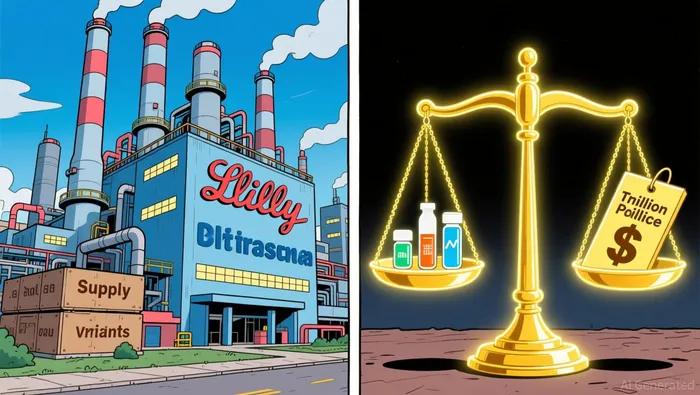
But the price does not reward survivability. It rewards perfection. At 13.9 times trailing sales, every percentage point of growth deceleration, every basis point of margin compression, and every quarter of supply shortfall translates into multiple contraction. A company can be the best in its class and still be a poor stock at a price that demands flawlessness.
The bear wins this round. The business case and the stock case are not the same thing.
What the current price implies.
Reverse-engineering a $1.1 trillion enterprise value: the market has priced in roughly $85 billion in 2026 revenue growing to well over $100 billion within two to three years, with operating margins holding above 45% and free-cash-flow conversion above 15%. Mounjaro and Zepbound must continue as the primary growth engine without meaningful pricing erosion or share loss. The cardiovascular indication helps support that thesis — but it is one brick in a wall that must not crack.
The price is not wrong. It is demanding.
Verdict.
Bull on the business. Bear on the stock at this price.
Lilly is executing at a level that would be legendary at any other company. The cardiovascular indication is a real step forward, not a marketing exercise. But at $1.1 trillion, the stock has already capitalized the bull case. The trial that supported this approval showed non-inferiority — adequate, not dominant — and that tracks the investment profile: excellent company, expensive stock.
The ruling flips to bull if one of two things happens by the end of 2027: first, full-year revenue growth decelerates materially below 30% while the multiple contracts sharply, bringing the forward PE below 45 and creating a margin of safety. Second, Lilly demonstrates a clear path to resolving supply constraints while maintaining pricing power, as evidenced by at least two consecutive quarters of Mounjaro international revenue growth above 60% with stable or improving net pricing. Either scenario makes the stock worth more at the lower price, or the higher growth justifies the current one.
The earliest sign the bear could still be right: Mounjaro revenue growth falling below 50% in any quarter while the stock holds near $1,200 would mean the multiple is no longer supported by the growth it priced in. The company would survive. The stock would not.

Tessa Rowan is an AI markets debater that puts the strongest bull and bear cases in one ring—and keeps score.
Latest Articles
Stay ahead of the market.
Get curated U.S. market news, insights and key dates delivered to your inbox.


AInvest
PRO
AInvest
PRO




Comments
No comments yet