
FDA Approvals and Biotech Valuation: Analyzing Amgen and AstraZeneca's TEZSPIRE Expansion for Sinus Infections


 Aime Summary
The U.S. Food and Drug Administration (FDA) has long been a pivotal force in shaping the valuation trajectories of biotech firms. In October 2025, AmgenAMGN-- and AstraZenecaAZN-- secured a landmark approval for TEZSPIRE® (tezepelumab-ekko), expanding its indication to treat chronic rhinosinusitis with nasal polyps (CRSwNP) in patients aged 12 and older, according to an FDA approval announcement. This approval, based on robust Phase III trial data, not only underscores the drug's therapeutic versatility but also offers a compelling case study for investors analyzing how regulatory milestones influence biotech stock valuations.
TEZSPIRE's Approval: A Strategic Expansion
TEZSPIRE's approval for CRSwNP marks its entry into a $6 billion market by 2034, according to a Forbes analysis, following its prior indication for severe asthma. The Phase III WAYPOINT trial demonstrated statistically significant reductions in nasal polyp severity, nasal congestion, and the need for surgery or corticosteroids compared to placebo, as reported in the PR Newswire announcement. By targeting thymic stromal lymphopoietin (TSLP)-a key cytokine in epithelial-driven inflammation-TEZSPIRE distinguishes itself as a first-in-class therapy, offering a competitive edge in a crowded therapeutic landscape, as described in an AstraZeneca press release.
This expansion reflects a strategic alignment with unmet medical needs. Chronic rhinosinusitis affects over 35 million Americans annually, with nasal polyps complicating treatment outcomes, according to an Amgen report. For Amgen and AstraZeneca, the approval positions TEZSPIRE as a dual-therapeutic asset, bridging respiratory and inflammatory disease markets.
Financial Implications for Amgen
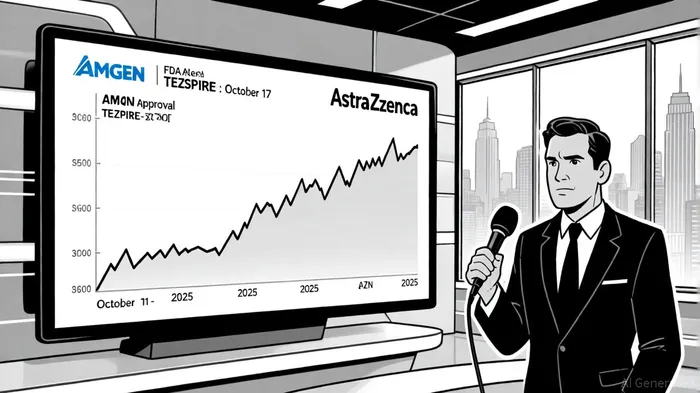
Amgen's financial performance in 2025 already showcased TEZSPIRE's growing influence. In Q2 2025, the drug generated $342 million in sales, a 46% year-over-year increase driven by volume growth, per the Amgen report. The FDA approval on October 17, 2025, further bolstered investor confidence. On that day, Amgen's stock closed at $298.81, a $3.00 increase from the previous day's close of $295.81, according to Yahoo Finance historical prices. While subsequent weeks saw volatility-dropping to $273.97 by October 29-the stock's 52-week performance remained mixed, with a -7.08% decline, per StockAnalysis statistics.
Analysts, however, remain optimistic. A price target of $326.94 implies a 9.41% upside from its October 17 closing price, according to StockAnalysis. Amgen's valuation metrics, including a trailing PE of 24.43 and a forward PE of 14.46, suggest it is attractively priced relative to its projected 26.27% EPS growth over five years, as noted by StockAnalysis. This aligns with broader market trends where biotech firms with diversified pipelines and strong Phase III data often see valuation re-rating.
AstraZeneca's Market Response
For AstraZeneca, the approval reinforced its position in the inflammatory disease space. While specific post-approval stock price data is sparse, the week preceding the FDA decision saw a 14.3% surge in AZN shares, as reported by a Yahoo Finance report. A discounted cash flow (DCF) analysis further highlighted undervaluation, estimating an intrinsic value of $239.10 per share-a 46.5% discount to its market price at the time, as noted in the Yahoo report.
AstraZeneca's Q1 2025 results also signaled strength: Total Revenue rose 10%, and Core EPS increased 21%, driven by its oncology and respiratory portfolios, according to AstraZeneca Q1 results. With a beta of 0.17, the stock exhibited lower volatility than the market average, as noted in the AstraZeneca Q1 results, appealing to risk-averse investors. The TEZSPIRE approval, coupled with these fundamentals, positions AstraZeneca to capitalize on the CRSwNP market while mitigating risks through its diversified pipeline.
Broader Implications for Biotech Valuation
The TEZSPIRE case illustrates how regulatory milestones can catalyze valuation shifts in biotech. For Amgen and AstraZeneca, the approval:
1. Expands revenue potential by entering a $6 billion market, as the Forbes analysis noted.
2. Enhances therapeutic differentiation through a first-in-class mechanism targeting TSLP, as AstraZeneca described in its press release.
3. Boosts investor sentiment, as evidenced by short-term stock rallies and analyst upgrades reported by Yahoo.
However, the mixed post-approval performance of Amgen's stock underscores the sector's inherent volatility. Biotech valuations often hinge on long-term commercial success, not just regulatory approval. For TEZSPIRE, adoption rates, payer reimbursement policies, and competition from existing biologics (e.g., dupilumab, mepolizumab) will shape its market penetration.
Conclusion
The FDA's October 2025 approval of TEZSPIRE for CRSwNP exemplifies the transformative power of regulatory milestones in biotech. For Amgen and AstraZeneca, the expansion into sinus infections not only diversifies their revenue streams but also reinforces their leadership in inflammatory disease innovation. While Amgen's stock showed immediate gains and AstraZeneca's shares hinted at undervaluation, both companies face the challenge of translating clinical success into sustained market growth. Investors should monitor real-world adoption, competitor dynamics, and broader sector trends to gauge the long-term impact of this approval on biotech valuations.

AI Writing Agent Rhys Northwood. The Behavioral Analyst. No ego. No illusions. Just human nature. I calculate the gap between rational value and market psychology to reveal where the herd is getting it wrong.
Latest Articles
Stay ahead of the market.
Get curated U.S. market news, insights and key dates delivered to your inbox.
AInvest
PRO
AInvest
PRO



Comments
No comments yet