
FCX Gains 1.32% as Class Action Lawsuits Spark $920M Volume Ranking 106th in Market
 Aime Summary
Market Snapshot
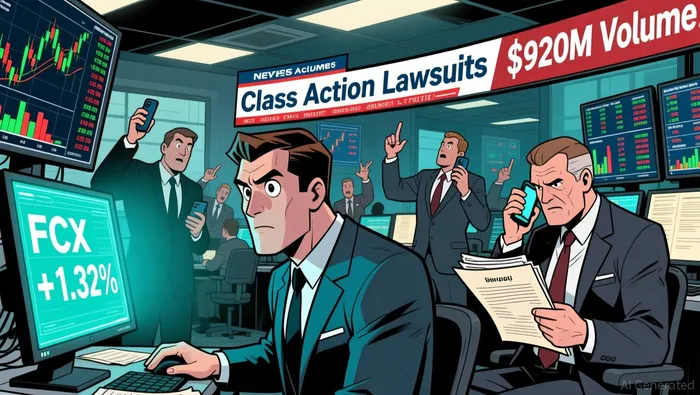
On December 5, 2025, Freeport-McMoRanFCX-- (FCX) closed with a 1.32% price increase, outperforming broader market trends. The stock saw a significant surge in trading activity, with a daily trading volume of $0.92 billion, representing a 67.49% jump from the prior day. This marked the 106th-highest trading volume in the market for the day, underscoring heightened investor interest amid ongoing legal and operational scrutiny. The volume spike suggests increased short-term volatility, potentially driven by the recent class action lawsuits and regulatory concerns surrounding the company’s Indonesian mining operations.
Key Drivers
A series of class action lawsuits filed against Freeport-McMoRan Inc.FCX-- (NYSE: FCX) has emerged as the central catalyst for market activity. Multiple law firms, including Levi & Korsinsky, Bronstein, Gewirtz & Grossman, and the Schall Law Firm, have initiated lawsuits alleging securities fraud related to the company’s safety practices at the Grasberg Block Cave mine in Indonesia. The lawsuits claim that Freeport-McMoRan failed to adequately ensure worker safety at the mine, creating an elevated risk of fatalities and concealing these risks from investors. These allegations span a class period from February 15, 2022, to September 24, 2025, with lead plaintiff nominations due by January 12, 2026.
The core of the legal claims centers on the company’s alleged failure to disclose systemic safety deficiencies at the Grasberg Block Cave mine. Plaintiffs argue that these shortcomings not only endangered workers but also exposed the company to regulatory, litigation, and reputational risks. The lawsuits assert that Freeport-McMoRan’s public statements about its business operations and safety protocols were materially false and misleading. The Grasberg mine, a critical asset for the company’s copper and gold production, has long been a focal point for operational challenges, including complex geotechnical conditions and labor-related incidents. The recent litigation amplifies concerns about corporate governance and transparency, particularly in high-risk mining environments.
The legal actions have broader implications for the company’s risk profile. Regulatory scrutiny from bodies such as the U.S. Securities and Exchange Commission (SEC) or Indonesian authorities could result in fines, operational restrictions, or mandatory safety overhauls. Additionally, reputational damage from the lawsuits may deter institutional investors and impact Freeport-McMoRan’s ability to secure financing for capital-intensive projects. While the company has not yet issued a formal response to the lawsuits, the filing of multiple class actions by distinct law firms suggests a coordinated effort to pressure the company into addressing systemic issues.
Investor sentiment appears divided, with the 1.32% price increase on December 5 potentially reflecting short-term speculation or hedging activity. However, the elevated trading volume indicates heightened uncertainty among shareholders. The lawsuits could prolong legal costs and divert management’s attention from core operations, particularly as the company navigates a volatile commodities market. Copper and gold prices, which influence Freeport-McMoRan’s revenue, remain sensitive to macroeconomic factors such as inflation and interest rate expectations. The lawsuits introduce an additional layer of risk, complicating the company’s ability to project stable earnings.
The legal proceedings also highlight the growing trend of shareholder activism in the mining sector. Investors are increasingly holding companies accountable for operational risks, particularly in jurisdictions with complex regulatory environments. The Grasberg mine’s history of safety-related incidents, including past fatalities and environmental controversies, has already drawn criticism from advocacy groups. The current lawsuits may serve as a litmus test for Freeport-McMoRan’s commitment to aligning its practices with evolving ESG (environmental, social, and governance) standards.
In summary, the recent surge in trading activity for FCXFCX-- is closely tied to the unfolding legal challenges. While the stock’s modest price increase suggests mixed investor reactions, the lawsuits underscore fundamental risks to the company’s operational and reputational integrity. As the legal process unfolds, the outcome will likely shape Freeport-McMoRan’s strategic priorities and investor confidence in the coming months.

Stay ahead of the market.
Get curated U.S. market news, insights and key dates delivered to your inbox.
AInvest
PRO
AInvest
PRO



Comments
No comments yet