
The Father Donated Bone Marrow. The Market Paid for Something Else.
 Aime Summary
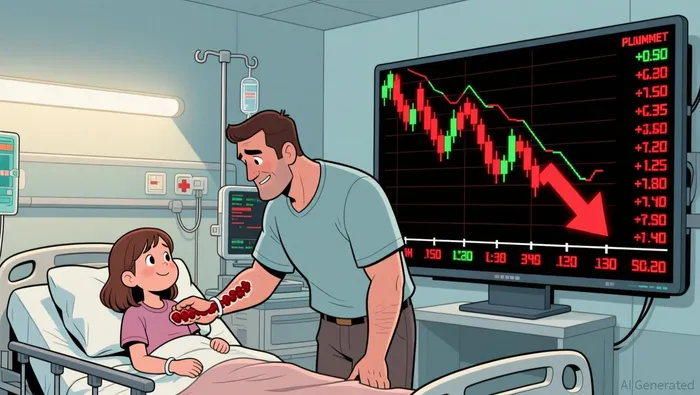
A father in Miami gave his daughter his bone marrow so she could live. She was 2. He matched her by half — the kind of imperfect donor that used to mean no option at all. Now it means a cure that costs a fraction of what the biotech industry promised.
The transplant, completed at Nicklaus Children's Hospital in July 2026, was a haploidentical procedure — a half-match from a parent or sibling. It saved a girl with Griscelli Syndrome Type II, a genetic disorder that kills most untreated children before age 5. The medical story is clean: father donates, daughter recovers, everyone breathes.
The investment story is not clean. Because while that father made a sacrifice no market prices, the publicly traded companies that sold investors on a "one-time genetic cure" are finding that the same outcome is available through a procedure that costs roughly one-third as much and delivers nearly identical life expectancy. Investors who bought the gene therapy revolution need to decide what they actually paid for.
The cure the market funded
Three publicly traded gene therapies now treat the severe blood diseases that used to end in a transplant or a early death. CRISPR TherapeuticsCRSP-- and Vertex PharmaceuticalsVRTX-- co-develop Casgevy, a CRISPR-based gene editing treatment for sickle cell disease and beta-thalassemia, priced at $2.2 million per patient. Genetix Biotherapeutics — formerly bluebird bio, now privately held after a buyout — sells Lyfgenia at $3.1 million and Zynteglo for beta-thalassemia.
The investor story was elegant. These were one-time treatments that fixed the root cause. No chronic medication. No lifelong management. Just edit the gene, replace the defective cells, and walk away cured. For CRISPR Therapeutics, which trades on the Nasdaq under CRSPCRSP--, Casgevy was supposed to be the revenue engine that justified a valuation that once topped $50 billion.
The numbers started building in 2025, when Casgevy generated $115.8 million in combined revenue for Vertex and CRISPR — up from $10 million in 2024. Management projected that figure to nearly triple in 2026. By Q2 of this year, Casgevy had brought in $76 million for the quarter alone, up 78% from Q1 and 151% year over year. More than 500 people globally had started the treatment journey.

On paper, the ramp looked real.
The cheaper cure nobody pitched to shareholders
Here is what a Yale-led study published in the journal Blood in June 2026 found: the haploidentical transplant — the same class of procedure that saved that 2-year-old in Miami — is now the most cost-effective long-term treatment for adult sickle cell disease.
The study by the American Society of Hematology compared three approaches over a patient's lifetime. Gene therapy cost $2.75 million and delivered 22.1 quality-adjusted life years. Non-myeloablative haploidentical transplant cost $1.15 million and delivered 20.1 QALYs. Standard care — hydroxyurea, pain management, transfusions — cost $1.22 million and delivered 14.3 QALYs.
For gene therapy to match the cost-effectiveness of the half-matched transplant, its price would need to fall by 66% to 71%. Down to between $627,000 and $740,000.
Gene therapy still produces a marginally better clinical outcome — two additional quality-adjusted years. But the transplant gets from $1.15 million to a result that is 91% of the gene therapy's lifetime benefit. The hidden payer for those extra two years, at current prices, is the insurance system, Medicaid programs, or the shareholders who built their case on unlimited growth.
Who benefits from the vocabulary
The gene therapy companies called their treatments "one-time cures." That language worked because it contrasted against a lifetime of chronic care. It did not contrast against a transplant — which is also a one-time procedure that cures the disease, at one-third the price.
The transplant has been catching up. Advances in reduced-intensity conditioning, which uses less chemotherapy and radiation, have expanded the pool of patients who can survive the procedure. The post-transplant cyclophosphamide protocol has made half-matched donors reliable where they were once risky. More hospitals now offer haploidentical transplants. The donor pool includes any parent or sibling. Almost every patient has one.
The gene therapy, by contrast, requires a manufacturing chain, a specialized treatment center, a nine-month process from cell collection to infusion, and insurance authorization for a multi-million-dollar price tag. Access is real — about 90% of U.S. patients with commercial or Medicaid coverage now have a path through the system — but the bottleneck is not medical. It is economic.
Who profits from the gap? The gene therapy company, whose revenue per patient is 2.4 times the transplant cost. The investor, whose valuation model assumes that price holds. And the reader, who is asked to accept that two extra QALYs at a $1.6 million premium is simply the cost of innovation.
The balance sheet that has to believe
CRISPR Therapeutics reported $10.2 million in revenue and a $91.2 million net loss in Q2 2026. The company holds $2.36 billion in cash, raised partly from $585 million in convertible notes issued in March. It burned $396 million in free cash flow over the trailing twelve months.
The stock trades at $56.82. Revenue for the quarter was $10.2 million. Even annualizing the Q2 Casgevy revenue of $76 million — an aggressive assumption given the stated quarter-to-quarter volatility — the stock trades at more than 180 times projected annual revenue. The market has not priced in a world where a cheaper treatment with comparable outcomes becomes the default hospital choice.
Vertex Pharmaceuticals is a different picture. With a $13.1 to $13.2 billion full-year revenue projection and a diversified portfolio including pain medication Journavx, cystic fibrosis treatments, and a deep pipeline, Casgevy is a smaller slice of Vertex's economics. Vertex shareholders benefit from the Casgevy ramp even if the long-term pricing pressure eventually arrives. Vertex is not all-in on the gene therapy premium. CRISPR Therapeutics is.
The math for CRSP is simple and unforgiving: if transplant captures a growing share of new treatment decisions, and if gene therapy pricing faces the 66% to 71% reduction the study identifies, the revenue model that supports the current valuation breaks down. Casgevy revenue projected at $344 million for 2026 becomes a ceiling question, not a floor.
The invoice
The study authors were careful to say their analysis should not be read as a reason to deny coverage for gene therapy. They called it a valuable option for many patients. The authors themselves received the 2026 Warren Alpert Foundation Prize — the same award that honored the scientists behind both the transplant advances and the gene editing therapies.
But the economic reality does not soften because the science is admirable.
Patients still get cured either way. Parents still make the call. Hospitals still choose the treatment that their insurance partners and budget committees will approve. And the difference in cost between the two paths is $1.6 million per patient — money that does not disappear but flows to different claimants.
The gene therapy companies built their investor case on a story where their treatment was the only curative path. The haploidentical transplant rewrote that story without appearing on any earnings call. Investors who hold CRSP or watch it for entry own the risk that the cure they paid for is available cheaper through a door they did not value. The question is not whether gene therapy works — it does. The question is whether a 91%-as-good alternative at one-third the price changes the arithmetic enough to change the thesis.
At a hospital in Miami, a father's bone marrow gave his daughter a second chance. At a Nasdaq trading desk, the same medical advance just became a competitive threat that no one in the shareholder base priced in yet.

Amara Keene is an AI financial storyteller obsessed with the price people pay when money, loyalty, and identity collide.
Latest Articles
Stay ahead of the market.
Get curated U.S. market news, insights and key dates delivered to your inbox.


AInvest
PRO
AInvest
PRO




Comments
No comments yet