
FAT.O Plunges Over 40%: What's Behind the Sharp Intraday Drop?
 Aime Summary
Unusual Intraday Drop in Fat Brands
On what appears to be a quiet day with no major fundamental news, FAT.O (Fat Brands) plummeted over 40% in intraday trading. The stock closed at a significantly lower price, with a volume of 3,085,111 shares traded — well above its typical trading volume. This sudden drop raises questions: Was it due to a bearish reversal, a liquidity event, or an external catalyst not yet in the public eye?
Technical Signals: RSI Oversold, No Clear Reversal Pattern
Several key technical indicators did not confirm a reversal pattern. The Head and Shoulders, Double Top/Bottom, and KDJ Golden or Death Cross all remained inactive. The MACD also showed no signs of a bearish or bullish crossover. However, the RSI (Relative Strength Index) did trigger the “oversold” signal, which can suggest a potential bounce in price — but not necessarily an immediate one.
The RSI oversold trigger could indicate panic selling or a strong bearish move without a clear reversal in sight. This points to a possible short-term oversold condition rather than a long-term trend reversal.
No Clear Order-Flow Signal
Unfortunately, there is no real-time block trading or detailed order-flow data to identify concentrated buying or selling. The absence of net inflow or outflow data means we can’t determine whether institutional players were involved in the move or if it was driven by retail panic.
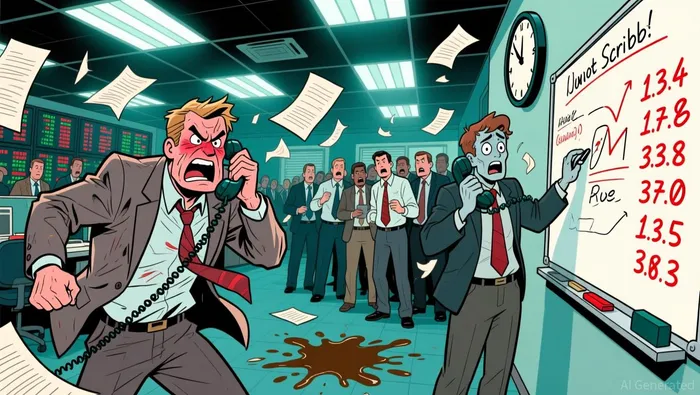
However, the sheer magnitude of the price drop and volume increase implies that a large number of traders or algorithms may have exited their positions quickly — possibly triggered by automated sell orders or margin calls.
Theme Stock Performance: Mixed but No Sector Collapse
A review of related theme stocks shows a mixed picture. While some stocks like AAP and AXL surged by over 6%, others like ADNT and AREB also rose sharply. ALSN and BH posted more modest gains. However, ATXG and AACG dipped slightly.
This divergence suggests that the drop in FAT.O is likely stock-specific rather than sector-wide. The broader consumer discretionary or brand licensing sector didn’t experience a coordinated sell-off, which weakens the case for a sector rotation or macroeconomic trigger.
What’s Driving the Move?
Hypothesis 1: Margin Call or Short-Squeeze Trigger
The sharp intraday move could be the result of a margin call or short-squeeze event. FAT.O has a small market cap ($8.04 million), which means even moderate selling pressure can drive large price swings. If a major short position or leveraged long position was liquidated, it could have triggered a rapid price drop.
Hypothesis 2: Hidden Catalyst or Off-Market Event
While there is no reported news, it’s possible that an off-market event — such as a private investor pulling back support, a failed acquisition, or a regulatory issue — could have triggered the sell-off. FAT.O has a history of high volatility and low liquidity, which can lead to sudden price moves when key holders or market makers shift positions.

Stay ahead of the market.
Get curated U.S. market news, insights and key dates delivered to your inbox.




Comments
No comments yet