
Fastenal's 0.8% Decline Amid $460M Volume Surge Ranks 366th in U.S. Equities
 Aime Summary
Market Snapshot
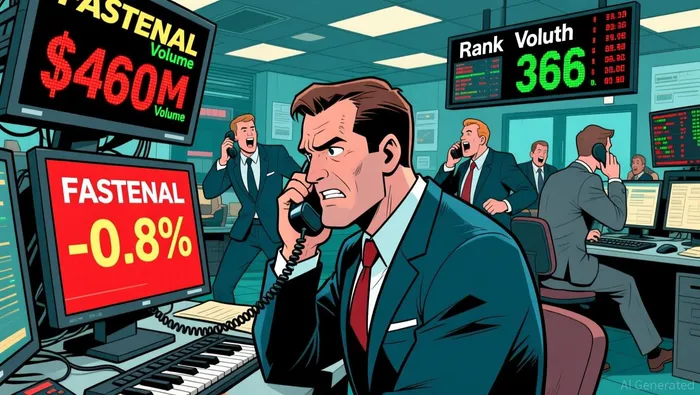
Fastenal (FAST) closed 2025-11-24 with a 0.80% decline, marking a bearish session despite a significant surge in trading activity. The stock’s daily trading volume reached $0.46 billion, a 37.57% increase from the prior day, and ranked 366th in terms of volume among U.S. equities. While elevated liquidity suggests heightened investor interest, the price weakness indicates divergent market sentiment, with short-term selling pressure outweighing volume-driven optimism. The stock’s performance contrasts with its broader 12-month range of $35.31 to $50.63, positioning it closer to its 50-day ($43.92) and 200-day ($44.38) moving averages.
Key Drivers
Strategic Expansion and Digital Integration
A pivotal development for FastenalFAST-- is its newly announced multi-year partnership with the Edmonton Oilers Entertainment Group, designating the company as the preferred MRO (maintenance, repair, and operations) supply partner for Rogers Place. This collaboration expands the use of Fastenal’s Managed Inventory Technology (MIT) in large-scale sports and entertainment venues, aligning with its broader digital supply chain strategy. The agreement reinforces Fastenal’s presence in the NHL ecosystem, a high-visibility platform that could enhance brand recognition and operational scalability. While analysts note this partnership does not immediately alter Fastenal’s core short-term growth drivers—such as digital adoption and on-site solution expansion—it underscores the company’s commitment to leveraging technology for market differentiation.
Management Changes and Financial Leadership
The appointment of Max Tunnicliff as Chief Financial Officer (CFO) has emerged as a critical catalyst for investor evaluation. Effective financial stewardship is now paramount, given Fastenal’s dual focus on pursuing high-profile partnerships like the NHL deal while managing margin pressures from input and freight costs. Tunnicliff’s prior experience in capital allocation and cost optimization positions him to address these challenges, particularly as the company navigates inflationary pressures and executes its $9.9 billion revenue target by 2028. The transition highlights Fastenal’s strategic emphasis on balancing aggressive growth with operational discipline, a delicate balance that could influence investor confidence in its long-term execution.
Analyst Sentiment and Valuation Discrepancies
The stock’s mixed analyst ratings reflect divergent views on its valuation and growth trajectory. Recent upgrades from Baird (to “Strong-Buy”) and Wolfe Research (to “Peer Perform”) contrast with downgrades from Sanford C. Bernstein (“Underperform”) and Barclays (“Equal Weight”). The consensus target price of $46.32 implies an 18% upside from its closing price of $39.91, but this range—from $38.00 to $67.00—reveals significant uncertainty. The disparity stems from differing assessments of Fastenal’s ability to sustain its 8.5% annual revenue growth while mitigating margin compression risks. For instance, Simply Wall St’s $43.58 fair value estimate (9% upside) assumes continued digital adoption, whereas cautionary voices highlight exposure to input cost volatility and freight inflation.
Earnings Performance and Dividend Dynamics
Fastenal’s Q3 2025 earnings report revealed a $0.29 EPS result, narrowly missing the $0.30 consensus estimate, though revenue of $2.13 billion matched projections. The 11.7% year-over-year revenue growth underscores its resilience in industrial distribution, but the 15.34% net margin and 32.69% return on equity indicate pressure to maintain profitability amid rising costs. The company’s 2.2% dividend yield (annualized $0.88) remains attractive, though the 82.24% payout ratio raises concerns about sustainability if margins contract further. Analysts like Barclays and JPMorgan have adjusted price targets to reflect these dynamics, with the latter raising its target to $46.00 amid a “Neutral” rating, signaling guarded optimism about earnings normalization.
Insider Activity and Institutional Confidence
Recent insider purchases, including 3,000 shares acquired by directors for $131,630, suggest confidence in Fastenal’s long-term value. These transactions, coupled with institutional buying by entities like Mufg Securities and Franklin Resources, indicate a degree of alignment between management and external investors. However, insiders own only 0.37% of the stock, limiting the immediate impact of their activity. The broader institutional stake, with a market cap of $45.82 billion and a P/E ratio of 37.30, reflects a premium valuation relative to peers, which could be justified if digital initiatives and margin management deliver on forecasts.
Outlook and Risk Factors
Fastenal’s 2028 outlook hinges on achieving $1.6 billion in earnings, a $0.4 billion increase from current levels, through its digital and MIT strategies. While the NHL partnership and CFO appointment are positive steps, risks persist, particularly from input cost inflation and freight expenses. Analysts caution that even high-profile contracts may not offset margin pressures without operational efficiencies. Additionally, the stock’s beta of 0.92 suggests slightly lower volatility than the market, but its PEG ratio of 3.75 implies overvaluation relative to growth expectations. Investors must weigh these factors against the company’s strong balance sheet (debt-to-equity of 0.03) and liquidity metrics (current ratio of 4.26) to assess its long-term viability.

Stay ahead of the market.
Get curated U.S. market news, insights and key dates delivered to your inbox.
AInvest
PRO
AInvest
PRO



Comments
No comments yet