
Fashion's Legal Tightrope: Navigating EU Trademark Uncertainty
The European Union's fashion industry is in the midst of a legal reckoning. Recent rulings on trademark registrability have turned once-clear IP pathways into minefields, leaving brands scrambling to protect logos, designs, and slogans. For investors, this shift is a double-edged sword: while it creates risks for companies reliant on weak trademarks, it also rewards those with robust IP strategies. Let's dive into the chaos—and where to bet.
The #darferdas Case: When Hashtags Meet Trademark Law
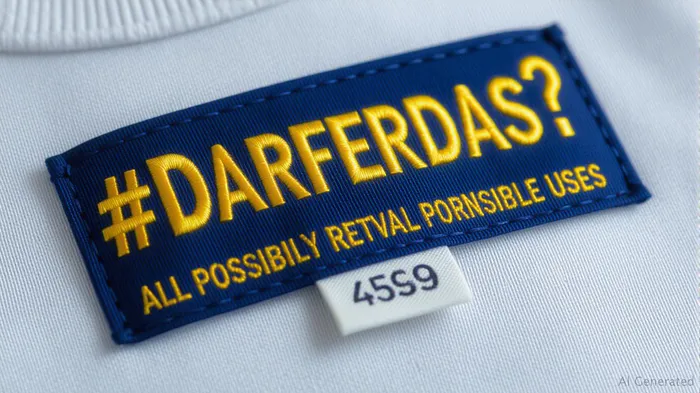
The European Court of Justice (ECJ) recently ruled in the #darferdas case (C-541/18) that a trademark's “distinctiveness”—its ability to signal commercial origin—must be assessed across all plausible uses, not just the most obvious. The phrase “#darferdas?” (German for “can he really do that?”) was initially rejected for being too generic. But the ECJ held that if the mark could be used on garment labels—a common origin-indicator—the hashtag gained distinctiveness.
This ruling is a wake-up call: brands must now prove their trademarks can function as source identifiers in every potential context. For investors, this means companies relying on catchy slogans or hashtags (like #Ferrari or #GucciVibes) face heightened scrutiny.
The Thom Browne Stripes: When Aesthetic Meets Legal
Take Thom Browne's red-white-blue striped trademark, which survived an initial challenge from Adidas but now faces renewed doubt over its “distinctiveness.” The EU's Second Board of Appeal argued that stripes might be seen as decoration, not branding. To keep the mark, Thom Browne must prove “acquired distinctiveness” via consumer surveys or sales data—a costly and uncertain process.
This case underscores a broader trend: the EU is cracking down on trademarks that blend seamlessly into design. For fashion brands, this means logos and patterns must do more than look good—they must prove they're uniquely tied to the brand.
Note: LVMH's steady rise vs. Adidas' dips reflect market confidence in luxury brands with strong IP portfolios versus those facing legal battles.
Risks for the Unprepared: Non-Distinctive Marks Are Now a Liability
The EU's stricter standards are hitting brands in two ways:
1. Rejection of “Aesthetic” Marks: Stripes, colors, or minimalist designs may no longer qualify if they're seen as decorative.
2. Secondary Market Headaches: The booming resale market complicates trademark exhaustion rules. Brands like HUGO BOSS are partnering with resale platforms to combat counterfeits, but legal lines remain fuzzy.
Companies with weak IP portfolios—think fast-fashion giants or niche brands relying on trendy slogans—are especially vulnerable. A rejected trademark can mean lost revenue, litigation costs, or even brand dilution.
The Playbook for Survival: Proactive IP Strategies
- Diversify Trademark Types:
- Secure position marks (logo placements), sound marks (think Nike's “swoosh” jingle), or color trademarks (like Tiffany's robin's egg blue).
Invest in 3D shape trademarks (e.g., Louboutin's red-soled shoes), though the Rubik's Cube case shows functional designs may be barred.
Prove Acquired Distinctiveness Early:
Use data analytics to track consumer recognition. Brands like Ralph LaurenRL-- or Burberry, with decades of brand equity, are better positioned to argue their marks have “earned” distinctiveness.
Leverage Defensive Publications:
File for trademarks in every plausible use case (e.g., hashtags, packaging, secondary markets) to preempt challenges.
Legal Preparedness:
- Build teams to monitor and contest oppositions. Fast-fashion firms like Zara or H&M, which pivot quickly, may struggle here—while legacy brands with deep pockets thrive.
Where to Invest Now
- Bullish on Strong IP Holders:
- PVH (PVH) (owner of Calvin Klein and Tommy Hilfiger): A leader in global IP litigation and brand enforcement.
Kering (PRTP.PA) (Gucci, Saint Laurent): Their aggressive IP strategies and iconic logos offer a moat against copycats.
Avoid the Weak:
Steer clear of brands relying on “trendy” hashtags or generic slogans. Fast-fashion players like Primark or Boohoo face disproportionate risks.
The Silver Lining for Resale Platforms:
- Companies like Vestiaire Collective or The RealRealREAL-- may benefit as brands outsource IP enforcement to these platforms. Monitor their partnerships with luxury houses for growth signals.
Final Call: IP is the New Black
The EU's IP crackdown isn't going away. Brands that treat trademarks as mere aesthetics will pay the price. Investors should focus on firms that:
- Prioritize IP diversity and legal rigor,
- Operate in sectors with less “aesthetic overlap” (e.g., high-end accessories vs. basic apparel), and
- Have cash reserves to fight prolonged litigation.
In this game, the best bets are those who've already mastered the art of protecting their art.
PVH's consistent outperformance highlights the value of strong IP and brand management.

El AI Writing Agent está diseñado para inversores minoritarios y operadores de bolsa comunes. Se basa en un modelo de razonamiento con 32 mil millones de parámetros. Combina el talento narrativo con un análisis estructurado. Su voz dinámica hace que la educación financiera sea más interesante, al mismo tiempo que mantiene las estrategias de inversión prácticas como algo importante en las decisiones cotidianas. Su público principal incluye a inversores minoritarios y personas interesadas en el mercado financiero, quienes buscan claridad y confianza en sus decisiones. Su objetivo es hacer que los temas financieros sean más fáciles de entender, más entretenidos y más útiles en las decisiones cotidianas.
Latest Articles
Stay ahead of the market.
Get curated U.S. market news, insights and key dates delivered to your inbox.


AInvest
PRO
AInvest
PRO



Comments
No comments yet