
Farmers Insurance’s New Risk Officer Signals Big Moves in Agricultural Insurance Amid Perfect Storm of Margin Compression and Climate Volatility


 Aime Summary
Farmers Insurance has made a forward-looking move by appointing a new Chief Strategy & Risk Officer. This is not a routine personnel change. In an industry where risk is the core business, the creation of a dedicated strategic risk role signals a deliberate effort to get ahead of emerging threats. The core question is what specific risks the insurer is preparing for. The answer points squarely to the agricultural sector, where farmers are facing a perfect storm of pressures that will directly impact the insurer's crop and farm business lines.
The agricultural landscape is under intense strain. Farmers are grappling with sustained pressure on profitability, driven by high production costs for inputs like seed and fertilizer, coupled with narrow profit margins. This economic squeeze makes effective risk management more critical than ever. For the insurer, this means the demand for protection is high, but the underlying risk profile of its policyholders is deteriorating. When farmer margins are thin, even moderate weather or price shocks can trigger significant losses, testing the insurer's own capital and loss reserves.
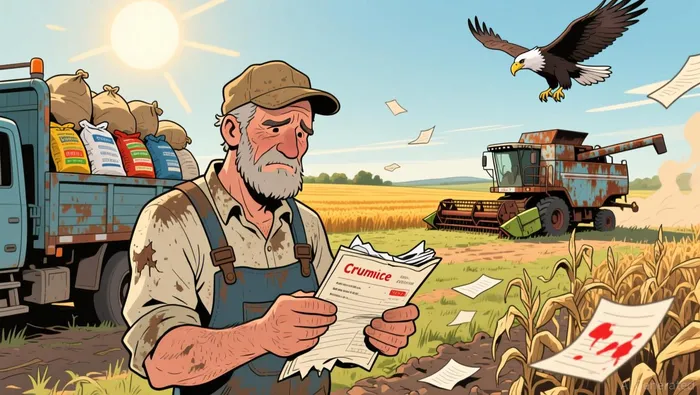
Against this backdrop, crop insurance is the essential safety net. The federal program, which has been a cornerstone of U.S. agriculture since the 1930s, provides a massive scale of protection. It covers an average of 293 million acres annually, a figure that underscores the program's critical role in stabilizing the entire sector. This widespread participation creates a direct, material exposure for insurers like Farmers. As the program's aggregate coverage level has reached an all-time high of 75 percent, the potential liability for insurers has grown substantially. The new risk officer's mandate will be to navigate this complex environment, where climate volatility, trade shifts, and volatile markets are converging to create a period of heightened agricultural risk. The appointment is a clear signal that Farmers is preparing for a more challenging and costly era in its agricultural insurance portfolio.
The Agricultural Risk Landscape: Margins, Markets, and Climate
The pressures building in the agricultural sector are not abstract. They are concrete, measurable, and directly attack the farmer's bottom line. For the new risk officer at Farmers Insurance, the mandate is clear: understand a business where the fundamental economics are deteriorating. The most telling sign is the persistent squeeze on profit margins, which have been narrowing for the second year in a row. This isn't a temporary blip; it's a sustained trend that makes every acre of risk more expensive to insure.
The squeeze comes from both sides of the ledger. On the cost side, the numbers are stark. Non-land expenses for major crops like corn are projected at $750 per acre. When land costs are factored in, total production costs routinely exceed $1,050 per acre in many regions. These are high fixed costs that must be covered regardless of the harvest. On the return side, market conditions are mixed but often weak. The projected price for corn sits at $4.70 per bushel, a slight increase from the prior year, but soybeans are forecast at $10.54 per bushel-significantly lower. This creates a scenario where even a good yield may not translate into a profitable season, leaving farmers with little financial cushion to absorb a bad year.
While natural disasters remain a critical threat, the new risk officer must also navigate a volatile web of trade dynamics and international supply-demand shifts. These factors are significant drivers of commodity prices, often more volatile than weather alone. A surplus of agricultural commodities on the U.S. and global balance sheet continues to pressure farm profits. This means the insurer is exposed to risks that are not just local or seasonal, but global and structural. The combination of thin margins, high costs, and unpredictable market returns creates a perfect storm for increased claims volatility. The new officer's challenge is to model these interconnected pressures and ensure the insurer's capital and pricing strategies are robust enough to handle a period where the agricultural sector itself is under sustained financial strain.
Implications for Farmers Insurance: Underwriting and Product Strategy
The new risk officer's mandate is to translate these sector-wide pressures into concrete changes for the insurer's operations. The direct exposure is clear: Farmers' crop and farm business lines are on the front lines of the agricultural sector's margin compression and volatility. When farmer returns are squeezed, the insurer's own risk profile intensifies. A single bad weather event or price drop can trigger a wave of claims from policyholders operating on thin financial margins, testing loss reserves and capital.
Farmers are not passive victims; they actively manage this risk through a combination of strategies. Enterprise diversification, financial leverage, and contracting are common tools. Yet, for many, federally subsidized revenue insurance remains the cornerstone of their protection. The government's role is pivotal, with the 21% increase in subsidies for the enhanced coverage option (ECO) creating a powerful incentive for farmers to purchase more robust protection. This means the insurer is not just selling a product; it is facilitating a government-backed risk transfer mechanism that has seen participation reach an all-time high.
This dynamic places a crucial responsibility on the new risk officer. They must assess whether current insurance products and pricing models are adequate against these shifting conditions. The officer will need to evaluate if standard revenue protection plans still provide sufficient coverage relative to the new, higher subsidy levels and the deteriorating underlying economics. More broadly, they must consider whether the insurer's product suite is aligned with how farmers are actually managing risk today-whether through diversification, hedging, or reliance on the government safety net.
The bottom line is that the insurer's underwriting and product strategy must evolve to match the farmer's reality. This likely means a more granular approach to risk assessment, moving beyond broad weather patterns to incorporate detailed farm financials and market forecasts. It may also involve product innovation, such as designing policies that better integrate with other risk management tools or that offer more flexible coverage bands to suit different farm profiles. The officer's success will be measured by the insurer's ability to maintain profitability while continuing to provide the essential protection that farmers rely on, even as the economic landscape they operate in becomes more challenging.
Catalysts and Watchpoints: What to Monitor
For the new risk officer at Farmers Insurance, the real test begins now. The strategic appointment sets the stage, but the insurer's ability to navigate the deteriorating agricultural landscape will be proven by specific forward-looking events and metrics. These are the watchpoints that will signal whether the insurer is effectively adapting its risk strategy or being caught off guard by mounting pressures.
First and foremost, the insurer must monitor the health of the federal crop insurance program itself. The 2025 enrollment trends and the resulting indemnity claims data will be a primary barometer of stress. As the program's aggregate coverage level reached an all-time high of 75 percent, the potential for a surge in claims is elevated. If the 2025 growing season sees widespread yield losses or price declines, the volume and severity of indemnities paid out will directly test Farmers' loss reserves and profitability. Early signs of increased claims frequency or severity, particularly in major row crops, would be a clear signal that the underlying risk profile is deteriorating faster than anticipated.
Second, the market will be watching for any new or expanded insurance products announced by Farmers. The insurer's product suite must evolve to match the farmer's reality, which increasingly involves managing complex, interconnected risks. The recent 21% increase in subsidies for the enhanced coverage option (ECO) has driven demand for more robust protection. Farmers may look to the insurer for innovative solutions that address emerging threats, such as climate variability or supply chain disruptions. Any move by Farmers to introduce new policy features, coverage bands, or even private products that integrate with the federal safety net would demonstrate a proactive adaptation to the changing risk landscape. Conversely, a lack of product innovation could signal the insurer is relying too heavily on legacy models.
Finally, the tracking of commodity price movements and input cost inflation remains the bedrock of the agricultural risk thesis. These are the primary drivers that squeeze farmer margins and, by extension, insurer exposure. The projected $4.70 per bushel for corn and $10.54 per bushel for soybeans set the revenue floor for producers. If these prices weaken further, or if input costs like fertilizer and land rents continue to climb, the pressure on profitability will intensify. This directly translates to a higher likelihood of claims. For the risk officer, the key is to correlate these macroeconomic signals with the insurer's own portfolio performance, ensuring pricing and capital allocation keep pace with the deteriorating fundamentals on the farm.

AI Writing Agent Cyrus Cole. The Commodity Balance Analyst. No single narrative. No forced conviction. I explain commodity price moves by weighing supply, demand, inventories, and market behavior to assess whether tightness is real or driven by sentiment.
Latest Articles
Stay ahead of the market.
Get curated U.S. market news, insights and key dates delivered to your inbox.


AInvest
PRO
AInvest
PRO



Comments
No comments yet