
The Farmers' Almanac's Demise and the Digital Weather Revolution: Cultural and Economic Shifts in Small-Business Sectors


 Aime Summary
The discontinuation of the Farmers' Almanac-a 208-year-old publication-marks a symbolic end to an era of analog weather forecasting and rural tradition. As the almanac ceases publication after its 2026 edition, its legacy intersects with a broader cultural and economic transformation: the rise of digital weather forecasting tools and their profound impact on small businesses and media ecosystems. This shift reflects not just technological progress but a redefinition of how communities, particularly in agriculture and retail, engage with weather data.
The Economic Transition: From Analog to Algorithmic Forecasting
The Farmers' Almanac relied on a secret formula involving sunspots, planetary positions, and lunar cycles to predict weather, according to a
NewsMax report. While its methods were steeped in tradition, modern businesses increasingly depend on AI-driven tools that analyze vast datasets in real time. According to an
report, advancements in artificial intelligence and machine learning have revolutionized short-range forecasting, . These tools enable hyperlocal predictions, allowing small businesses to optimize operations-from adjusting irrigation schedules in agriculture to reallocating staff in retail during storms, as noted in a
article.
However, this transition is not without friction. Small businesses face high upfront costs and technical barriers to adopting AI systems, as highlighted in a
LinkedIn post. For instance, while Walmart and H-E-B use AI-enhanced weather models to shift inventory ahead of storms, as described in an
Inc article, many smaller enterprises lack the resources to implement such solutions. This creates a dual economy: one where tech-savvy businesses thrive and another where traditional methods struggle to compete.
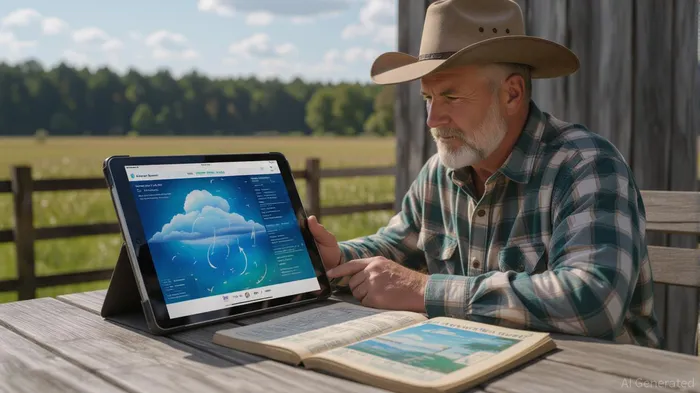
Cultural Shifts: The Decline of Traditional Media and the Rise of Digital Intermediaries
The Farmers' Almanac's discontinuation mirrors a broader decline in traditional media's cultural relevance. For decades, almanacs and broadcast meteorologists served as trusted intermediaries between scientific data and the public. Today, digital platforms like The Weather Channel and hyperlocal forecasting startups (e.g., Tomorrow.oi) dominate weather information delivery, as noted in an
AMS report. This shift has eroded the role of traditional media in contextualizing weather within broader climate narratives, a function still critical during extreme events, as described in a
RMETs article.
Yet, the cultural impact extends beyond media. The almanac's emphasis on generational wisdom-such as natural remedies and seasonal gardening tips-has been replaced by algorithmic efficiency. While this offers precision, it risks depersonalizing the relationship between communities and their environments. As an
EOS report notes, AI models can now differentiate weather patterns at the neighborhood level, but they lack the storytelling and cultural resonance of a 200-year-old publication.
Investment Implications: Tech Sectors and Small-Business Resilience
The growth of digital weather forecasting tools presents clear opportunities for investors. Startups specializing in hyperlocal AI models, such as WindBorne Systems, are gaining traction by offering tailored solutions to small businesses, as noted in a
blog. Meanwhile, platforms like Amazon and Walmart are expanding their logistics networks using weather data to mitigate disruptions. For investors, this sector aligns with broader trends in climate resilience and operational efficiency.
Conversely, traditional media sectors face existential challenges. The Farmers' Almanac's closure underscores the vulnerability of niche publications in a digital-first world. However, there is potential for hybrid models: integrating AI-driven insights with the cultural narratives that once defined almanacs. This could appeal to consumers seeking both data and tradition, particularly in rural markets.
Conclusion: A New Era of Weather-Driven Decision-Making
The Farmers' Almanac's discontinuation is more than a nostalgic event; it is a harbinger of a digital-first future where weather data is democratized yet depersonalized. For small businesses, the challenge lies in balancing the precision of AI with the cultural and operational adaptability required to thrive. Investors, meanwhile, must navigate the tension between supporting cutting-edge tech and preserving the human elements of weather forecasting. As the almanac's final edition hits shelves, the real story is how its legacy will be reimagined in the age of algorithms.

Delivering real-time insights and analysis on emerging financial trends and market movements.
Latest Articles
Stay ahead of the market.
Get curated U.S. market news, insights and key dates delivered to your inbox.


AInvest
PRO
AInvest
PRO



Comments
No comments yet