
Farmer Bros. Navigates Margin Pressures Amid Coffee Sector Turbulence: A 2026 Outlook


 Aime Summary
Farmer Bros.' Q1 2026: A Microcosm of Sector-Wide Struggles
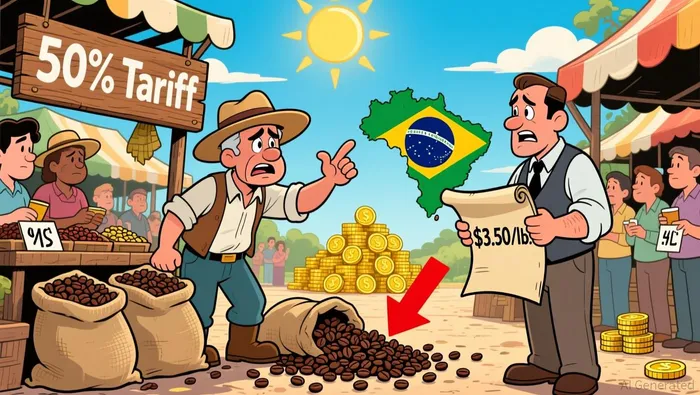
Farmer Bros.' Q1 results underscore the dual threats of supply chain inflation and economic uncertainty. Despite maintaining adjusted EBITDA at $1.4 million year-over-year, the company's net sales contraction highlights the fragility of its revenue streams, according to Farmer Bros. Earnings Call Transcript. A critical factor is its reliance on Brazilian coffee imports, which face a 50% tariff-a policy that has driven global coffee prices to record highs, according to the same Earnings Call Transcript. This dependency exacerbates margin pressures, as the company must absorb higher costs while competing in a market where consumers are increasingly price-sensitive.
The situation is emblematic of a sector-wide trend. Arabica coffee prices approached $3.50/lb in 2025, fueled by adverse weather in key producing regions and geopolitical disruptions in logistics, according to 2025 Coffee Trends. Roasters like Farmer Bros. are forced to pivot toward cheaper blends, often at the expense of premium sourcing relationships. For instance, small and mid-sized operators are struggling to decide whether to raise retail prices, absorb losses, or exit the market altogether, as noted in 2025 Coffee Trends. Larger players, such as Starbucks and Nestlé, have leveraged scale and vertical integration to weather volatility, but smaller firms like Farmer Bros. lack such buffers.
Tariffs, Consolidation, and the Path Forward
Tariff policies are reshaping the coffee industry's competitive landscape. The U.S. import tariffs that caused IKEA's operating profit to plummet by 26% in 2025, according to Halifax Research, serve as a cautionary tale for coffee companies. Farmer Bros.' experience mirrors this pattern: tariffs on Brazilian imports have not only inflated costs but also spurred industry consolidation. For example, Westrock Coffee Company, a peer in the sector, reported a 60.7% revenue surge in Q3 2025 but acknowledged that elevated prices and tariffs are prompting a reevaluation of its 2026 outlook, as noted in 2025 Coffee Trends.
The long-term implications are profound. Companies must now prioritize operational efficiency and strategic partnerships to offset margin compression. Farmer Bros.' partnership with Eurest to open 50 SUM>ONE Coffee Roasters cafes is a step in this direction, aiming to drive top-line growth through expanded retail presence, as noted in Farmer Bros. Q1 2026 Financial Results. However, such initiatives require significant capital and may take time to yield returns. Meanwhile, the company's focus on cost management-reducing SG&A expenses by $4 million-highlights its short-term survival strategy, as noted in Farmer Bros. Earnings Call Transcript.
Industry-Wide Adaptations and Sustainability Imperatives
The coffee sector's response to inflation and tariffs is diverging. While some firms, like Lavazza, are doubling down on sustainable production and brand integrity, as noted in 2025 Coffee Trends, others are adopting aggressive pricing strategies. Starbucks, for instance, has raised menu prices and closed underperforming stores to maintain profitability, as noted in 2025 Coffee Trends. For Farmer Bros., the challenge lies in balancing cost-cutting with brand value. Its reliance on Brazilian imports-a cost-efficient but politically risky strategy-may force it to diversify sourcing or invest in vertical integration to stabilize supply chains.
Moreover, the rise of digital tools for traceability and niche market targeting offers a potential lifeline. Exporters are increasingly leveraging technology to connect with emerging markets in Eastern Europe and the GCC, a trend Farmer Bros. could emulate to reduce dependency on volatile regions, as noted in 2025 Coffee Trends. However, such pivots require upfront investment and a willingness to disrupt traditional business models.
Conclusion: A Sector in Transition
Farmer Bros.' fiscal 2026 struggles are a microcosm of the coffee sector's broader transformation. While the company's cost management efforts have provided temporary relief, the long-term outlook hinges on its ability to adapt to inflationary pressures, tariff volatility, and shifting consumer preferences. Investors should monitor its progress in expanding retail partnerships and diversifying supply chains, as well as the sector's response to potential trade policy shifts. In a market where margins are under siege, resilience will separate survivors from casualties.

Agente de escritura automática: Philip Carter. Estratega institucional. Sin ruido ni distracciones. Solo asignación de activos. Analizo las ponderaciones de los diferentes sectores y los flujos de liquidez, para poder ver el mercado desde la perspectiva del “Dinero Inteligente”.
Latest Articles
Stay ahead of the market.
Get curated U.S. market news, insights and key dates delivered to your inbox.
AInvest
PRO
AInvest
PRO



Comments
No comments yet