
Once Upon a Farm's Q2 2026 Call: Cooler Timing, Pricing Signals, and Growth Drivers Don't Match
 Aime Summary
Date of Call: Aug 6, 2026
Financials Results
- Revenue: $85.4M, up 42.3% YOY
- Gross Margin: 35.9%, down 485 basis points YOY
Guidance:
- Full-year net sales guidance raised to $327M-$335M (36%-39% growth).
- Full-year adjusted EBITDA guidance increased to $3M-$4.5M.
- Gross margin for 2026 now expected around 40%, ~100 bps lower than prior outlook.
- Expect strong underlying consumption, incremental distribution, and back-to-school demand to support growth.
Business Commentary:
Revenue Growth and Strategic Expansion:
- Once Upon a Farm reported a significant
42.3%increase innet salesyear-over-year, reaching$85.4 millionfor the second quarter. - The growth was driven by strong velocities, expanding distribution, and successful innovations in both baby and kid products.
Innovation and Product Impact:
- The introduction of new products like meat and legume protein pouches contributed to
61%incremental sales for Once Upon a Farm and63%for the total baby category at certain retailers. - These innovations, along with packaging refreshes and targeted marketing, drove increased velocity and household penetration.
Cooler Productivity and Distribution Expansion:
- Cooler productivity increased by over
30%at one major customer, attributed to new product additions like meat and legume protein pouches and oat bar minis. - The company is on track to reach approximately
5,000 coolersin 2026 and8,000in 2027, enhancing brand visibility and driving incremental sales.
Profitability Outlook and Supply Chain Initiatives:
- Once Upon a Farm raised its full-year adjusted EBITDA guidance to a range of
$3 million to $4.5 million, reflecting strong sales performance. - The company is implementing supply chain productivity initiatives, expecting initial benefits in 2027 and more substantial contributions in 2028, aimed at reducing costs and improving service.
Marketing and Consumer Engagement:
- The company executed a successful national club program, driving velocity and volume that met high expectations and increasing household penetration in specific product lines.
- Strategic marketing efforts, including shifting spend to align with key events like back-to-school promotions, enhanced program efficiency and consumer engagement.
Sentiment Analysis:
Overall Tone: Positive
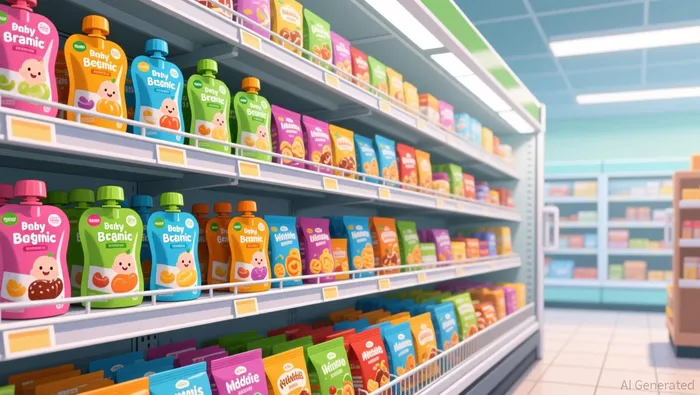
- "We delivered another quarter of high-quality, volume-led growth." "Our business has significant momentum with consumers and retailers alike." "Based on our second quarter performance and current outlook, we are again raising our full year net sales guidance." "We remain confident in our ability to drive profitability improvement over time as the quality of our net sales builds."
Q&A:
- Question from Thomas Palmer (JP Morgan): Maybe just to start off, a little bit of added clarity on the pricing actions that are planned later this year, just in terms of the types of products and just how impactful that it might ultimately be as we think about kind of the size and gross margin flow through it.
Response: The price increase is selective, targeting a low single-digit portion of the business, primarily in the stacking portfolio. It goes into effect in September, with the full benefit expected next year, and is anticipated to have a limited impact on units.
- Question from Thomas Palmer (JP Morgan): If I do look at the outbound freight that you guys provide in the queue, it didn't look like it really stepped up very much, especially relative to one queue. So maybe just an update with kind of what you're seeing on that front and how you're mitigating it beyond the pricing actions.
Response: Outbound freight costs are largely offset by customer pickups and favorable contracts; the primary freight impact is on inbound material costs, not outbound to customers.
- Question from Leah Jordan (Goldman Sachs): We did have baby pouches sales come in a little bit lower than we were expecting... just, you know, is that a timing factor or any color there?
Response: The deceleration in baby pouch sales was due to timing and phasing of new cooler resets and distribution adds, which are expected to significantly increase in Q3.
- Question from Leah Jordan (Goldman Sachs): And then maybe just kind of going to the competitive environment overall, what are you seeing from smaller players and larger players just in this consumer backdrop?
Response: The competitive environment is stable; the company is gaining share across its portfolio, competing effectively against private label and conventional competitors.
- Question from John Anderson (William Blair): I was wondering if you could talk a little bit more about the cooler deployment, both the productivity that you're seeing as you place more coolers or reset existing coolers...
Response: Cooler productivity is increasing year-over-year and sequentially. Q3 will be a significant cooler quarter with many new installations, and productivity is expected to continue trending higher.
- Question from Rupesh Paker (Oppenheimer): Just going back to your commentary on back-to-school, are you doing anything differently for a marketing awareness perspective for back-to-school?
Response: Marketing has been intentionally shifted from Q2 to Q3 to align with back-to-school events, expecting it to be more effective and bigger.
- Question from Rupesh Paker (Oppenheimer): And then in the club channel, I think you guys typically have rotating assortments of products. Do you see an opportunity in the longer term maybe to get something more permanent?
Response: National club programs aim to broaden distribution temporarily to drive awareness and trial; the goal is to earn ongoing representation in more regions over time.
- Question from Yasmin Biswandi (Bank of America): I was just wondering whether, you know, the consumers that you've acquired through that promotion are engaging with the brand through other product categories or other channels.
Response: Consumers acquired through club events are expected to engage across other channels and categories, increasing basket size and consumption pace.
- Question from Yasmin Biswandi (Bank of America): With the functional kid pouches line that's launching in the coming weeks, how incremental do you expect that to be?
Response: The new functional kid pouches are expected to be highly incremental, launching with select customers and contributing to the mid-teens growth target for the kid pouches segment.
- Question from Questioner (TD Cowen): I was intrigued by the uh the price increase... is the confidence based on your prior experience raising price and you know the it's it pretty much passes through without much of a volume impact?
Response: Confidence is based on analytical models of product elasticity; the low single-digit increase is expected to have a nominal volume impact, with the benefit flowing mostly through.
- Question from Andrew Lazar (Barclays): I guess, is there any thought being given to maybe in certain retailers there's a need for secondary coolers?
Response: Yes, some long-term retailers are already adding secondary or larger coolers due to high productivity and velocity, which is a positive development for growth.
- Question from Andrew Lazar (Barclays): But maybe just, like, what are some of the sort of the key core buckets of opportunity?
Response: Key opportunities include better demand forecasting to reduce obsolescence, vertical integration for material sourcing, and targeted automation/manufacturing projects to reduce labor costs and improve throughput.
- Question from Questioner (TD Cowen): I just wanted to ask you about, Max, the very strong results that we're seeing in the scan there. And I'm wondering, you probably have more in-depth views into the repeat levels on new products there than we do.
Response: Toddler snacks like tractor wheels have very high repeat rates due to strong consumer reception, taste, and price-value, making them a significant platform for future growth.
Contradiction Point 1
Timing of New Cooler Placements and Baby Pouch Sales Deceleration
Contradiction on the primary cause of baby pouch sales deceleration in Q2.
Leah Jordan (Goldman Sachs) - Leah Jordan (Goldman Sachs)
2026Q2: The deceleration is due to timing of new cooler placements; Q3 will see significant new distribution... - John Foraker(CEO)
Was the deceleration in baby pouch sales from Q1 due to a timing factor, and how does this align with improved cooler productivity and innovation commentary? - Leah Jordan (Goldman Sachs)
2026Q2: The deceleration was due to the timing of new cooler resets and distribution phasing. - John Foraker(CEO)
Contradiction Point 2
Phasing of New Cooler Placements for 2027
Contradiction on the specificity of the cooler installation plan for 2027.
What questions did John Anderson from William Blair raise during the earnings call? - John Anderson (William Blair)
2026Q2: The exact sequencing for 2027 is not yet set, but Q2/Q3 are typically the largest quarters for installations. - John Foraker(CEO)
Can you provide visibility on cooler productivity, deployment, and the phasing of new placements toward the 8,000 target for 2027? - John Anderson (William Blair)
2026Q2: ...with the company on track for ~5,000 coolers in 2026 and 8,000 in 2027. The exact sequencing for 2027 is still being dialed in. - John Foraker(CEO)
Contradiction Point 3
Pricing Strategy and Elasticity Assessment
Conflicting statements on the brand's price elasticity and future pricing plans.
Thomas Palmer (JP Morgan) - Thomas Palmer (JP Morgan)
2026Q2: Based on historical elasticity, the impact on unit volume is anticipated to be nominal. - John Foraker(CEO)
What are the planned pricing actions for later this year by product type and their impact on gross margin? - Tom Palmer (JPMorgan)
2026Q1: Brand is inelastic; price increases could be considered in the future... - Larry Waldman(CFO)
Contradiction Point 4
Cooler Productivity and Growth Outlook
Inconsistent messaging on the current state and future scalability of cooler productivity.
Questioner (TD Cowen) - Questioner (TD Cowen)
2026Q2: Coolers are strategically extremely important... They drive baby snack sales and early brand acquisition. - Larry Waldman(CFO)
Given coolers' 3-5% annual sales growth despite being a smaller business segment, is their strategic importance underappreciated? - Jon Andersen (William Blair)
2026Q1: These products are incremental to assortment, with coolers seeing over 20% increased productivity... - John Foraker(CEO)
Contradiction Point 5
Primary Driver of 2026 Sales Growth
Inconsistent emphasis on whether growth is volume-led or includes planned pricing actions.
2026Q2: The price increase, effective late September... The full benefit is expected next year... - John Foraker(CEO)
What are the planned pricing actions for later this year by product type and their potential impact on gross margin? - Leah Jordan (Goldman Sachs)
2025Q4: The 2026 growth is expected to be primarily volume-driven. - John Foraker(CEO)

Discover what executives don't want to reveal in conference calls
Latest Articles
Stay ahead of the market.
Get curated U.S. market news, insights and key dates delivered to your inbox.


AInvest
PRO
AInvest
PRO




Comments
No comments yet