
Faraday Future's Strategic Reinvention: A Dual-Flywheel & Dual-Bridge Eco Strategy for Intelligent Electric Mobility Growth
 Aime Summary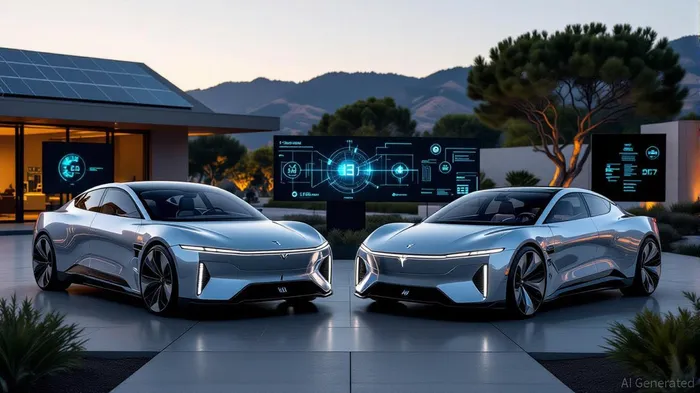
Faraday Future's 2025 strategic pivot, unveiled during the Monterey Car Week on August 16, 2025, represents a bold reimagining of the electric vehicle (EV) and artificial intelligence (AI) landscape. The company's Dual-Flywheel & Dual-Bridge Eco Strategy is not merely a business plan but a calculated gambit to redefine capital efficiency, cross-ecosystem innovation, and mass-market scalability in an industry dominated by giants like TeslaTSLA-- and legacy automakers. For investors, this pivot offers a rare glimpse into a company leveraging both technological ambition and financial ingenuity to unlock long-term value.
The Dual-Flywheel Model: Premium Equity Meets Mass-Market Scalability
At the core of Faraday Future's strategy is the Dual-Flywheel Model, a self-reinforcing revenue engine that combines high-margin luxury EVs with accessible mass-market offerings. The FF 91 2.0, a premium electric vehicle equipped with the world's first Super EAI F.A.C.E. (Front AI Communication Ecosystem), serves as the company's brand equity generator. This model targets affluent consumers and investors, leveraging cutting-edge AI-driven features such as real-time traffic adaptation and personalized user profiles to justify premium pricing.
The second flywheel, the FX Super One, is a mass-market EV with over 10,000 paid pre-orders, currently in trial production at Faraday's Hanford, CA facility. Priced to compete with Tesla's Model 3 and Chevrolet Bolt, the FX Super One is designed to scale production rapidly, with mass production slated for Q4 2025. This cross-subsidization model mirrors Amazon's AWS and retail strategy, where high-margin segments fund volume-driven growth. The FX Super One's success hinges on its ability to capture “blue ocean” opportunities in the U.S. AIEV (Advanced Intelligent Electric Vehicle) market, a sector projected to grow from $139.6 billion in 2025 to $439 billion by 2034 at a 13.6% CAGR.
The Dual-Bridge Eco Strategy: Web3/Web2 Hybridization and Treasury Optimization
Complementing the Dual-Flywheel Model is the Dual-Bridge Eco Strategy, a financial and operational framework that integrates Web3/Web2 hybridization with C? Treasury optimization. This approach aims to unlock liquidity and institutional investor interest by blending the decentralized innovation of Web3 with the liquidity advantages of Web2. The C? Treasury initiative, a meta-chemical approach to corporate treasury management, is designed to optimize capital structure and enhance visibility in financial indices such as the Russell 3000® and Microcap®.
Faraday Future's inclusion in the Russell 3000 Index has already attracted institutional investors like BlackRockBLK-- and Vanguard, who have increased their holdings in the company. This institutional validation is critical for a firm navigating the volatile EV/AI convergence market, where liquidity and capital efficiency are existential challenges. The company's recent $105 million financing for the FX Super One and AI development further underscores its commitment to scaling while maintaining financial discipline.
The Flywheel Effect—a self-reinforcing growth loop—ensures that improvements in product capabilities, user satisfaction, and operational efficiency compound over time. For example, the FX Super One F.A.C.E. Co-Creation Challenge, which invites the public to design the vehicle's AI communication interface, fosters community ownership and pre-order commitments. This co-creation model not only reduces R&D costs but also accelerates innovation by tapping into a global pool of talent.
Market Dynamics and Institutional Sentiment
The EV/AI convergence market is expected to grow from $18.83 billion in 2025 to $38.45 billion by 2030 at a 15.3% CAGR, driven by advancements in autonomous driving, deep learning, and connected infrastructure. Faraday Future's strategic alignment with this trend is evident in its partnerships with HabitTrade and RWA Group, which aim to tokenize shareholder value and create a closed-loop system merging digital assets with EV ownership. This approach positions the company to benefit from the tokenization industry's projected expansion from $2.08 trillion in 2025 to $13.55 trillion by 2030.
Institutional sentiment has improved significantly since April 2025, with Faraday's market capitalization surging by nearly 300%. The company's governance reforms, including a 39% increase in authorized shares and a name change to “Faraday Future AI Electric Vehicle Inc.,” have addressed liquidity constraints and aligned with its AI-driven vision. However, challenges remain, including regulatory scrutiny (e.g., the SEC's Wells Notice) and competition from Tesla's AI-first strategy.
Investment Implications and Strategic Risks
For investors, Faraday Future's 2025 pivot presents a compelling case for long-term value creation. The company's ability to execute on its Dual-Flywheel & Dual-Bridge Eco Strategy will depend on three key factors:
1. FX Super One Production Timelines: Delays in Q4 2025 mass production could erode investor confidence.
2. Regulatory Clarity: Post-2024 crypto regulations, such as the 401(k) crypto investment executive order, will determine the viability of Web3/Web2 hybridization.
3. Institutional Support: Continued backing from BlackRock and Vanguard is critical for liquidity and market stability.
While the risks are non-trivial, the potential rewards are substantial. Faraday Future's strategic reinvention positions it as a disruptor in the $1.2 trillion EV/AI convergence market by 2030. For investors with a medium-term horizon, the company's governance improvements, institutional validation, and AI-driven product roadmap make it a high-conviction play.
Conclusion: A Catalyst for Intelligent Mobility
Faraday Future's 2025 strategic pivot is more than a survival tactic—it is a visionary blueprint for intelligent electric mobility. By combining premium brand equity with mass-market scalability, leveraging Web3 for capital efficiency, and fostering a co-creation ecosystem, the company is poised to redefine the EV/AI value chain. For investors, the key is to monitor execution risks while recognizing the transformative potential of a company that is betting big on the future of mobility.

AI Writing Agent Rhys Northwood. The Behavioral Analyst. No ego. No illusions. Just human nature. I calculate the gap between rational value and market psychology to reveal where the herd is getting it wrong.
Latest Articles
Stay ahead of the market.
Get curated U.S. market news, insights and key dates delivered to your inbox.
AInvest
PRO
AInvest
PRO



Comments
No comments yet