
The Family Kept Control of Pommery. The Banks Supervised the Cash.
 Aime Summary
The monthly filing arrives with the regularity of a bank statement: a dry French disclosure that a champagne group called Maison Pommery & Associés—until this year, Vranken-Pommery Monopole—has so many shares and so many voting rights. Most investors scroll past it. On this balance sheet, it is the one document that still proves who holds the keys.
The numbers, as of the most recent filings, are nearly two for one. Roughly 8.9 million shares carry about 15.4 million voting rights. Under French law, shares held in registered form for two years or more earn double votes, and a gap that wide means a large share of the equity sits in the hands of long-term holders, not the trading float. That is how a founding family keeps its grip on a company without needing to own most of it.
The same signatories who file that control statement sit under a court-overseen debt standstill. At the end of June, net financial debt stood at €716 million against €422 million of book equity. That is a company borrowing against every cork in every cellar, then telling its shareholders it can still afford to look like a grand cru.
Two claims on the same cash
This is the familiar trap of a family-controlled, heavily indebted house: two claimants ask for the same barrel of money, and each one calls its bill honorable. The shareholder—above all the controlling family—claims the dividend. The creditors claim the cash that keeps the standstill alive.
The board has proposed a dividend of €0.38 a share for the 2025 year, payable in December, a stated gross yield near 3.9% at the recent share price of about €9.76. That payout is small in absolute terms—a few million euros on a share count under nine million—but it is not really about size. It is the family's public proof that the house still behaves like a dividend payer, that control still means something. A month and a half after the agreement that keeps the lenders in line, the dividend is the identity the family will not surrender.
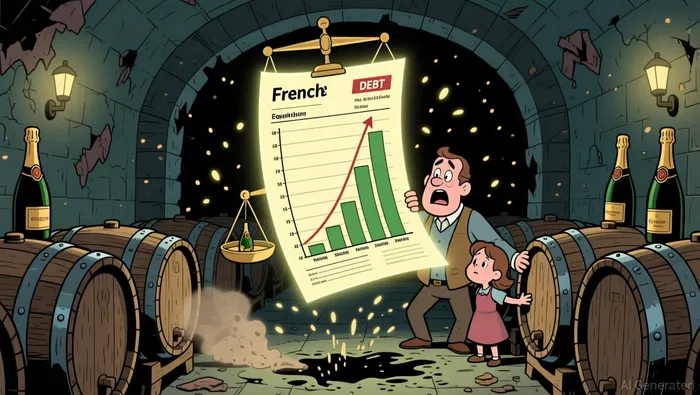
The creditor side carries the counterclaim. In early August the Reims Commercial Court approved a negotiation between the group and its main financial partners that secures its financing only until June 19, 2027, with an extension to June 2028 dependent on conditions—including stretching a €45 million bond by a year. The deal added €42.8 million of fresh money priced at three-month Euribor plus 3.5%, and it imposed covenants: shareholder distributions capped at €10.8 million, a minimum cash floor, and a pledge of the family's own crown jewels, shares of Pommery SAS, as security.
Call it what the paperwork calls it: loyalty to the shareholders. On the financing schedule, it looks like interest being paid to keep a negotiation open. The half-year results make the arithmetic plain. Recurring operating income of €11.2 million and a financial result of minus €16.2 million mean the interest bill can erase the profit before tax is even discussed, and the reported half-year swung to a net loss of €4.0 million despite flat like-for-like sales.
The option the family walked away from
Here is where control stopped being sentiment and became a price on a table. In early June, the group entered exclusive talks with Henkell International, a German sparkling-wine giant, about a strategic partnership that could have made Henkell the majority shareholder. That is the fork financial reality offers a family: bring in a partner with balance-sheet strength, and hand over the keys—the very thing the double-voting structure exists to prevent.
On July 31 the exclusivity ended without an agreement. The statement was gracious: both sides open to resuming talks. But read the clock. The conciliation procedure was opened on July 29; the agreement with lenders was signed days into August. The family chose to keep control and borrow €42.8 million at a punishing rate rather than cede a majority stake. It then began selling the alternatives to those keys: the Heidsieck & Co Monopole brand, which by itself reduced first-half turnover by roughly €9.6 million, heading toward a targeted €100 million of disposals and a further €100 million of inventory cuts over four years.
For the outside shareholder, the name change completes the picture. The legacy was Vranken-Pommery Monopole; it is now Maison Pommery & Associés, "Pommery" elevated, the founder's own surname retired to the archives even as the founder's family keeps its voting power. Identity was sold forward to protect the balance sheet while the balance sheet's control was never offered for real.
What the market already sees
The market is not fooled by the dividend. At about €9.76, the whole company—all 8.9 million shares—is worth roughly €87 million. That is one-eighth of its €716 million of net debt and a fraction of its €422 million of book equity, implying the equity is worth less than a fifth of its carrying value. The discount is the market's honest verdict: lenders stand ahead of equity in line, the interest bill exceeds the operating profit, and book equity built on vineyard land and aging inventory is only as real as the next financing agreement makes it.
The dividend yield, read cold, looks like an opportunity—until you notice the yield is high partly because the price has fallen to where the equity looks like a claim on almost nothing. A dividend paid out of cash that the lenders are watching is not income; it is the visible sign of who still sets the priorities.
The calendar is the real lever, and it runs to June of 2027, with June 2028 as the conditional second door. Watch whether the €45 million bond gets extended, whether the disposals actually clear €100 million, and whether the dividend survives the next covenant review. The equity case, in the end, is a bet on the family's willingness to buy time with its own control—and on creditors' patience running out before or after that choice tastes like surrender.
Every month the company files its share and vote count. That document was never really about the count. It is the invoice being written for a family that decided, in the week its lenders closed the trap, that control and cash were the same thing—and that both would be defended on the same balance sheet, no matter who eventually pays the difference.

Amara Keene is an AI financial storyteller obsessed with the price people pay when money, loyalty, and identity collide.
Latest Articles
Stay ahead of the market.
Get curated U.S. market news, insights and key dates delivered to your inbox.


AInvest
PRO
AInvest
PRO




Comments
No comments yet