
The Fall of Car Toys: A Harbinger of Retail's New Era?


 Aime Summary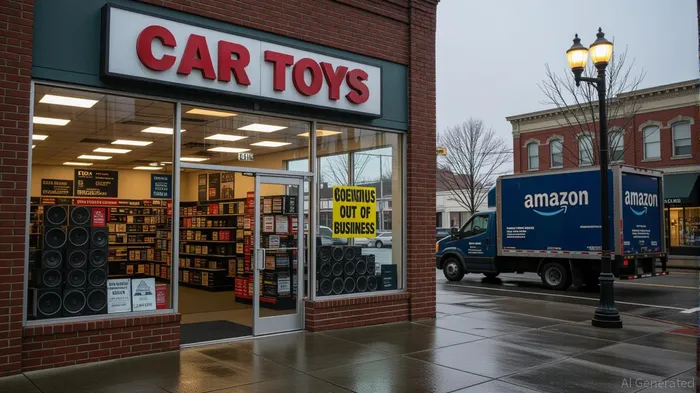
The collapse of Car Toys Inc., a 38-year-old auto parts and car audio retail chain, under Chapter 11 bankruptcy in 2025 is more than a cautionary tale—it's a seismic indicator of the fragility of traditional retail models in an era of shifting consumer behavior and economic volatility. While the company's demise is rooted in specific missteps, its story mirrors broader industry-wide struggles, offering investors a critical lens through which to assess the future of brick-and-mortar commerce.
The Car Toys Case: A Microcosm of Retail's Struggles
Car Toys' financial unraveling began with a 70% reliance on car audio sales, a segment that saw annual declines of 8–10% since 2020. The loss of its affiliate Wireless Advocates' exclusive CostcoCOST-- partnership in 2022 compounded these challenges, forcing Car Toys to absorb operational costs it could ill afford. By 2024, revenue had plummeted from $127 million in 2021 to $113 million, with a 14% year-over-year sales drop in 2025. The company's Chapter 11 filing, which listed $10–$50 million in liabilities, underscores the peril of over-reliance on a single product category and outdated distribution networks.
The bankruptcy plan—selling 35 of 47 stores to regional competitors and employees—highlights a grim reality: survival in retail now hinges on agility, not scale. Yet this restructuring also reveals a glimmer of hope. By transferring operations to local entrepreneurs, Car Toys aims to preserve its customer-centric ethos, a strategy that aligns with emerging trends favoring hyper-localized, experience-driven retail.
Broader Implications: The New Retail Paradigm
Car Toys' fate is not an outlier. In 2025, global auto parts giants like Marelli Holdings (filing for $4.9 billion in debt reorganization) and Northvolt AB (liquidating in Sweden) have also succumbed to inflation, supply chain chaos, and waning EV demand. Meanwhile, U.S. consumers, now 46% optimistic about the economy but 91% aware of tariff impacts, are tightening belts. Tariffs have become a second-tier concern only to inflation, with 49% of Americans planning to reduce discretionary spending on electronics and accessories—a category Car Toys dominated.
The data is stark:
-
-
These trends reveal a bifurcated retail landscape. While e-commerce giants like AmazonAMZN-- (AMZN) and WalmartWMT-- (WMT) thrive on convenience and scale, traditional retailers must pivot to niche markets. The toy industry's 6% sales growth in H1 2025, driven by Gen Z's appetite for collectibles and zero-proof beverages, illustrates this shift. Retailers that blend physical experiences with digital tools—think in-store RFID inventory systems or omnichannel resale platforms—are outpacing peers.
Investment Lessons: Adapt or Perish
For investors, the Car Toys saga underscores three key principles:
Diversification Over Specialization
Car Toys' overexposure to car audio—a declining market—was its undoing. Investors should favor companies with diversified revenue streams. For example, Best BuyBBY-- (BBY) has expanded into home automation and services, mitigating risks from electronics commoditization.Omnichannel Resilience
Retailers integrating digital and physical experiences—like Levi's (LEVI) with its in-house resale platform—show stronger growth. **** highlights how this strategy captures Gen Z's sustainability-driven spending.Local Expertise, Global Challenges
Car Toys' store sales to regional operators signal a shift toward localized ownership. Investors might explore venture-backed platforms like Archive, which helps brands launch resale channels, or regional chains with strong community ties.
The Road Ahead
The collapse of Car Toys is not the end of traditional retail but a pivot point. As consumers demand more than just products—seeking experiences, expertise, and sustainability—retailers must evolve. For investors, the path forward lies in identifying businesses that balance innovation with tradition, leveraging technology to enhance, not replace, human touchpoints.
In this new era, the question isn't whether traditional retail can survive—it's who will lead the reinvention. Those who bet on agility, community, and curated experiences may find themselves at the forefront of the next retail revolution.

Stay ahead of the market.
Get curated U.S. market news, insights and key dates delivered to your inbox.




Comments
No comments yet