
Falcon Finance's Transparency and Diversification Strategy: A New Benchmark for Stablecoin Trust and Growth


 Aime Summary
In the rapidly evolving world of decentralized finance (DeFi), stablecoins have emerged as critical infrastructure for bridging traditional and digital asset ecosystems. However, the collapse of TerraUSD (UST) in 2022 and the ongoing regulatory scrutiny of major stablecoins like USDTUSDC-- and USDCUSDC-- have underscored the urgent need for institutional-grade risk mitigation and collateral innovation. Falcon FinanceBYFC--, a synthetic dollar protocol, has positioned itself as a compelling alternative by combining overcollateralization, diversified reserves, and on-chain transparency. This article examines how Falcon Finance’s strategies address the core challenges of stablecoin trust and scalability, offering a blueprint for the future of institutional-grade DeFi.
Transparency as a Cornerstone of Trust
Falcon Finance’s public Transparency Dashboard is a game-changer in an industry plagued by opacity. The dashboard provides real-time collateralization checks, asset breakdowns, and quarterly attestation reports, all verified by third-party auditors like HT Digital and Zellic [1]. This level of transparency is a stark contrast to traditional stablecoins, which often rely on off-chain reserves and opaque custodial arrangements [2]. For institutional investors, this means Falcon Finance eliminates the need to trust a single entity with their capital—instead, they can verify solvency and collateralization independently.
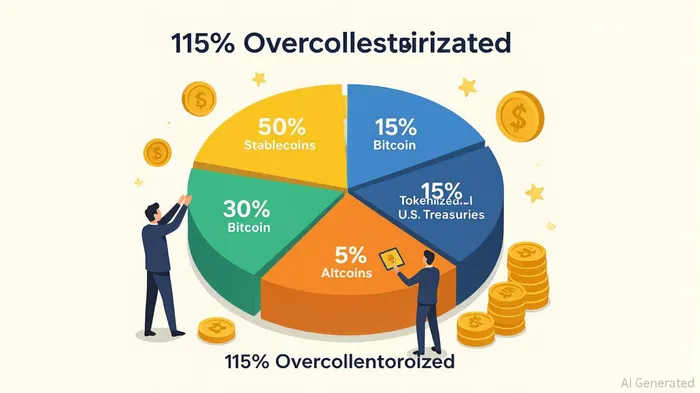
The protocol’s 115% overcollateralization ratio (as of August 2025) further reinforces trust. Unlike undercollateralized stablecoins, which are vulnerable to liquidity crises, Falcon Finance ensures that every USDf stablecoin is backed by more than $1 in assets. These reserves include a mix of stablecoins, BitcoinBTC--, and tokenized real-world assets like U.S. Treasuries [3]. This diversification reduces exposure to any single asset’s volatility, a critical advantage in turbulent markets.
Institutional-Grade Risk Mitigation
Falcon Finance’s $10 million on-chain insurance fund, launched in August 2025, is a strategic innovation that addresses a major pain point in DeFi: the lack of buffers during market stress. This fund, capitalized by USD1 and protocol fees, acts as a backstop for USDf in open markets, covering yield commitments and absorbing potential losses [4]. For context, traditional stablecoins like USDC rely on centralized custodians and lack such mechanisms, leaving them exposed to liquidity shocks [2].
The insurance fund’s design is particularly noteworthy. It expands alongside the ecosystem, ensuring that as USDf’s circulation grows, so does the fund’s capacity to absorb risks. This self-sustaining model aligns with institutional expectations for long-term stability. Additionally, Falcon Finance’s use of ERC-4626-compliant vaults minimizes smart contract risks, a critical consideration for institutions wary of exploits [1].
Collateral Innovation and Yield Sustainability
Falcon Finance’s approach to collateral innovation sets it apart from competitors. While most stablecoins rely on fiat or crypto-only reserves, Falcon integrates tokenized real-world assets (RWAs) such as U.S. Treasuries into its reserve portfolio [3]. This diversification not only enhances stability but also taps into the growing RWA market, which is projected to reach $1 trillion in TVL by 2026.
The protocol’s dual-token structure (USDf and sUSDf) further distinguishes it. sUSDf holders earn yield through market-neutral strategies like funding rate arbitrage and altcoin staking, avoiding the pitfalls of unsustainable incentives seen in traditional stablecoins [1]. This model generates consistent returns without exposing the protocol to directional market risk, a key concern for risk-averse institutions.
Challenges and the Road Ahead
Despite its strengths, Falcon Finance faces challenges. The insurance fund remains untested in a major crisis, and regulatory uncertainties—particularly around its partnership with WLFI, a Trump-linked project—could pose risks [3]. Additionally, stablecoin discounts in volatile markets may strain liquidity, though the 7-day cooldown period for redemptions mitigates this to some extent [2].
However, Falcon Finance’s alignment with regulatory trends bodes well for its future. The U.S. government’s January 2025 executive order promoting dollar-backed stablecoins and the introduction of the STABLE and GENIUS Acts signal growing institutional acceptance of protocols like Falcon Finance [4].
Conclusion
Falcon Finance’s transparency, overcollateralization, and collateral innovation address the core weaknesses of traditional stablecoins while meeting institutional-grade standards. By combining on-chain verification, diversified reserves, and a self-sustaining insurance fund, the protocol offers a scalable, resilient alternative to fiat-backed models. As DeFi continues to mature, Falcon Finance’s strategies may well become the new benchmark for stablecoin trust and growth.
Source:
[1] How Falcon Finance Manages Risk as a Stablecoin Protocol, [https://falcon.finance/news/how-falcon-finance-manages-risks]
[2] Unpacking Risks of Stablecoins vs. Synthetic Dollars, [https://falcon.finance/news/stablecoin-risks-explained-how-synthetic-dollars-compare]
[3] Falcon Finance: The Future of Stable Crypto Business..., [https://www.onesafe.io/blog/falcon-finance-stability-yield-crypto]
[4] An Introduction to Stablecoins | Advisories, [https://www.arnoldporter.com/en/perspectives/advisories/2025/05/an-introduction-to-stablecoins]

Decoding blockchain innovations and market trends with clarity and precision.
Latest Articles
Stay ahead of the market.
Get curated U.S. market news, insights and key dates delivered to your inbox.






Comments
No comments yet