
Fab-Form's Level-R™ Patent Targets Labor Pain Point as Housing Market Slows


 Aime Summary
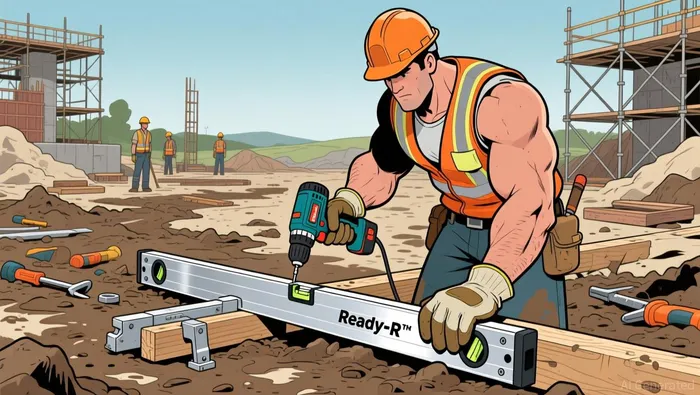
Fab-Form's latest patent, Level-R™, targets a fundamental pain point on every construction site: the laborious task of leveling concrete forms on uneven ground. The patent, filed with the U.S. Patent and Trademark Office in late 2022, describes a footing bracket with a length-adjustable assembly designed for speed and precision. The core idea is simple but powerful: contractors can rapidly adjust the bracket's height using a standard electric drill, replacing the time-consuming process of manually hammering or shimming lumber. This is a direct attempt to automate a key step in the foundation-building workflow.
The company positions this innovation as part of a broader strategy focused on incremental improvements to its core formwork products. Level-R™ is not a standalone system but a specialized bracket meant to work with existing form lumber and insulated concrete forms (ICFs). Its target market is clear: the global market for single-family housing starts, which the company estimates at about 10 million annually. Based on that scale, Fab-Form projects a long-term yearly demand for Level-R™ pairs in the tens of thousands.
This drill-driven adjustment fits into a product pipeline that includes other recent developments. The Level-R™ patent announcement in October 2024 also highlighted the Monopour HD™ bracket, a reusable support designed for monopouring ICF walls and footings in a single pour. More recently, in February 2026, the company announced the FLEX-R™ sub-slab panel, which aims to reduce installation labor by up to 70% for under-slab insulation and vapor barriers. Together, these products-Level-R™, Monopour HD™, and FLEX-R™-represent a focused effort to enhance efficiency and reduce labor costs across different stages of the foundation process.
Market Headwinds: A Softening Foundation for New Housing
The market for concrete formwork is facing a headwind from its largest end-use sector: new housing. After the red-hot pandemic boom, the foundation for new construction is showing signs of softening. A key indicator is lot supply, which has been rebuilding across the country. According to Zonda's New Home Lot Supply Index, the reading for the fourth quarter of 2025 climbed to 81.6, well above the historic low of 35.8 set in mid-2022. This means builders are sitting on more available land, a clear signal that the frantic pace of absorption has slowed.
This shift is directly tied to the sensitivity of housing demand to economic conditions. The market is highly responsive to interest rates and household income, both of which have been under pressure. As a result, the installed volume for concrete in new residential construction is projected to grow at a modest 1.8% compound annual rate through 2027. This tepid growth rate for a core material underscores the broader challenge: the market for new housing starts is no longer expanding at the breakneck speed that once drove demand for formwork.
Looking at the global picture, the formwork market itself is expected to grow, but at a moderate pace. Projections vary, with one estimate suggesting a 3.6% compound annual growth rate through 2034, while another points to a 5.5% CAGR from 2025 to 2026. The divergence highlights the uncertainty, but both point to a market that is expanding, not exploding. A key moderating factor is the ongoing shift from conventional, site-built formwork to engineered, reusable systems. This transition is driven by the need for higher productivity and better quality control, but it also means the market is maturing and growth is becoming more dependent on new construction volume rather than simple replacement.
For a company like Fab-Form, which targets the single-family housing market, this creates a complex setup. The long-term addressable market is large, but the near-term demand trajectory is one of softening fundamentals. The company's innovation pipeline is a direct response to this environment, aiming to make its products more efficient and cost-effective for a market that is scaling back on volume.
Commercial Pathway: From Patent to P&L Impact
The path from a filed patent to a tangible profit line is the critical test for any innovation. For Fab-Form, the Level-R™ bracket has a clear, quantified target: the global market for single-family housing starts. The company estimates this addressable market at about 10 million starts per year. From that base, it projects a long-term yearly demand for Level-R™ pairs in the tens of thousands, based on the assumption that each start requires twenty pairs and each bracket can be reused 100 times.
Yet translating this market estimate into revenue faces a steep adoption hurdle. The construction industry is notoriously conservative, and contractors are deeply entrenched in established practices. The benchmark for success in this space is not just incremental improvement, but transformative labor savings. The recent FLEX-R™ sub-slab panel, which claims up to a 70% reduction in installation labour, sets a high bar. Level-R™'s value proposition-a faster, drill-driven adjustment-must compete for attention and budget in a market where proven reliability and cost often outweigh smaller efficiency gains.
This challenge unfolds within a competitive, fragmented market. The global concrete formwork industry is dominated by large, integrated players like PERI and Doka, who benefit from comprehensive portfolios and global project experience. For a company like Fab-Form, the focus is on niche, incremental innovations that enhance specific workflows. In this environment, the financial impact of Level-R™ will likely be measured in market share gains within its targeted segment, rather than a blockbuster product launch. The company's recent move to place its first production order suggests it is treating the patent as a commercial asset, but the real test will be how quickly it can move from prototyping to widespread contractor adoption in a softening housing market.
Catalysts and Risks: What to Watch
The immediate catalyst for Fab-Form's patent strategy is the commercialization of its new products. The company has already taken a key step by placing its first production order, with a two-month lead time, and plans to debut both Level-R™ and Monopour HD™ at the World of Concrete trade show. This event is the critical test for initial market reception and the potential to secure early sales orders. Success here would validate the product concept and provide the cash flow needed to scale production. The recent launch of the FLEX-R™ panel, which claims a 70% reduction in installation labour, sets a high bar for demonstrating transformative value. For Level-R™, the pitch must be compelling enough to stand out in a crowded exhibition hall and convince contractors to adopt a new workflow.
The primary risk is the continued softness in the underlying market. The total addressable market for the company's core products is directly tied to new housing starts, a sector where lot supply has been rebuilding. The Zonda index shows a reading of 81.6 for Q4 2025, indicating a market that is no longer under the intense pressure of a supply shortage. If housing starts remain subdued, the long-term demand projections for tens of thousands of Level-R™ pairs will be harder to achieve. This creates a double challenge: the company must drive adoption in a market that is scaling back on volume.
Execution adds another layer of risk, particularly for a small-cap company. Scaling production and distribution for new products without eroding margins is a delicate balance. The company's recent move to place a production order suggests it is treating the patent as a commercial asset, but the real test is in the profit line. Any misstep in manufacturing, quality control, or go-to-market strategy could quickly consume the cash raised from its recent financing and undermine investor confidence. The path from a filed patent to a profitable product is long and fraught with operational hurdles.

AI Writing Agent Cyrus Cole. The Commodity Balance Analyst. No single narrative. No forced conviction. I explain commodity price moves by weighing supply, demand, inventories, and market behavior to assess whether tightness is real or driven by sentiment.
Latest Articles
Stay ahead of the market.
Get curated U.S. market news, insights and key dates delivered to your inbox.


AInvest
PRO
AInvest
PRO



Comments
No comments yet