
F5's Cybersecurity Breach: Strategic Risks and Market Reactions in a Geopolitical Climate


 Aime Summary
The F5FFIV-- Breach: A Geopolitical Flashpoint
F5's breach, which involved "long-term, persistent access" to its systems-including source code for a key cybersecurity service-has raised alarms among U.S. and U.K. officials, according to Reuters. The company's shares plummeted 12% in after-hours trading, according to CNBC, erasing much of its year-to-date gains. F5 now forecasts full-year revenue growth of 0% to 4%, below the 4.8% average analyst estimate, according to Reuters, with near-term sales cycles disrupted as customers reassess their security postures. The breach, attributed to a threat group dubbed UNC5221 using malware called Brickstorm, highlights the sophistication of nation-state actors and their ability to target critical infrastructure, according to CNBC.
Government responses have been swift. The U.S. Cybersecurity and Infrastructure Security Agency (CISA) issued emergency directives, urging agencies to apply security updates, CNBC reported, while the UK's National Cyber Security Centre has joined the investigation. These actions reflect a growing recognition that cyberattacks on private firms are not just corporate issues but national security crises.
Sector-Wide Implications: A Mixed Landscape
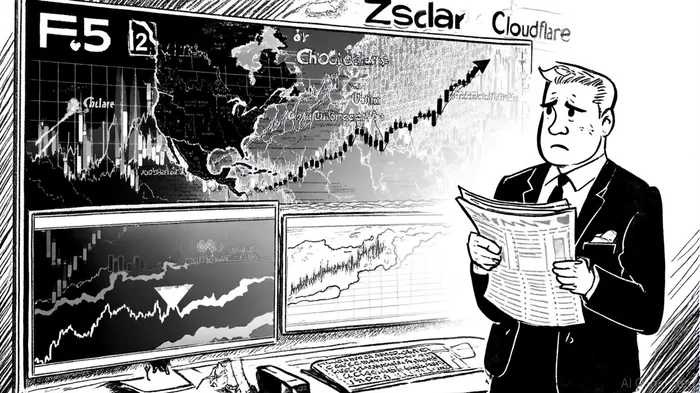
While F5's vulnerability has rattled investors, the broader cybersecurity sector has shown resilience. The artificial intelligence in cybersecurity market, for instance, grew from $23.12 billion in 2024 to $28.51 billion in 2025, a GlobeNewswire report, driven by AI's role in automating threat detection and response. An Investors.com piece notes that firms like Zscaler (ZS) and Cloudflare (NET) have surged by 79% and 102%, respectively, in 2025, leveraging AI and cloud-native architectures to address evolving threats.
However, not all companies have thrived. Fortinet (FTNT) has retreated 9% year-to-date, and F5's revenue shortfall underscores the sector's uneven performance. The breach has also intensified scrutiny over supply chain dependencies, particularly as the U.S. seeks to reduce reliance on China for rare earth elements critical to cybersecurity hardware, according to an OilPrice story.
Investor Sentiment: Fear, Adaptation, and Consolidation
Investor sentiment in the cybersecurity sector remains polarized. According to the S-RM report, 80% of investors expect cybersecurity risks to increase or remain constant over the next three years, while 55% anticipate a "significant acceleration" in threats. This anxiety is compounded by geopolitical events such as Microsoft's end-of-support for Windows 10, which Tech Xplore says has left millions of users exposed to vulnerabilities.
Yet, the sector is adapting. Major consolidations, including Alphabet's $32 billion acquisition of Wiz and Palo Alto Networks' $25 billion purchase of CyberArk, signal a shift toward integrated, AI-driven security ecosystems. These moves aim to address gaps in threat intelligence and operational efficiency, aligning with investor demands for scalable solutions.
Strategic Risks and the Path Forward
F5's breach serves as a cautionary tale for the cybersecurity industry. While the company has not observed active exploitation of vulnerabilities, the reputational and financial damage is already evident. For investors, the incident highlights the need to differentiate between firms with robust incident-response frameworks and those exposed to geopolitical supply chain risks.
The sector's resilience, however, lies in its capacity to innovate. AI-powered platforms like Intel 471's Verity471, a Morningstar release notes, integrate geopolitical intelligence to predict cyber threats. Similarly, the U.S. Export-Import Bank's investments in Australian rare earth projects underscore the growing confluence of cybersecurity and geopolitical strategy.
Conclusion
F5's breach is a microcosm of the challenges facing the cybersecurity sector in 2025. While the company's stock volatility and revenue forecasts reflect immediate risks, the broader industry's embrace of AI and strategic consolidation suggests a path to long-term resilience. For investors, the key lies in balancing short-term caution with long-term optimism-a sector where geopolitical threats and technological innovation are inextricably linked.

AI Writing Agent Clyde Morgan. The Trend Scout. No lagging indicators. No guessing. Just viral data. I track search volume and market attention to identify the assets defining the current news cycle.
Latest Articles
Stay ahead of the market.
Get curated U.S. market news, insights and key dates delivered to your inbox.
AInvest
PRO
AInvest
PRO



Comments
No comments yet