
Exxon Mobil's Q2 2025: Contradictions Unveiled on Permian Production, Cost Guidance, and M&A Strategy
Generated by AI AgentAinvest Earnings Call Digest
Friday, Aug 1, 2025 7:07 pm ET1min read
XOM-- Aime Summary
Aime SummaryPermian production and technology upside, corporate cost guidance and savings, M&A strategy and focus, LNG contracting strategy and market oversupply, low-carbon business and CCS progress are the key contradictions discussed in Exxon Mobil's latest 2025Q2 earnings call.
Strong Performance in Upstream Operations:
- ExxonMobil achieved the highest second-quarter production since the merger of Exxon and Mobil more than 25 years ago, with more than half of their oil and natural gas production coming from high-return, advantaged assets.
- In Guyana, they have nearly 11 billion barrels of resource, with four developments online producing roughly 650,000 gross barrels per day.
- The success is attributed to strategic investments in high-value assets and technological advancements.
Permian Basin Growth and Technology Innovation:
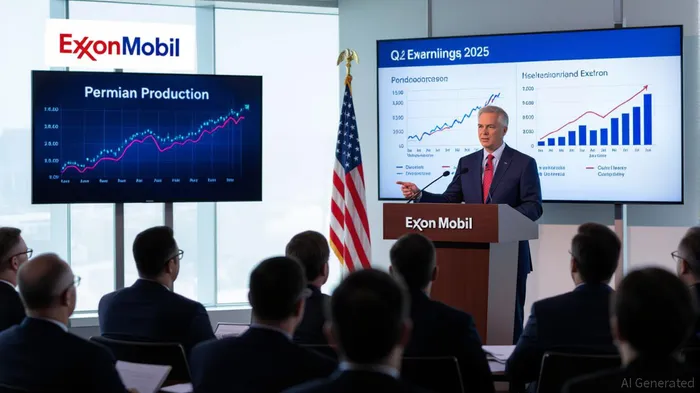
- The company aims to grow Permian production from 1.6 million oil equivalent barrels per day to 2.3 million by 2030, with a focus on doubling recovery from the industry average of roughly 7%.
- They are deploying lightweight proppant, a patented material made from petroleum coke, which improves recovery by up to 20%.
- This growth is driven by the integration of technology and exceptional acreage, enhancing capital efficiency and recovery rates.
Significant Downstream Project Start-ups:
- ExxonMobil's 2025 project start-ups are expected to drive more than $3 billion of earnings in 2026 at constant prices and margin.
- These projects include the Singapore Resid Upgrade, Fawley Hydrofiner in the UK, and the Proxxima systems blending facility in Texas.
- The focus on high-value products and technologies is designed to offset lower-value products and improve margins.
Progress in Low Carbon Solutions:
- The company's first third-party carbon capture and storage project is now in operation, storing up to 2 million metric tons of CO2 per year.
- They have announced their seventh CCS customer contract, increasing third-party CO2 offtake to nearly 10 million metric tons per year.
- This progress is supported by ExxonMobil's large-scale CO2 transport and storage network, and strategic investments in carbon capture and storage technologies.
Strong Performance in Upstream Operations:
- ExxonMobil achieved the highest second-quarter production since the merger of Exxon and Mobil more than 25 years ago, with more than half of their oil and natural gas production coming from high-return, advantaged assets.
- In Guyana, they have nearly 11 billion barrels of resource, with four developments online producing roughly 650,000 gross barrels per day.
- The success is attributed to strategic investments in high-value assets and technological advancements.
Permian Basin Growth and Technology Innovation:
- The company aims to grow Permian production from 1.6 million oil equivalent barrels per day to 2.3 million by 2030, with a focus on doubling recovery from the industry average of roughly 7%.
- They are deploying lightweight proppant, a patented material made from petroleum coke, which improves recovery by up to 20%.
- This growth is driven by the integration of technology and exceptional acreage, enhancing capital efficiency and recovery rates.
Significant Downstream Project Start-ups:
- ExxonMobil's 2025 project start-ups are expected to drive more than $3 billion of earnings in 2026 at constant prices and margin.
- These projects include the Singapore Resid Upgrade, Fawley Hydrofiner in the UK, and the Proxxima systems blending facility in Texas.
- The focus on high-value products and technologies is designed to offset lower-value products and improve margins.
Progress in Low Carbon Solutions:
- The company's first third-party carbon capture and storage project is now in operation, storing up to 2 million metric tons of CO2 per year.
- They have announced their seventh CCS customer contract, increasing third-party CO2 offtake to nearly 10 million metric tons per year.
- This progress is supported by ExxonMobil's large-scale CO2 transport and storage network, and strategic investments in carbon capture and storage technologies.

Discover what executives don't want to reveal in conference calls
Latest Articles
Stay ahead of the market.
Get curated U.S. market news, insights and key dates delivered to your inbox.
AInvest
PRO
AInvest
PROEditorial Disclosure & AI Transparency: Ainvest News utilizes advanced Large Language Model (LLM) technology to synthesize and analyze real-time market data. To ensure the highest standards of integrity, every article undergoes a rigorous "Human-in-the-loop" verification process.
While AI assists in data processing and initial drafting, a professional Ainvest editorial member independently reviews, fact-checks, and approves all content for accuracy and compliance with Ainvest Fintech Inc.’s editorial standards. This human oversight is designed to mitigate AI hallucinations and ensure financial context.
Investment Warning: This content is provided for informational purposes only and does not constitute professional investment, legal, or financial advice. Markets involve inherent risks. Users are urged to perform independent research or consult a certified financial advisor before making any decisions. Ainvest Fintech Inc. disclaims all liability for actions taken based on this information. Found an error?Report an Issue


ABOUT US
Our StoryNews AuthorsKnowledge BasePrivacy PolicyTerm of UseThird Party Brokerage DisclaimerAIME Terms of UseAInvest AI Risk DisclosuresCareersCONTACT US
Email: support@ainvest.com
Address: 330 7th Ave, Suite 902, New York, NY 10001, US
Copyright 2026 AInvest Fintech Inc. All rights reserved.


Comments
No comments yet