
Extreme Fear Index Signals UK Fiscal Tensions Amid Treasury Warnings
 Aime Summary
- UK Treasury officials warn that Prime Minister Andy Burnham’s aggressive use of fiscal rule 'flexibility' to fund investment could destabilize markets and spike borrowing costs.
- The mechanism allows investment borrowing via Public Financial Institutions (PuFins) to bypass debt rules, but officials fear this creates a binding constraint only on interest servicing, risking investor backlash if markets perceive a lack of fiscal discipline.
- The Resolution Foundation estimates that every £10 billion in borrowing adds £500 million to the debt-interest bill, significantly eroding the government's fiscal buffer.
- Real-world constraints exist, as only a limited number of projects meet the required long-term return hurdles for PuFins, and excessive spending could crowd out private investment or become inflationary.
UK Treasury officials are expressing deep concern over Prime Minister Andy Burnham’s strategy to utilize fiscal rule 'flexibility' to significantly ramp up investment in housing, transport, and defense sectors. While the Prime Minister intends to remain strictly within the bounds of fiscal rules, he aims to maximize a 2024 legislative rewrite that permits almost unlimited borrowing for investment purposes if channeled through Public Financial Institutions (PuFins). Under this specific financial structure, borrowing designated for investment is excluded from the secondary debt rule because the loan is recorded as a financial asset that offsets the liability, effectively causing the debt to vanish from standard debt metrics. However, Treasury officials warn that this maneuver could backfire by destabilizing financial markets and triggering 'bond vigilantes' to drive up gilt yields, as investors may perceive this flexibility as a significant fiscal flaw.
The primary constraint on this expanded borrowing model is not the debt ceiling itself, but rather the cost of servicing the additional debt. The Resolution Foundation estimates that every £10 billion in borrowing adds £500 million to the annual debt-interest bill, which significantly erodes the government's fiscal buffer and limits future policy options. Chancellor John Healey prefers the term 'scope' to describe this maneuver, suggesting that welfare cuts and budget reprioritization are necessary to facilitate rapid investment. Nevertheless, the Office for Budget Responsibility notes that the government has little capacity for expansionary policy due to high national debt and weaker growth projections, raising questions about the sustainability of this approach without causing market turbulence.
How Does The PuFin Mechanism Impact Market Perception?
The PuFin mechanism allows the government to bypass standard debt metrics by recording investment loans as financial assets, but this creates a binding constraint only on interest servicing. Officials fear that investors may view this flexibility as a fiscal flaw, potentially triggering a backlash if markets perceive a lack of fiscal discipline. The risk is that 'bond vigilantes' could drive up gilt yields, increasing the cost of borrowing for the government and potentially destabilizing the broader financial system. This concern is particularly acute given that the only constraint on this borrowing is the cost of servicing the debt, which can become prohibitively expensive if yields rise.
The government’s ability to execute this strategy is also limited by real-world constraints, as only a limited number of projects meet the required long-term return hurdles for PuFins. Excessive spending on ineligible projects could crowd out private investment or become inflationary, further complicating the economic landscape. The Treasury’s warning highlights the delicate balance between pursuing ambitious investment goals and maintaining market confidence, with the potential for significant economic consequences if the latter is compromised.
What Are The Risks Of Ignoring Fiscal Buffers?
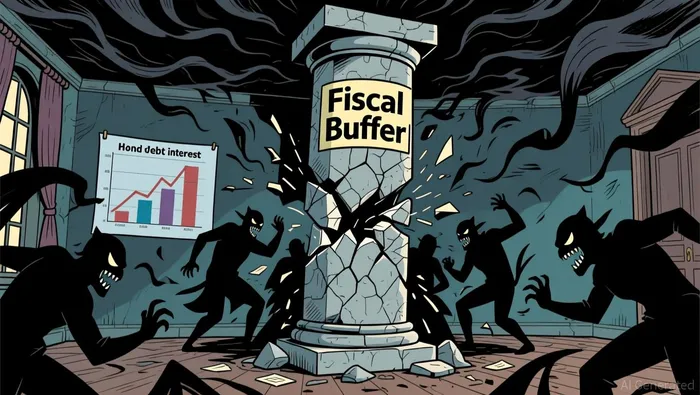
The Resolution Foundation’s estimate that every £10 billion in borrowing adds £500 million to the debt-interest bill underscores the significant erosion of the government's fiscal buffer. This erosion limits the government's ability to respond to future economic shocks or downturns, as the increased interest burden reduces the available fiscal space. Chancellor John Healey’s suggestion that welfare cuts and budget reprioritization are necessary for rapid investment further highlights the trade-offs involved in this strategy. However, the Office for Budget Responsibility’s note that the government has little capacity for expansionary policy due to high national debt and weaker growth projections suggests that the risks of ignoring fiscal buffers are substantial.
The potential for excessive spending to crowd out private investment or become inflationary adds another layer of complexity to the government’s strategy. If markets perceive that the government is prioritizing short-term investment gains over long-term fiscal stability, the resulting loss of confidence could lead to higher borrowing costs and reduced economic growth. The Treasury’s warning serves as a stark reminder of the importance of maintaining fiscal discipline, even in the face of ambitious investment goals, and the potential consequences of ignoring the constraints imposed by market expectations.

Blending traditional trading wisdom with cutting-edge cryptocurrency insights.
Latest Articles
Stay ahead of the market.
Get curated U.S. market news, insights and key dates delivered to your inbox.


AInvest
PRO
AInvest
PRO




Comments
No comments yet