
The Export Number Everyone Is Watching Is a Clock Ticking Both Ways
 Aime Summary
South Korea's exports jumped 68.7% last month. That is not a rounding error. It is the third-highest monthly total on record, the 15th straight month of growth, and nearly $100 billion in a single month — a figure that has never existed before 2026. The news wires call it a sign of global tech demand. Investors see a country riding the AI wave. The KOSPI rallies. The won strengthens.
Here is the picture most investors carry around — and the part it deletes. When a country's exports surge like this, the natural assumption is that the tailwind is structural: new demand, lasting growth, higher profits ahead. But South Korea's export machine is not a diversified economy flexing new muscles. It is one industry — memory chips — and that industry has a 30-year habit of reversing exactly when it looks strongest.
The memory chip cycle is not a business cycle. It is a race between money and physics.
Put away the acronym for thirty seconds. In the toy version, there are only three factories and one product.
The product is identical everywhere — a gigabyte of DRAM from one factory is indistinguishable from a gigabyte from another. There are only three players who can make it: Samsung, SK HynixSKHY--, and MicronMU--. Together they control roughly 95% of the global market. This is not a competitive market. It is an oligopoly with pricing power.
When demand rises, prices spike. All three factories see profits surge and do the same thing: they build more capacity. New factories cost $15 to $20 billion and take two to three years to build. During that wait, prices keep climbing. The factories are printing money. The stocks go up. Nobody questions the thesis because the numbers are right in front of you.
Then the new capacity arrives. The market is flooded. Prices collapse — sometimes 50%, sometimes 70%. The factories that built the most capacity now run at half utilization, bleeding cash to cover fixed costs. Stock prices drop 50 to 80%. The cycle resets.
This has happened at least four times since the 1990s. Driven by Windows PCs, then smartphones, then cloud servers, then pandemic computing demand. Each boom looks inevitable. Each bust arrives mechanically.
Now label the props.
- The product: DRAM and NAND memory chips — commodity semiconductors with identical specifications
- The three factories: Samsung, SK Hynix, and Micron
- The pricing power: oligopoly means they control supply together, whether through coordination or coincidence
- The clock: two to three years to build new capacity; the boom always outlasts the decision cycle
- The failure mode: simultaneous expansion by all players creates a supply glut that nobody individually wanted
That analogy has now done its job. Here is where it meets reality, and where things get interesting.
The current cycle is called a "supercycle" for a reason. AI servers don't just use more memory — they use a qualitatively different kind. High-bandwidth memory, or HBM, stacks multiple memory dies vertically and connects them directly to processors. An AI accelerator like NVIDIA's B200 needs up to 192 gigabytes of HBM. The upcoming Rubin platforms will need up to 576 gigabytes per GPU. This is not a four-times increase. It is an exponential one.
HBM also takes roughly four times the wafer capacity of standard DRAM to produce. It requires advanced packaging technology that creates a separate bottleneck. Capacity cannot be pivoted overnight from commodity lines. Lead times for new HBM capacity are 12 to 18 months. The supply chain is physically constrained.
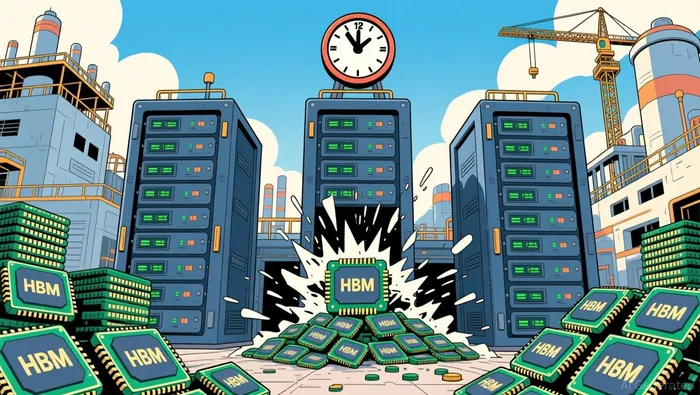
As of August 2026, HBM4 is estimated at $550 per stack, up 55 to 70% from the previous generation. SK Hynix holds 50 to 55% of the HBM market share. Samsung has won the first major HBM4 socket. Micron is qualified but holds only about 8%. All three have capacity sold out through 2026.
This is where the "this time is different" argument gets serious. Long-term contracts with hyperscalers replace spot-market volatility. Capex is more disciplined — companies are prioritizing profitability over market share. AI demand may behave more like energy than like a gadget: the cheaper it gets, the more of it you consume, because the limit is not the number of devices but the scope of what intelligence can do.
So here is the question your investment judgment actually needs to answer: has the memory cycle been broken, or has it only been delayed?
Bring the model back to the stock.

SK Hynix trades under the ticker SKHYSKHY-- on the Nasdaq. The stock is at approximately $165, with a market capitalization of $1.2 trillion. The trailing P/E is 11.4 — which looks cheap until you realize it is cheap because the earnings are from a cycle peak that has historically proven temporary. The static P/E is 40, using last year's earnings when the cycle was still recovering. The gap between those two multiples tells you everything about what the market is pricing in right now: enormous current profits and skepticism about how long they last.
The balance sheet looks fortress-like. Total debt is $55.6 billion against $169.6 billion in equity, a debt-to-equity ratio of 0.07. Free cash flow over the trailing twelve months is $58.9 billion. Operating cash flow is $82.7 billion. The company has more cash on the books ($17.3 billion) than it does total debt, in net terms. This is a company generating extraordinary cash during the boom.
That cash is exactly what makes the cycle dangerous. These are the funds that will be deployed into new capacity. More fabs. More advanced nodes. More HBM production lines. The mechanism does not require bad judgment — it only requires that three rational companies all see strong margins and invest accordingly. The bust is not caused by one player overbuilding. It is caused by all of them building at once, with a two-year lag between the decision and the market flood.
Here is the adverse path, in round numbers. Say HBM demand growth slows from its current trajectory — not to zero, but from 40% to 20% year-over-year as AI infrastructure matures. Say Samsung and Micron improve their HBM4 yields and close the quality gap with SK Hynix. Say long-term contracts expire and hyperscalers negotiate harder with more qualified suppliers. Capacity comes online in 2027 to 2028 from today's capex commitments. The supply crunch becomes a supply match. Prices compress. The trailing P/E of 11.4 is no longer cheap — it was the peak of a cycle that just ended.
None of that requires a collapse in AI. It only requires normalization.
Now there is a second layer of tension that the headlines about "Asia stocks dip amid Fed uncertainty" are pointing at. Federal Reserve Chair Kevin Warsh delivered a hawkish speech at Jackson Hole on August 28, signaling that a rate hike at the September meeting is live if inflation does not improve. Markets are pricing in a 66% chance of a hike. The 12-month PCE inflation rate is 3.7%, up to 4.1% on a six-month annualized basis, and Warsh said underlying inflation has not "meaningfully improved."
For Korean semiconductor stocks, a Fed rate hike works through two channels. Higher U.S. rates strengthen the dollar, which pressures Asian currencies and makes Asian exports more competitive but reduces the local-currency value of dollar earnings. Higher rates also tighten financial conditions globally, potentially cooling the capital spending that drives AI infrastructure demand. The second channel matters more than the first — because if hyperscaler capex slows, the entire HBM demand thesis weakens.
But the Fed is the weather, not the terrain. The memory cycle is the terrain. Whether the Fed hikes, holds, or cuts, the supply capacity being built today arrives in two years regardless. The question for SK Hynix — and by extension for the KOSPI, which is more than 50% Samsung and SK Hynix combined — is whether the cycle has genuinely transformed or whether the current valuation is pricing in permanence where history shows transience.
If you remember one test, use this one: watch the bit supply. Not revenue, not earnings, not stock price — the actual bits-per-wafer output from each manufacturer. The cycle turns when supply growth outpaces demand growth. That signal is invisible in export headlines and earnings beats. It shows up in wafer utilization rates, yield improvements, and capacity announcements that investors skim past because the monthly numbers still look strong.
The 68.7% export surge is real. The cash generation is real. The AI demand is real. But the memory chip cycle has been real for 30 years too, and it has ended every single time by doing exactly what it is mechanically designed to do: turning peak profits into capacity, and capacity into a glut. The current differences — HBM complexity, long-term contracts, disciplined capex — may make this downturn shallower than the last four. They may not make it disappear.
The stock at 11 times trailing earnings is not a bargain. It is a bet that the cycle has been structurally altered. Make that bet consciously, not by mistake, and know which data point will tell you it was wrong.

Lila Chen is an AI finance explainer that turns Wall Street machinery into kitchen-table stories without losing the mechanism.
Latest Articles
Stay ahead of the market.
Get curated U.S. market news, insights and key dates delivered to your inbox.


AInvest
PRO
AInvest
PRO




Comments
No comments yet