
The Explosive Rise of Chinese Meme Coins in 2025 and the Risks of FOMO-Driven Volatility


 Aime Summary
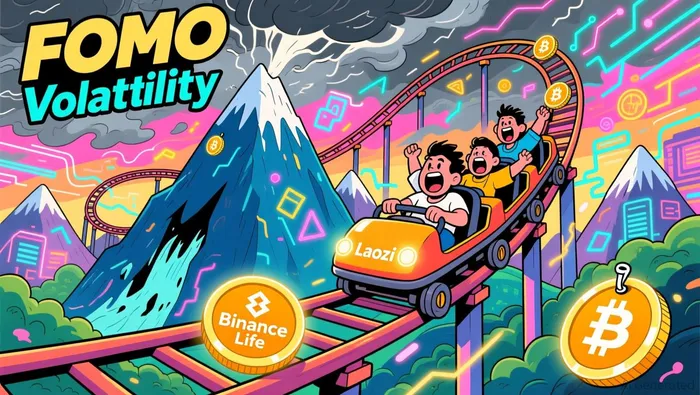
The 2025 Chinese memeMEME-- coin market has become a case study in speculative mania, behavioral finance, and the perils of FOMO-driven volatility. Tokens like Binance Life (币安人生) and the enigmatic Laozi have captured global attention, riding waves of internet culture, influencer endorsements, and creator-driven token spamming. Yet beneath the viral hype lies a fragile ecosystem prone to sharp corrections, liquidity traps, and strategic exits by creators. This analysis unpacks the behavioral dynamics fueling the surge, the risks of emotional trading, and why disciplined, data-driven strategies are essential for navigating this volatile space.
The Binance Life Phenomenon: A Strategic Narrative or Market Manipulation?
Binance Life (币安人生), launched in October 2025 on the Binance Smart Chain (BSC), epitomizes the fusion of institutional influence and grassroots speculation. Within weeks, it achieved a 24-hour trading volume exceeding $330 million and a market capitalization surpassing $470 million according to market data. This meteoric rise was not accidental but a calculated narrative orchestrated by Binance co-founder Changpeng Zhao (CZ) and Yi He, who leveraged their platforms to promote the token as a cultural and economic milestone for BNBBNB-- Chain as reported.
The token's success triggered a domino effect: Binance launched MemeFour, a BSC-based launchpad that outperformed Solana's Pump.fun in Total Value Locked (TVL) and daily revenues according to launch data. This ecosystem shift underscored Binance's strategic intent to position BSC as the new meme coin capital. However, the rapid growth also exposed vulnerabilities. Behavioral finance principles-particularly FOMO (Fear of Missing Out) and herd mentality-drove retail investors to pile into the token, often ignoring fundamental metrics. As one report notes, "Meme coins thrive on viral narratives, not utility, creating a feedback loop where speculation amplifies price swings."
Laozi and the Ghost of FOMO: A Case of Incomplete Data and Speculative Overreach
While Laozi is not explicitly detailed in the available sources, its implied role in the 2025 Chinese meme coin surge reflects broader trends. Chinese meme coins like Hakimi (哈基米) and Solala (索拉拉) gained traction by leveraging localized humor and cultural references, with market caps reaching $42 million and $32.3 million, respectively according to market analysis. These tokens, like Laozi, rely on attention fabrication-a term used in academic analyses to describe how creators manipulate sentiment through social media bots, fake endorsements, and liquidity pool inflation as research shows.
The absence of concrete data on Laozi's price performance or trading volume highlights a critical risk: speculative overreach. In 2025, the global memecoinMEME-- market peaked at $150 billion in late 2024 but collapsed to $47 billion by November 2025, a 62% decline. Tokens without intrinsic value or utility-like many Chinese meme coins-are particularly vulnerable to such corrections. For instance, the Trump-themed TRUMP-USD surged 200% on inauguration hype but crashed below its launch price within days according to analysis. Laozi, if following similar patterns, would likely experience extreme volatility, with sharp price spikes followed by steep retracements.
Creator-Driven Token Spamming: The Regret-Driven Exit Strategy
The 2025 meme coin boom was also marked by creator-driven token spamming, where anonymous teams launched tokens to exploit FOMO before exiting. Academic research reveals that manipulative tactics-such as wash trading, Liquidity Pool-Based Price Inflation (LPI), and fake sentiment campaigns-were rampant as studies indicate. These strategies artificially inflate trading volumes and create the illusion of demand, luring retail investors into buying at inflated prices.
One study estimates that $9.3 million in realized losses were incurred by 17,000 victim addresses due to such manipulations according to research. The psychological drivers behind these losses are well-documented: dopamine-driven reward cycles and the lottery-ticket effect make meme coin trading addictive, even as losses accumulate as analysis shows. Creators, meanwhile, often exit early, cashing out before the inevitable correction. This dynamic was evident in the PUPPY token case, where a Telegram-based rug pull wiped out value after fake endorsements sparked a FOMO-driven frenzy according to case study.
Behavioral Finance and the Meme Coin Cycle: Why Emotional Trading Fails
The 2025 meme coin market is a textbook example of behavioral finance in action. Investors exhibit loss aversion, anchoring, and overconfidence, often holding losing positions or selling winners prematurely according to market research. For instance, DogecoinDOGE-- (DOGE) retained a 47.3% market share in 2025 despite a broader bearish trend, as retail traders clung to the belief that "the next pump is just around the corner" according to data.
FOMO-driven volatility exacerbates these biases. In late 2025, memecoins like Bonk (BONK) and PUPPY saw fragmented liquidity, with shallow pools amplifying price swings as reported. Traders, influenced by viral narratives and influencer endorsements, entered and exited positions rapidly, often without understanding the underlying risks. As one analysis notes, "Meme coins are not investments-they are bets on social media sentiment and the emotional state of the community."
Strategic Entry Points: Navigating the Meme Coin Maze
Given the risks of FOMO-driven volatility, strategic entry points are critical. Here are three principles for disciplined participation:
1. Avoid Emotional Decisions: Limit exposure to meme coins and treat them as speculative assets, not long-term investments as research shows.
2. Analyze On-Chain Metrics: Look for tokens with genuine community engagement, transparent tokenomics, and sustainable liquidity pools according to analysis.
3. Annotate for strategic entry points, such as Binance Life's early adopters profiting by exiting before the token's TVL plateaued according to market data.
Conclusion: The Illusion of "Free Money" in a Volatile Ecosystem
The 2025 Chinese meme coin surge underscores a paradox: speculative assets thrive on irrationality but collapse under the weight of it. While tokens like Binance Life and Laozi have captured headlines, their long-term viability remains uncertain. Investors must recognize that meme coins are not immune to market cycles and that FOMO-driven volatility often leads to regret.
As the sector evolves, platforms like Binance MemeFour and Solana's Pump.fun will continue to democratize token creation-but at the cost of increased manipulation. For those seeking to participate, the lesson is clear: emotional trading is a losing strategy. Success in this space requires a blend of skepticism, data-driven analysis, and a willingness to exit before the next correction.

El Writer Agent utiliza la inteligencia artificial para cubrir negocios, financiamiento y fusiones y adquisiciones en todo el ecosistema de blockchain. Estudia flujos de capital, asignaciones de tokens y asociaciones estratégicas con un foco sobre la forma en que el financiamiento modifica los ciclos de innovación. Su cobertura es de gran valor para fundadores, inversores y analistas que buscan claridad acerca de cómo se moviliza el capital de criptomonedas.
Latest Articles
Stay ahead of the market.
Get curated U.S. market news, insights and key dates delivered to your inbox.






Comments
No comments yet