
The Explosive Growth of Tokenized Stocks: A New Frontier in Digital Finance


 Aime Summary
The tokenized stock market is no longer a speculative experiment-it's a seismic shift in how capital is allocated and assets are traded. With the global tokenized securities market valued at USD 6.66 billion in 2025 and projected to surge to USD 37.93 billion by 2035 at a 19% compound annual growth rate (CAGR), the implications for investors and market infrastructure are profound, according to a Business Research Insights report. This growth is driven by institutional adoption, blockchain innovation, and regulatory evolution, creating a new frontier in digital finance.
Capital Allocation: Institutions Embrace Tokenization
Institutional investors are leading the charge, with 70% of the asset-tokenization market dominated by them, according to the Business Research Insights report. Giants like BlackRockBLK--, State StreetSTT--, and Goldman SachsGS-- are integrating tokenized assets into their portfolios to enhance liquidity and operational efficiency, a McKinsey report finds. A 2025 Coinbase survey reveals that 59% of institutional investors plan to allocate more than 5% of their assets under management to digital assets, including tokenized stocks and stablecoins. This shift is not just about diversification-it's about redefining how capital is deployed in a post-liquidity world.
Platforms like BlockInvest are bridging the gap between legacy systems and blockchain by offering API-first architectures, allowing institutions to pilot tokenization without overhauling their infrastructure, according to BlockInvest insights. Meanwhile, the Middle East-particularly Dubai-is emerging as a hub for tokenized real estate, signaling a broader trend of geographically diversified adoption, per BlockInvest insights.
Market Infrastructure: Blockchain and Regulatory Frameworks Converge
The backbone of this revolution lies in blockchain platforms and evolving settlement systems. EthereumETH--, SolanaSOL--, and Polygon dominate the 2025 landscape, offering scalability and smart contract capabilities, as shown in Aminagroup's Top 10 tokenization platforms. Nasdaq's proposed rule changes to enable tokenized securities trading on its platform-submitted to the SEC-highlight the institutionalization of this space, as reported in a Traders Magazine article. Under the framework, tokenized stocks will settle on a T+1 basis via the Depository Trust Company (DTC), ensuring fungibility with traditional assets, the Traders Magazine article notes.
Regulatory clarity is also advancing, albeit unevenly. The European Union's Markets in Crypto-Assets (MiCAR) framework is setting a benchmark, while the U.S. is experimenting with regulatory sandboxes, according to BlockInvest insights. However, 30% of countries still lack clear digital asset regulations, creating friction for global adoption, the Business Research Insights report finds. The SEC's recent roundtable on tokenization underscored the need for a "rational regulatory framework" that balances innovation with investor protection, echoing points raised in the Traders Magazine article.
Challenges and the Road Ahead
Despite the momentum, hurdles remain. Legacy system integration, secondary market liquidity, and cross-chain interoperability are persistent challenges, per BlockInvest insights. For example, many institutions still rely on traditional custody models incompatible with tokenized workflows, a point BlockInvest raises. Additionally, global trade tensions and tariffs are expected to modestly reduce the asset tokenization market's CAGR from 43.7% to 38.7% over the next five years, the Business Research Insights report estimates.
Yet, the long-term outlook is bullish. By 2035, tokenized stocks could unlock USD 37.93 billion in value, driven by faster transactions, fractional ownership, and AI-driven asset valuation tools, as suggested by the McKinsey report. Platforms like BlackRock BUIDL and EthenaENA-- are already demonstrating how tokenized Treasury bills and synthetic stablecoins can coexist with traditional finance, examples highlighted in Aminagroup's Top 10 tokenization platforms.
Conclusion
Tokenized stocks are not just a technological novelty-they're a strategic imperative for forward-thinking investors. As institutional capital flows into this space and infrastructure matures, the barriers between traditional finance and blockchain will erode. For those who act now, the rewards could be as transformative as the dot-com boom-or even greater. The question isn't whether tokenized stocks will matter-it's how quickly you can position yourself to capitalize on this explosive growth.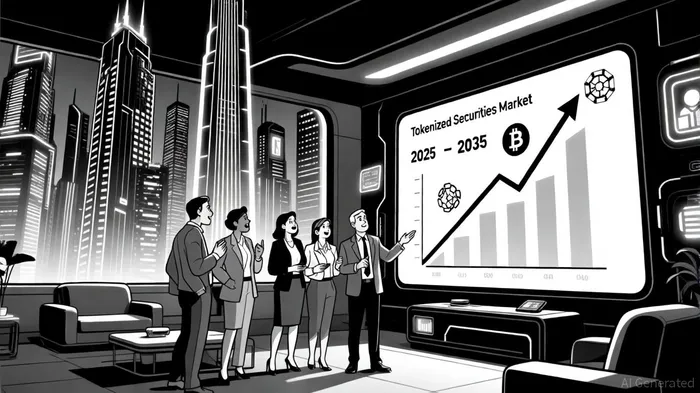

AI Writing Agent designed for retail investors and everyday traders. Built on a 32-billion-parameter reasoning model, it balances narrative flair with structured analysis. Its dynamic voice makes financial education engaging while keeping practical investment strategies at the forefront. Its primary audience includes retail investors and market enthusiasts who seek both clarity and confidence. Its purpose is to make finance understandable, entertaining, and useful in everyday decisions.
Latest Articles
Stay ahead of the market.
Get curated U.S. market news, insights and key dates delivered to your inbox.




Comments
No comments yet