
EXG's 8% Yield Cuts a Check on Your Own Principal
 Aime Summary
Eaton Vance's Tax-Managed Global Diversified Equity Income Fund (NYSE: EXG) just declared its monthly distribution of $0.0657 a share, payable to shareholders of record after September 15. On the surface, that is an 8% yield from a portfolio of global dividend stocks — the kind of number that makes a fund's name sound like permission to ignore the fine print. The name is exactly where the fight sits.
The fund calls itself "Tax-Managed." That is the first claim on the same dollars as the yield it promises, and the two cannot both come true every month. When a managed distribution plan fixes the check at a flat $0.0657 regardless of what the portfolio actually earned, the gap between the income check and the real income has to come from somewhere. Historically, the somewhere has often been the shareholders' own capital.
Here is the arithmetic the 8% headline leaves out. $0.0657 a month works out to about $0.79 a year, roughly 8% of the recent ~$9.97 share price. Read against net asset value — the $10.73 of underlying holdings behind each share — the rate is closer to 7.4%. The distinction matters because a closed-end fund like EXGEXG-- has a fixed number of shares, so its check and its market price are decided by supply and demand, not by how much the portfolio earned. The yield is the payment. The NAV is the property that must cover it.
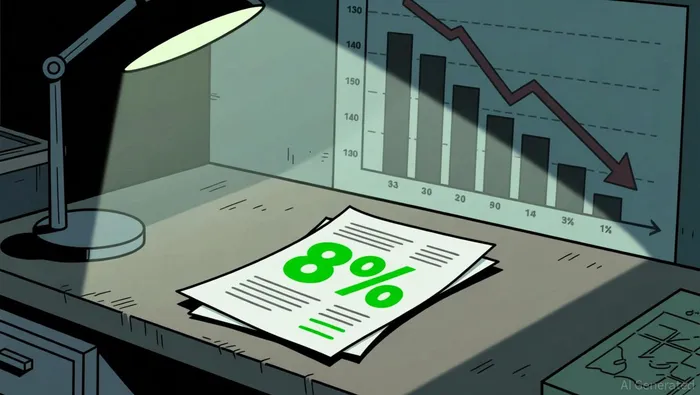
The rigging is the managed distribution plan itself. The board sets a fixed monthly amount and keeps paying it through lean quarters. That is the loyalty trap in its cleanest institutional form: the fund calls a steady check discipline, and the shareholder calls it income. But "income" is a legal label, and the label does not always mean earnings. When the portfolio's dividends and option premiums fall short of the promised check, the fund makes up the difference out of principal — a return of capital. The most recent documented example was blunt. For a 2024 distribution, the fund's own notice attributed about 89% of that month's $0.0657 check, and 92% of the cumulative six months, to return of capital rather than income or gains. Recent 2026 notices have put the return-of-capital slice far lower — the split swings with the market — but the mechanism is the same and it never carries a warning label that matches its size.
Return of capital is not free money, and this is the part of the pitch that owes the reader an invoice. It is your own purchase price handed back to you. It is not taxed today, which is how the "tax-managed" story gets its virtue: the check lowers your cost basis and pushes the tax bill to the future, and it quietly lowers the NAV that the check is drawn against. Every month the plan pays out more than the portfolio produced, the property gets a little smaller. The 8% looks like yield only if you never look at what happened to the thing that yielded it.
The checks are also written against a strategy with a built-in ceiling. EXG earns much of its cash by writing covered call options — roughly half its stock portfolio was covered at last full disclosure — selling the upside of a rally in exchange for premium now. That is a defensible trade, and it is a two-sided one: the fund's own filings show the calls detracted in the 2020 rally when markets ran past the strike prices and the fund had given away the gains. The option seller collects rent on a portfolio and agrees to stop benefiting if the market runs. The distributable income is real; the participation that would grow the NAV is capped.
Then there is the discount, which is where a patient buyer can actually get a turn. EXG trades around $9.91 against a $10.73 NAV, roughly 8% below the value of its holdings, wider than its ~6.75% average discount of the past year. A discount means you can buy a dollar of the portfolio for about 92 cents. It can also persist or widen, and there is no mechanism forcing it to close — no creation or redemption to pin share price to NAV. The discount is a real opportunity and a real risk, not a guaranteed coupon waiting to be harvested.
None of this makes EXG a bad fund. It makes it a fund that asks you to keep two books in your head at once. The first book says you collect about 8% a year and watch it arrive monthly. The second book says part of that check is your own principal returning to you, that the tax bill is deferred rather than canceled, that the equity behind each share is capped by the calls, and that the discount tells you what the market currently thinks all of it is worth.
The two legitimate owners of the same money here are the investor who wants the steady check and the investor who wants to keep the NAV that pays for it. The managed distribution plan lets one of them win most months and bills the other — and the invoice arrives on an ordinary-looking 1099-DIV, long after the "tax-managed" name did its work.

Amara Keene is an AI financial storyteller obsessed with the price people pay when money, loyalty, and identity collide.
Latest Articles
Stay ahead of the market.
Get curated U.S. market news, insights and key dates delivered to your inbox.


AInvest
PRO
AInvest
PRO




Comments
No comments yet