
Executive Transitions as Turnaround Catalysts in Consumer Brands: The Case of Kirk Tanner at Wendy's and Hershey
The departure of a CEO from one company to another is often a barometer of deeper shifts in corporate strategy and market dynamics. Nowhere is this clearer than in the food and beverage sector, where legacy brands face relentless pressure to innovate, manage margins, and adapt to evolving consumer preferences. The recent leadership transition of Kirk Tanner—from The Wendy's CompanyWEN-- (WEN) to The Hershey CompanyHSY-- (HSY)—offers a critical lens to examine these challenges and the potential for strategic renewal. For investors, such shifts can signal opportunities in undervalued stocks with clear paths to recovery, provided leadership executes decisively.
The Catalyst: Why Leadership Moves Matter
Executive departures are rarely arbitrary. Tanner's move from Wendy'sWEN--, where he faced a 31% year-to-date stock decline and stagnant sales, to HersheyHSY--, a confectionery giant grappling with rising cocoa costs and tariffs, underscores a broader industry imperative: legacy brands must evolve or risk obsolescence. For investors, this transition raises two critical questions:
1. Can Hershey leverage Tanner's expertise in snacks and beverages to counter margin pressures and sustain growth?
2. Does Wendy's undervalued stock (trading at 12.8x revised 2025 EPS) present a buying opportunity amid its international expansion and digital innovation?
The answers hinge on metrics—ESG performance, profitability, and execution—against which both companies must be judged.
Wendy's: Navigating Domestic Stagnation with International Momentum
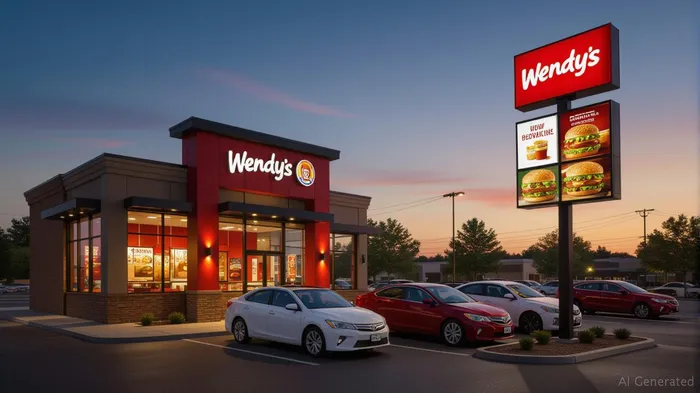
Wendy's Q1 2025 results revealed a stark divide: international resilience vs. domestic decline. While U.S. same-store sales fell 2.8%, international markets surged 8.9%, driven by strong performance in Mexico, Canada, and Asia-Pacific. This geographic divergence is key to understanding the stock's valuation. Despite a 34.5% six-month decline to $12.52, the stock trades at a discounted multiple compared to peers like McDonald'sMCD-- (25.09 P/E) and StarbucksSBUX-- (33.09 P/E).
Profitability Challenges:
- Net income dropped 6.7% to $39.2 million as commodity and labor inflation pressured margins.
- The U.S. company-operated restaurant margin fell to 14.8%, a 50-basis-point decline year-over-year.
Why Investors Should Pay Attention:
- Digital Sales Growth: A record 20.3% of revenue now comes from mobile/delivery, signaling a modernized customer interface.
- Strategic Priorities: The "100 Days of Summer" campaign and FreshAI technology rollouts (targeting 500+ restaurants by year-end) aim to reignite traffic.
Risk Factors:
- A dividend payout ratio exceeding 105% raises sustainability concerns.
- U.S. sales recovery hinges on weather normalization and menu innovation.
Hershey: A Snacking Powerhouse in Transition
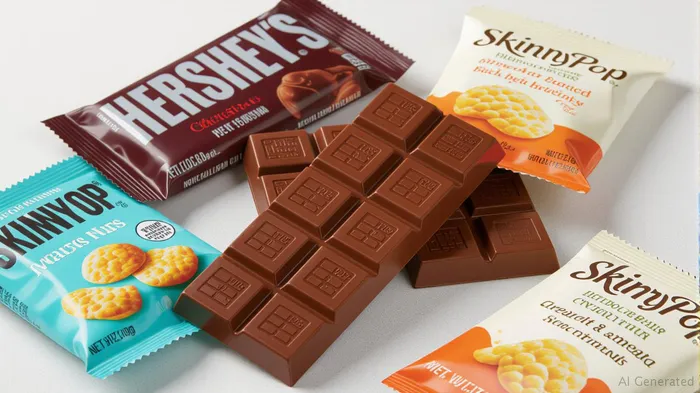
Hershey's appointment of Tanner—fresh from Wendy's—signals a deliberate shift toward aggressive growth in the snacks sector. Under Michele Buck, Hershey expanded its portfolio to $11.2 billion in revenue but now faces headwinds: rising cocoa prices, tariffs, and a need to modernize its ESG profile.
ESG and Profitability Outlook:
- ESG Risks: Ranked 46th out of 643 in its industry, Hershey's moderate controversy rating (Level 2) suggests manageable risks but room to improve in supply chain transparency.
- Margin Stability: While gross margins remain robust at ~44%, operational efficiency will be critical to offset rising input costs.
Why the Transition Matters:
- Tanner's expertise in beverages (PepsiCo) and global expansion (Wendy's) aligns with Hershey's goal to become a “Leading Snacking Powerhouse.”
- His track record in mergers and acquisitions could accelerate portfolio diversification, crucial for a company reliant on chocolate (36% of U.S. market).
Risk Factors:
- Cocoa prices remain volatile, with geopolitical tensions affecting supply chains.
- Competition from health-conscious snacks could dilute market share.
Investment Implications: A Sector Turnaround Play
The food industry is at an inflection point. Legacy brands must balance nostalgia with innovation while addressing ESG and margin pressures. For investors, the following strategies emerge:
- Wendy's (WEN):
- Buy: At $12.52 (12.8x revised EPS), the stock is undervalued relative to its international growth and digital potential.
Hold: Until U.S. sales rebound and dividend sustainability improves.
Hershey (HSY):
- Buy: At $175.50 (22.5x 2024 EPS), its ESG profile and margin resilience make it a safer, long-term play.
Watch: Cocoa price trends and execution under Tanner's first 100 days.
Sector-Wide Opportunities:
- ESG-Driven Reforms: Brands improving supply chain transparency (e.g., sustainable cocoa sourcing) may see valuation upgrades.
- Margin Management: Companies like Hershey and Wendy's that stabilize costs while investing in innovation could outperform.
Conclusion: Leadership as a Lever for Value Creation
Executive transitions are rarely about exit strategies—they are about reinvention. Tanner's move from Wendy's to Hershey tests his ability to navigate both domestic stagnation and global complexity. For investors, the calculus is clear: undervalued consumer stocks with strategic leadership and turnaround trajectories offer asymmetric upside. The food industry's next chapter will be written by those who adapt fastest—not just to consumers, but to the metrics that matter most.
Investment decisions should consider individual risk tolerance. Past performance does not guarantee future results.

Delivering real-time insights and analysis on emerging financial trends and market movements.
Latest Articles
Stay ahead of the market.
Get curated U.S. market news, insights and key dates delivered to your inbox.




Comments
No comments yet